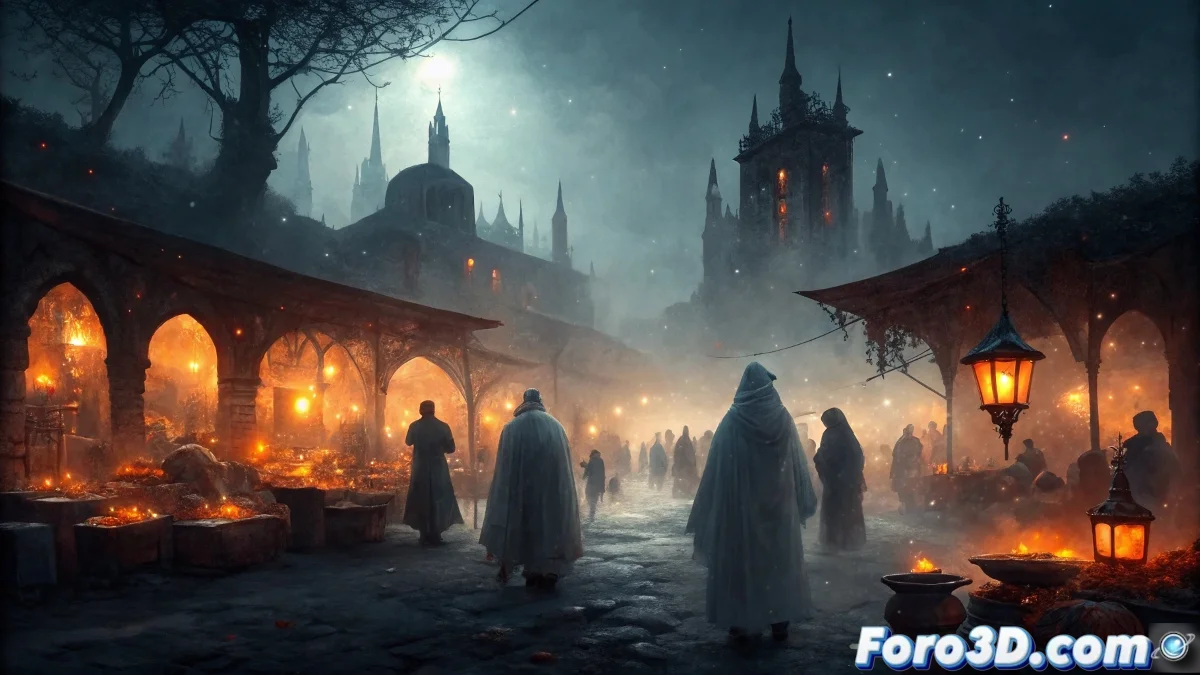
The Ash Man: Creating a Folkloric Entity in Unreal Engine
The Ash Man constitutes a fascinating figure from British folklore dating back to the 18th century, representing a domestic entity intimately linked to ancient chimneys of traditional homes. Unlike other mythological creatures that traverse smoke ducts, this singular presence manifests as an anthropomorphic silhouette composed of compacted soot that permanently inhabits ventilation structures. The first documented testimonies come from oral traditions in Yorkshire and Lancashire, where inhabitants described evidence of its presence through inexplicable traces of fine ash in theoretically inaccessible places 🕵️♂️.
Historical Context and Conceptual Evolution
During the peak of the Industrial Revolution, narratives about the Ash Man experienced notable expansion parallel to urban growth and the proliferation of homes with traditional heating systems. The entity evolved from a simple manifestation of combustion residues to acquiring intelligent behaviors and deliberate activity patterns that suggested self-awareness. Contemporary accounts associated its presence with characteristic odors of rarified smoke permeating rooms without apparent source, consolidating the theory that the igneous element acted as a fundamental catalyst for its materialization in our existential plane 🔥.
Main Documented Characteristics:- Humanoid silhouette composed exclusively of dense soot and compacted ash
- Permanent manifestation in chimney ducts and ventilation systems
- Ability to leave material traces in impossible-to-access locations
This folkloric entity personifies the domestic risks associated with fire in eras prior to central heating systems, serving as a preventive metaphor about the maintenance of traditional installations.
Technical Implementation in Unreal Engine
The digital recreation of the Ash Man requires a meticulous technical approach combining elements of organic modeling, advanced particle systems, and atmospheric lighting setup. The process begins with the project setup using the Cesium template to establish authentic georeferenced coordinates in British regions like Yorkshire, subsequently importing Victorian architectural assets from Quixel Bridge with special attention to historical chimney models and eroded stone textures that convey temporal authenticity 🏰.
Development Workflow:- Project setup with precise georeferencing via Cesium
- Selection and import of specialized Victorian architectural assets
- Development of humanoid skeleton with elongated proportions and hunched posture
- Implementation of particle system for constant soot emission
Model and Skeletal System Development
For the anatomical representation of the creature, a basic humanoid skeleton is developed in Blender with deliberately elongated proportions and a permanently hunched posture that evokes morphological adaptation to confined spaces. The skeletal system implementation in Unreal incorporates additional bones in the limbs to facilitate fluid but irregularly articulated movements, deliberately avoiding the naturalness of conventional human animations and accentuating its supernatural nature. The main mesh integrates an anchored particle system that simulates the continuous shedding of soot microparticles, creating a visual effect of constant decomposition and reformation 👻.
Material and Ambient Lighting System
The main material is developed using Unreal Engine's node system, combining multiple layers of soot textures with variable roughness parameters and subtle subsurface scattering that gives organic depth to the surface. The ambient lighting setup establishes a chromatic profile dominated by warm tones originating from the chimney that strategically contrast with cold lights from windows and other openings. Directional lights are complemented with volumetric effects that simulate light rays filtering through suspended dust, intensifying the oppressive atmosphere and ethereal character of the entity through chiaroscuro play ✨.
Advanced Material Setup:- Combination of multiple soot texture layers with variable roughness
- Implementation of subtle subsurface scattering for organic depth
- Controlled emission parameters for dim glow effects
- Normal maps to simulate compacted ash texture
Special Effects and Final Post-Processing
The Niagara system is used to develop ash particles that dynamically respond to the character's movement, with spawn rate parameters linked to displacement and rotation speed. A post-process volume with custom configuration is implemented, including selective depth of field, controlled chromatic aberration, and cinematic grain to enhance visual realism. For the final render, the movie render queue sequence is used with temporal anti-aliasing and multiple sampling settings that preserve the fine details of ash and soot textures, ensuring maximum visual fidelity in the representation of this enigmatic folkloric entity 🎬.
Cultural Legacy and Contemporary Applications
This mythological figure represents the tangible personification of historical domestic risks associated with fire and combustion processes in eras prior to centralized heating. Its enduring legacy remains alive in regional tales that function as a metaphorical warning about the importance of preventive maintenance of chimneys and regular cleaning of smoke ducts. In the contemporary cultural context, the Ash Man has significantly influenced representations of elemental entities in modern British horror literature, masterfully symbolizing the intrusion of the primitive and ancestral into seemingly safe and modernized domestic spaces 🏠.