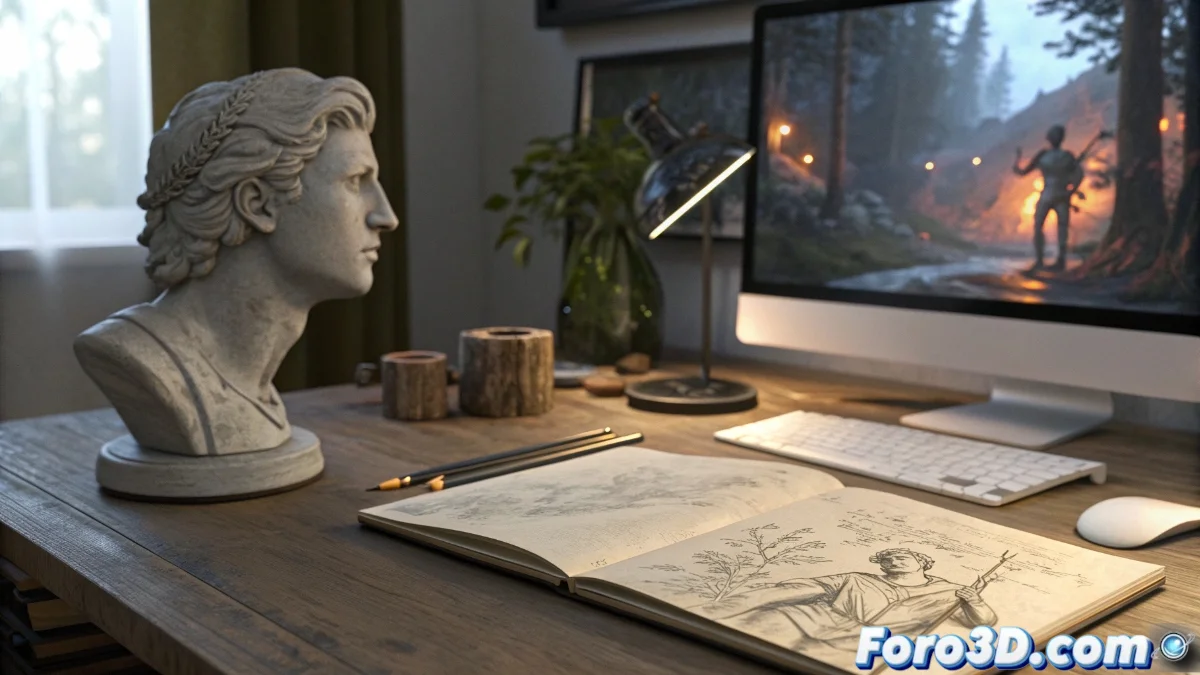
The Artistic Essence in 3D Modeling: Beyond Technical Mastery
In the realm of three-dimensional design, mastering software tools is merely the beginning of the creative journey. The true magic emerges when we cultivate our ability to observe the environment deeply, understand the fundamentals of visual composition, and develop an aesthetic sensitivity that allows us to infuse emotions into every project. Without these foundations, even the most technically impeccable model can feel empty and fail to establish a genuine connection with the viewer. Technique serves as the vehicle, but artistic vision determines the final destination 🎨.
Observation as a Fundamental Pillar
Observing our surroundings with meticulous attention is the first step to substantially enriching our 3D work. It goes beyond superficial looking; it involves carefully analyzing how light interacts with materials, how shadows sculpt forms, and how chromatic nuances transform according to environmental conditions. By studying these visual phenomena in tangible reality, we gain the ability to recreate them authentically in our digital environments, adding depth and credibility to our creations. This continuous practice trains our perception to capture the very essence of what we aspire to represent, transcending mere superficial reproduction 🔍.
Key Aspects of Detailed Observation:- Light Interaction: study how natural and artificial light modifies the appearance of objects
- Shadow Behavior: understand how they define volumes and create atmospheres
- Chromatic Dynamics: observe how colors transform under different lighting conditions
The Creative Irony: we often spend hours perfecting complex shaders, when the solution lies in a simple camera adjustment that doesn't even require rendering.
Composition and Aesthetic Sensitivity Applied
Composition acts as the visual language that guides the observer's gaze and communicates the deep intention of the work. In the 3D context, this translates to meticulously organizing scenic elements to tell stories or evoke specific emotions. Applying principles like the golden ratio or mass balance can dramatically enhance visual impact. Simultaneously, artistic sensitivity enables us to select color palettes, textures, and lighting schemes that reflect the emotional tone we wish to convey. Combining these technical aspects with intuition cultivated through the study of traditional art produces pieces that not only stand out visually but also resonate emotionally 🖼️.
Essential Compositional Elements:- Visual Guide: structure the scene to direct the viewer's attention
- Chromatic Harmony: select palettes that reinforce the emotional narrative
- Visual Hierarchy: establish priorities among elements to tell coherent stories
Balance Between Technique and Expression
The constant challenge in 3D modeling lies in finding the perfect point where technical excellence meets authentic artistic expression. Too often, artists get trapped in unnecessary technical complexities, forgetting that well-executed simplicity often contains more soul than an overload of details. Remember that digital tools are means to a creative end, not the end itself. Cultivating an integral artistic mindset, where observation, composition, and sensitivity develop in parallel with technical skills, is what ultimately differentiates memorable works from merely competent ones ✨.