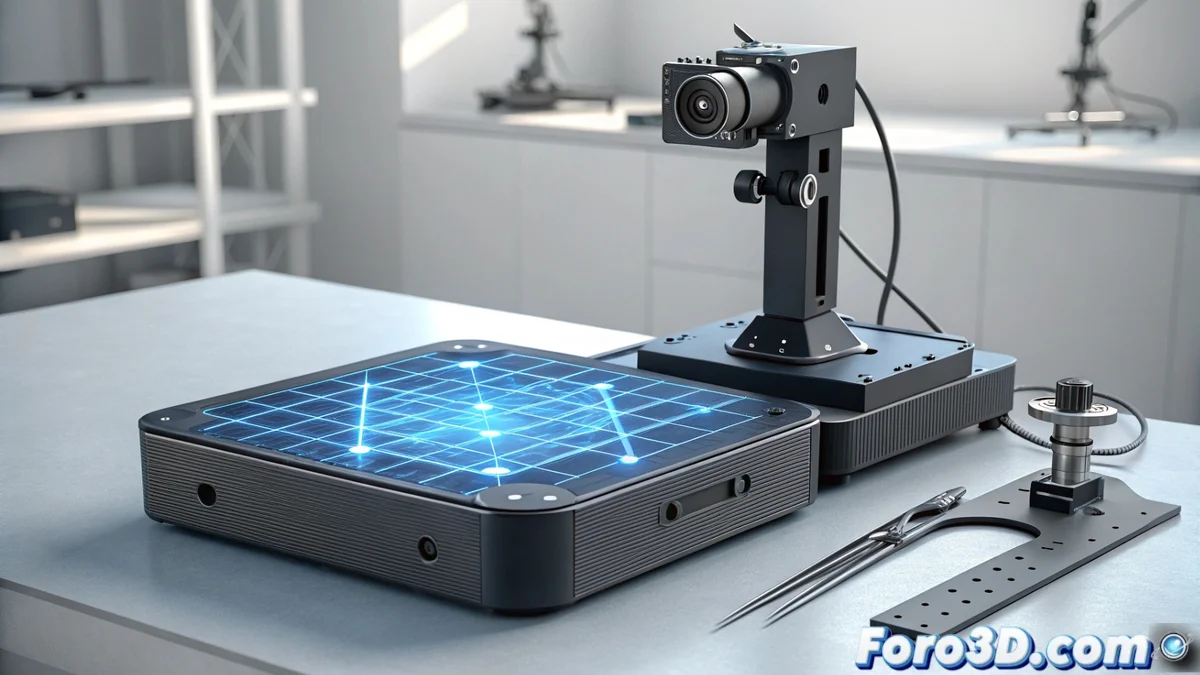
The Artec Micro 3D Scanner Captures Small Objects with High Precision
In the field of precision 3D digitization, the desktop Artec Micro scanner stands out as a key tool for capturing the geometry of tiny components. Its ability to reproduce details at the micrometric scale makes it indispensable in laboratories and manufacturing workshops. 🔬
How does this scanning technology work?
The system does not use physical contact. Instead, it projects a structured blue light pattern onto the object to be digitized. Two high-resolution cameras observe how this pattern deforms on the surface, thereby calculating the position of millions of points in space. This method allows eliminating the need for adhesive markers, speeding up the process and protecting delicate or valuable parts.
Main features of the workflow:- Process data in real time: Artec Studio software automatically aligns and fuses each capture while scanning.
- Generate dense point clouds: The result is an extremely detailed digital representation of the physical part.
- Export to standard formats: Textured polygonal meshes can be saved as STL or OBJ for use in any CAD or animation software.
Structured light technology enables contactless digitization, ideal for fragile or high-value parts where the surface cannot be altered.
Practical applications in industry
This device is not only for documentation. It integrates effectively into reverse engineering processes and quality inspection of manufactured components. The obtained 3D models allow comparing the real part with its original digital design, detecting minimal deviations.
Sectors that leverage its capabilities:- Dentistry and jewelry: For digitizing crowns, implants, or jewelry designs with maximum fidelity.
- Mold and tooling manufacturing: For inspecting and replicating tight-tolerance parts.
- Scientific research: For studying biological samples, fossils, or electronic components.
Considerations for optimal scanning
Despite its advanced technology, the scanner may have difficulties with very shiny surfaces or deep cavities. In these cases, it is sometimes necessary to apply a temporary anti-reflective spray to obtain a perfect capture. This small step reminds us that even the most powerful tools can benefit from established workshop techniques. The final result, however, is a 3D model ready for measuring, analyzing, or manufacturing with absolute confidence. 🏭