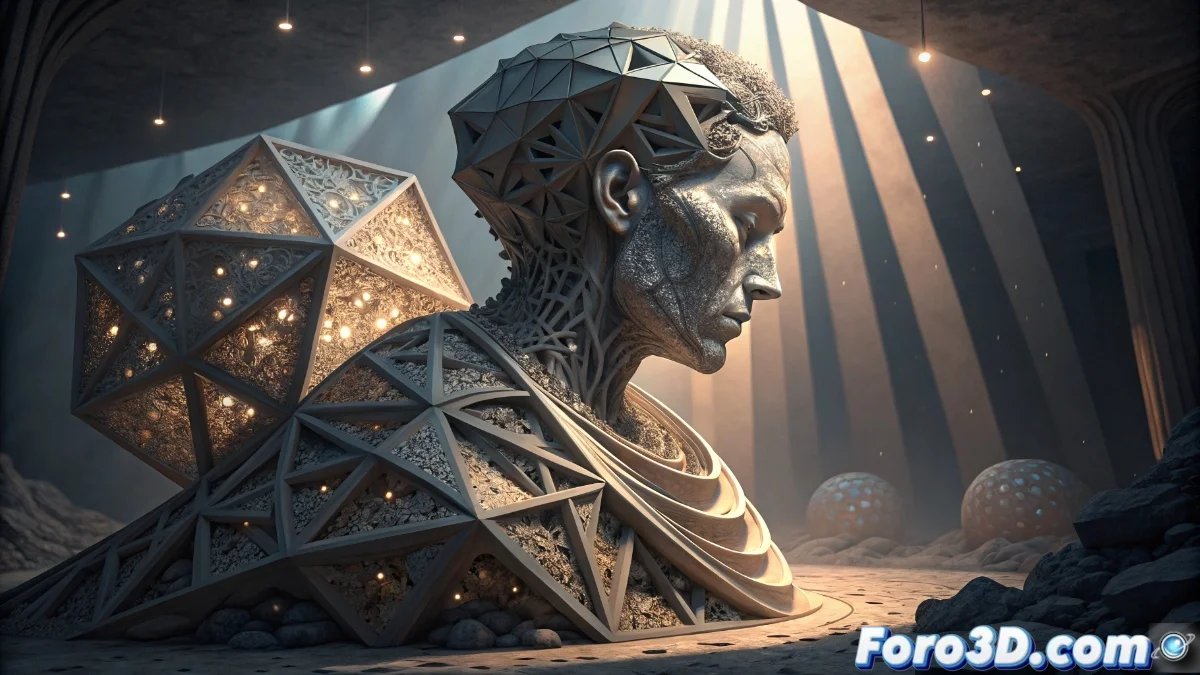
The Art of Chamfer Sculpting in Digital Modeling
Chamfer sculpting represents a conceptual evolution in 3D modeling where sharp edges are transformed into fundamental compositional elements. This methodology turns each bevel and chamfer from mere technical finishes into the primary visual vocabulary that defines the aesthetic identity of digital creations. 🎨
The Expressive Dimension of Beveling
When the chamfer transcends its basic utilitarian function, it acquires expressive capabilities that go beyond simple edge smoothing. These geometric elements work synergistically to establish a coherent visual language where the depth of the bevels, their specific angles, and proportional relationships create a dynamic system of visual tensions and resolutions. The modulated and repetitive application of these components generates organizing rhythmic patterns that structure extensive surfaces, while strategic variations introduce focal points that break monotony without compromising overall unity.
Fundamental characteristics of expressive beveling:- Calculated depth and tilt angles that establish visual weight and structural lightness
- Systems of tensions and resolutions that communicate both mass and formal elegance
- Modulated rhythmic patterns that organize large surfaces through conscious repetition
The real challenge arises when every edge of your model begins to resemble an artistic installation more than a functional element, demonstrating that visual complexity often resides in the meticulous treatment of every corner.
Balance Between Technique and Aesthetics
The effective implementation of chamfer sculpting requires a conscious balance between technical precision and artistic sensitivity. Advanced beveling tools must be employed with compositional intentionality rather than automatism, considering how multiple chamfers interact with lighting systems, affect shadow distribution, and modify the perception of original proportions. This approach demands deep knowledge of topology and its relationship with light flow, as every decision on size, angle, and bevel density fundamentally alters the visual reading of the object in its environmental context.
Essential technical considerations:- Calculated interaction between multiple chamfers and environmental lighting systems
- Conscious modification of proportional perception through strategic bevels
- Intrinsic relationship between advanced topology and light behavior on surfaces
The Controlled Obsession with Detail
Chamfer sculpting can become an absorbing practice where the artist dedicates more time to beveling than to modeling the main forms. This obsession with chamfers can lead to scenarios where apparently simple objects require complex subdivisions, demonstrating that the path to visual sophistication often lies in the methodical and excessive treatment of every edge. The technique completely redefines volumetric perception through the choreographed interaction of inclined planes that capture and redirect light, generating hypnotic luminous gradients and geometric rhythms that guide the gaze through virtual architectures where angular hardness is softened by precisely calculated millimeter transitions. ✨