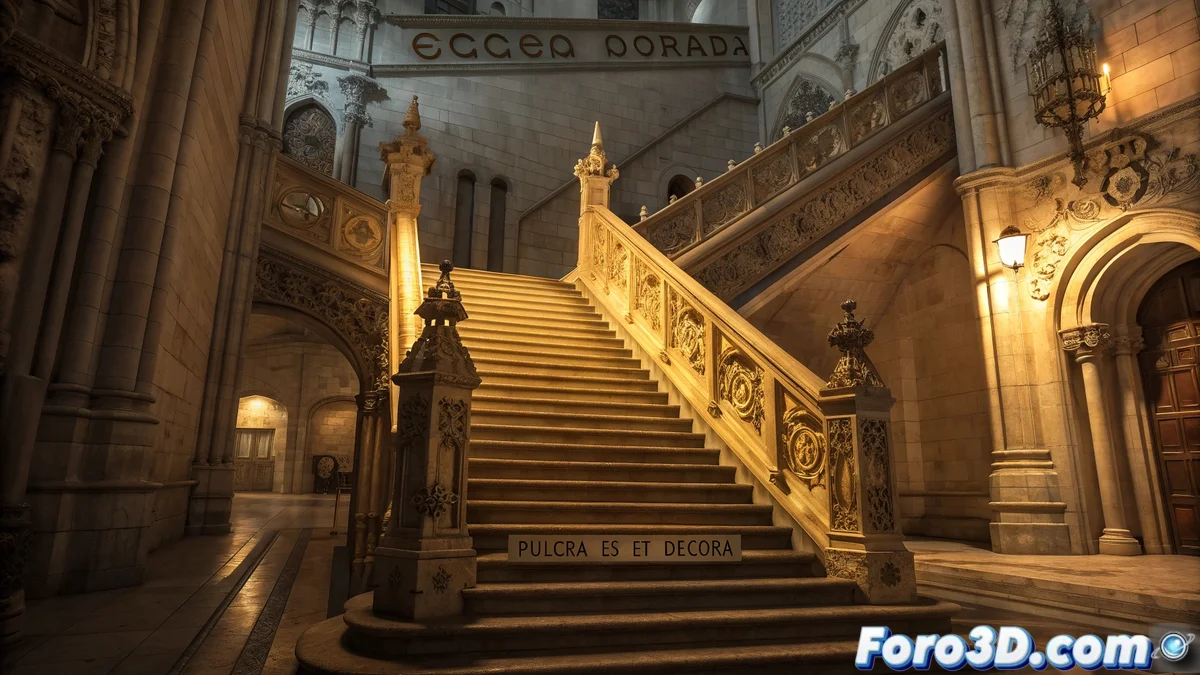
When Stone Tells Stories: The Secrets of Burgos
Burgos Cathedral is not just a Gothic masterpiece; it is a textbook of ingenious solutions. Built on a hillside, its architects had to devise true marvels like the Golden Staircase to overcome internal level differences. 🏰 Additionally, a curious anecdote surrounds the Latin inscription PULCHRA ES ET DECORA on its facade: the letter H in PULCHRA was supposedly omitted due to lack of space. For 3D artists, these peculiarities are a perfect opportunity to combine historical accuracy and creativity using Blender.
Starting from the Foundations: Blockout and Scale
The first crucial step is to establish the correct scale. In Blender, units are set to meters and a basic geometric blockout is created using cubes and cylinders to define the naves, transept, and lantern tower. 🧱 The Golden Staircase is initially sketched with a curve that defines its ascending path, ensuring proportions are believable relative to a human reference model. This planning phase is vital to avoid later scale issues that would ruin the sense of monumentality.
The Art of Modeling Gothic Stone
Turning the blockout into detailed architecture requires patience. Walls, pointed arches, and buttresses are refined, applying Bevel modifiers to soften edges and add robustness. The main facade is modeled in sections, using instances for repetitive elements like archivolts to maintain coherence and streamline the work. 💎 For finer sculptural details, such as gargoyles or capitals, Blender's Sculpting mode can be used or detail alphas projected to save on geometry.
Recreating a historic building is an exercise in digital archaeology, where every detail tells part of its story.
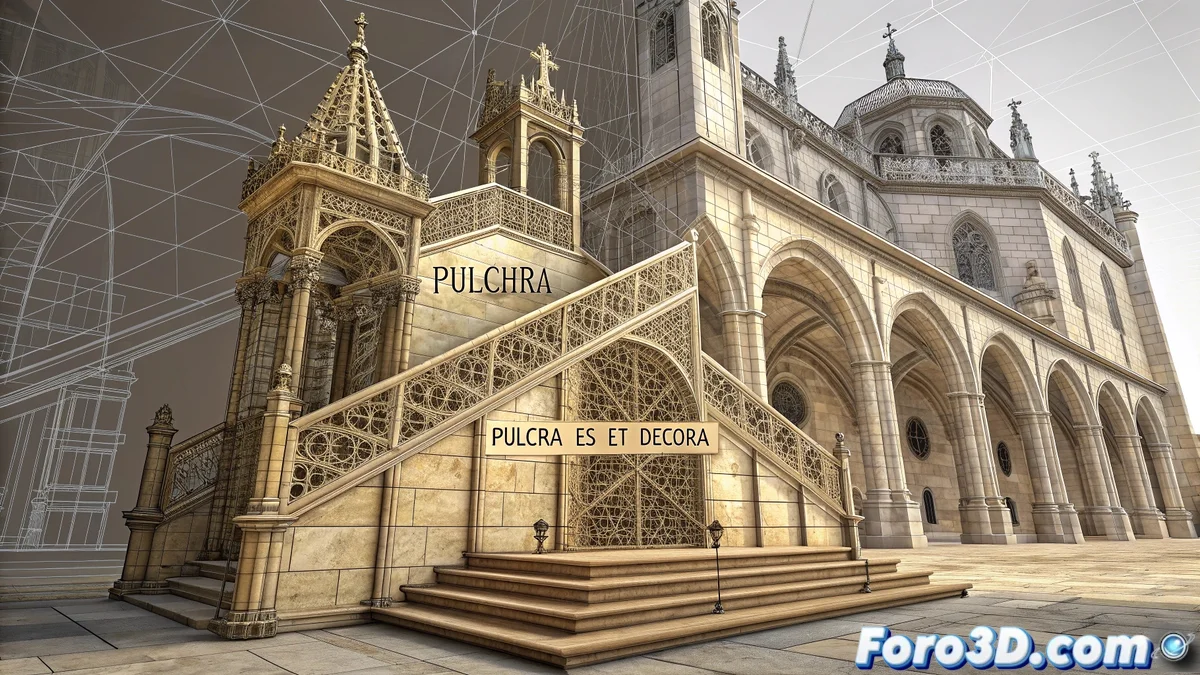
The Star: The Golden Staircase
Modeling the staircase is a fascinating challenge. It begins by defining the load-bearing structure and then using arrays or Geometry Nodes to distribute the steps precisely and uniformly. Railings and ornaments are modeled separately, paying special attention to the golden elements, which will require a specific material. The key is to capture the baroque elegance of the staircase and how it integrates to resolve the terrain's level difference, a testament to medieval engineering. ✨
Textures and Lighting: Bringing History to Life
Texturing with PBR materials is essential for realism. Aged limestone textures are applied with Normal, Roughness, and Displacement maps to simulate time's erosion. For the golden details, a metallic shader with variable roughness simulates worn shine. 🎨 Lighting becomes the storyteller: sunlight creates dramatic backlights outside, while inside, warm area lights and light volumes passing through stained glass generate a solemn and mystical atmosphere.
Some key technical aspects for optimal results are:
- Organization with collections: Keep the scene tidy for an efficient workflow.
- Use of modifiers: Leverage Array and Mirror for symmetrical architecture.
- Geometry optimization: Use multiresolution or alphas for details without saturating the scene.
- Render by passes: Export separate passes (Z-depth, AO) for flexible compositing.
The process culminates in Blender's compositor, where colors are adjusted to accentuate the stone's warmth and the gold's shine, a slight vignette is added to focus attention, and depth of field is enhanced. In the end, what is obtained is not just an image, but a recreation that breathes history. It is ironic that in a cathedral that defies gravity, the greatest obstacle for its builders was, apparently, the space for a simple letter. A lesson in humility for any digital artist. 😄