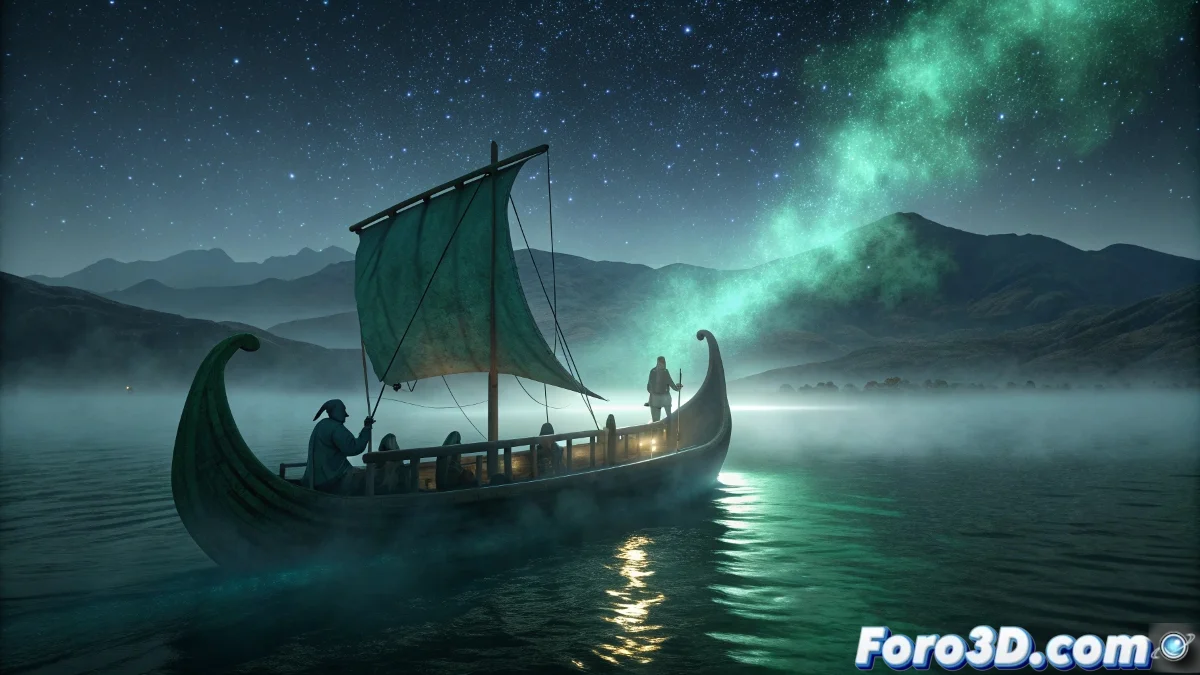
The Ancestral Mystery of the Spectral Ship of Lake Titicaca
Andean cultures have woven for centuries a fascinating narrative about a supernatural vessel that plies the waters of the world's highest navigable lake. This legend represents the indigenous cosmovision regarding death and the sacred respect for natural forces 🌊.
Origins and Transformation of the Myth
The original tales merged with colonial traditions, creating a unique symbology where the ship acts as a spiritual guide for the souls of the drowned. Aymara communities developed this belief as a metaphysical explanation for water tragedies, establishing protective taboos around nighttime navigation.
Characteristic Elements of the Legend:- Appears exclusively on moonless nights with total darkness
- Sails in absolute silence without creating ripples in the water
- Functions as a water psychopomp transporting souls
Sighting the spectral ship is considered an omen of imminent death among riparian communities
Contemporary Cultural Significance
This ancestral narrative retains vitality in the collective imagination, influencing fishing and tourist practices. Anthropologists interpret the myth as a prevention mechanism that discourages dangerous activities, while generating global interest as intangible cultural heritage.
Impact on the Local Community:- Determines safe fishing times according to lunar phases
- Establishes traditional routes avoiding areas considered sacred
- Maintains a reverent attitude toward the lake as a living entity
Technical Recreation in Carrara
To visualize this legend in 3D environments, Carrara offers specialized tools that allow capturing the ethereal essence of the phenomenon. The proper setup of translucent materials and atmospheric effects is crucial to achieve supernatural authenticity ✨.
Initial Project Setup:- Open Carrara and create a new document with 1920x1080 px ratio (16:9)
- Set units to metric system and global scale to 100%
- Import real height map of Lake Titicaca using Terrain Editor
- Adjust Earth curvature to 0.001 in scene properties
- Organize layers into groups: mountain-background, water-surface, ghost-ship
- Use Polygon Modeler with Extrude Along Curve tool
- Create base hull with 12 longitudinal segments and 8 transverse
- Apply Morph Target with random deformation from 0.3 to 0.7
- Generate ghost oars with Low-Poly modeling (less than 50 polygons each)
- For tattered sails, use Cloth Simulator with zero gravity
- Create main Distant Light with RGB 180,200,255 color
- Set intensity to 0.15 and soft shadows with sample rate 8
- Add Point Light volumetric around the ship with 20 meters radius
- Set up Spot Light directional with 35 degrees angle pointing at the ship
- Enable Global Illumination with 2 bounces and intensity 0.08
- For the ship: Subsurface Scattering with translucency 0.8 and roughness 0.1
- Ghost shader: blend Mix Shader with 70% transparency and 30% emission
- Emission color: RGB 200,220,255 with intensity 0.3
- Water: Dielectric material with IOR of 1.33 and micro-bump mapping
- Add Normal Map for ripples with scale of 0.02
- Enable Volumetric Atmosphere with density of 0.4 and height of 50 meters
- Create particle system for mist using Particle Emitter
- Set up 1000 particles with size between 2-8 meters and lifespan of 30 seconds
- For render: Adaptive Sampling with 16 samples/pixel and Ray Tracing enabled
- Export as PNG sequence with 16-bit color depth
Technical and Cultural Conclusion
The digital recreation of this legend demonstrates how modern tools can preserve and visualize intangible cultural heritage. Work in Carrara requires deep understanding of both 3D techniques and the anthropological context that gives meaning to each spectral element 🌌.