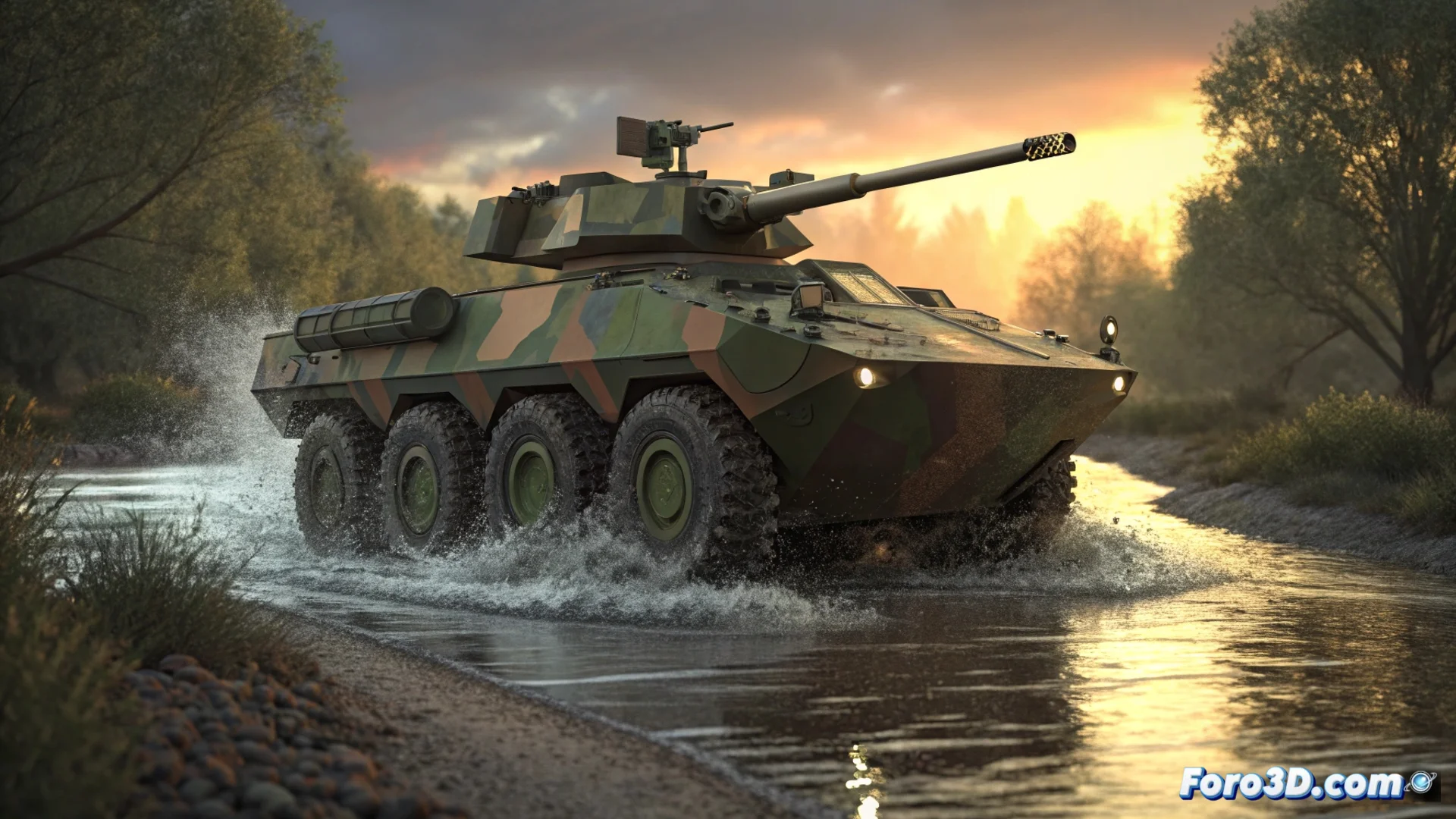
The AMX-10 RC: a hybrid armored vehicle for modeling and simulation
In the field of military modeling and simulation, certain vehicles stand out for their unique design. The AMX-10 RC is one of them: a French reconnaissance armored vehicle with 6x6 traction that fuses the agility of a wheeled vehicle with the firepower of a light tank. Its imposing silhouette and technical capabilities make it a fascinating challenge for any 3D artist. 🎯
Anatomy of a wheeled giant
With dimensions of 9.15 meters long (including the gun), 2.78 m wide, and 2.56 m high, its presence is dominant. Its appearance moves away from light armored cars to approach more closely the profile of a combat vehicle. One of its most notable features is the hydropneumatic suspension, which allows modifying the chassis height. This not only optimizes its profile in combat but also increases stability when firing. Additionally, it is prepared to operate in amphibious environments, being able to cross bodies of water propelled solely by the rotation of its wheels. 🌊
Key details to capture its essence:- Wheels and chassis: The six large wheels, with a characteristic space between the first two pairs, define its base. The hull is formed by sloped armor plates.
- Turret and armament: The angular turret houses the long 105 mm F2 gun. The secondary armament includes two 7.62 mm machine guns.
- Suspension dynamics: Representing how the hydropneumatic system alters the vehicle's height and inclination adds realism and complexity to the model.
Its low and wide profile, along with a large turret, are essential to convey its hybrid nature between a tank and a wheeled vehicle.
Firepower and strategic mobility
The heart of its offensive power is the 105 mm F2 ME gun, a caliber that equips many main battle tanks. This gives it a disproportionate firepower capacity for a vehicle of its category. Mobility is provided by a diesel engine coupled to an automatic transmission, allowing it to move effectively on roads to reconnoiter and attack quickly. Its amphibious capability grants it a tactical advantage in overcoming water obstacles without complex preparations. ⚙️
Technical aspects for simulation:- Propulsion: Simulate the behavior of a diesel engine and automatic transmission in a 15-ton vehicle.
- Amphibious physics: Recreate the buoyancy and propulsion generated solely by the wheels in water.
- Gun recoil: Implement the physical effects of firing a high-caliber weapon on a wheeled chassis.
Challenges in modeling and simulation
For those who model this armored vehicle, the challenge goes beyond the exterior geometry. A detail that often goes unnoticed is the driver's position, located in the front left part of the hull, with a very limited field of vision. This means that driving this vehicle on rough terrain depends more on skill than on brute power, a crucial nuance for simulating realistic driving behaviors. Capturing the essence of the AMX-10 RC involves understanding this duality: it is a powerful firepower platform, but with the visibility and handling limitations of a specialized armored vehicle. Mastering these contrasts is key to creating an authentic 3D model and a credible simulation. 🖥️