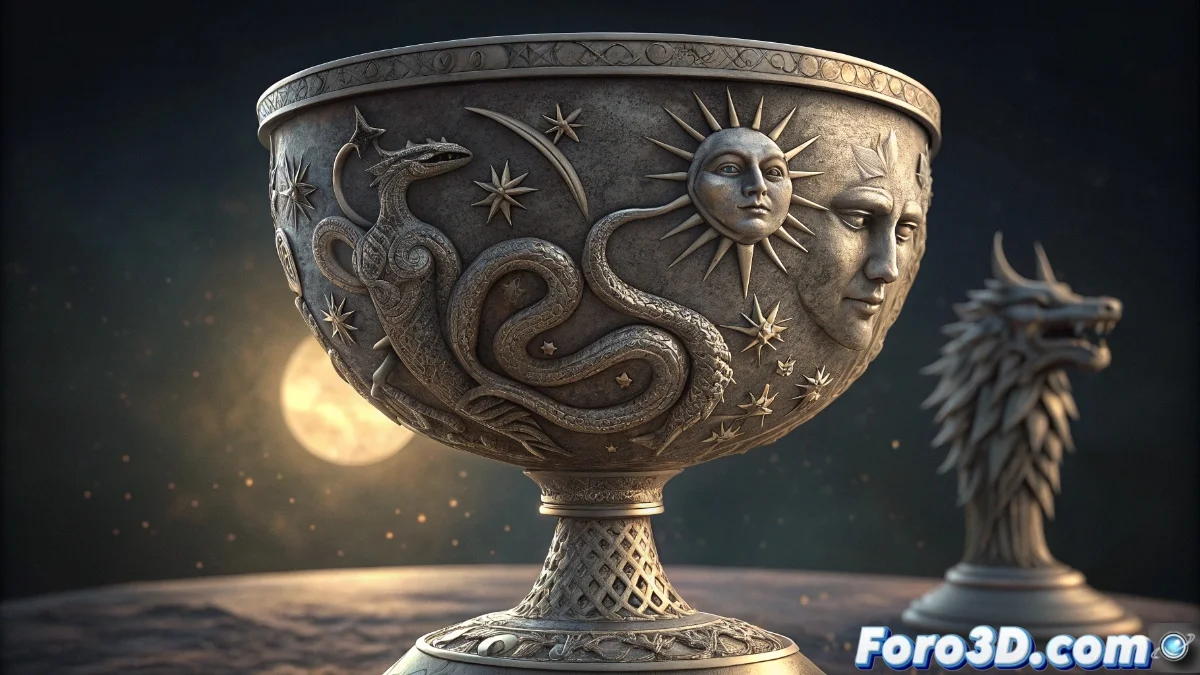
The Ain Samiya Chalice and Its Cosmological Narrative in the Bronze Age
The Ain Samiya silver chalice, from the Middle Bronze Age, constitutes an exceptional archaeological testimony that reflects the cosmological conceptions of the ancient Near East. Its intricate reliefs visually narrate the process of the universe's creation, with a duality that pits initial disorder against established harmony. This artifact, dated approximately between 2300 and 2000 BCE, predates Mesopotamian texts like the Enuma Elish by over a millennium, suggesting a sophisticated understanding of the cosmos at an early stage of civilization 🌌.
Symbolism and Visual Narrative in the Reliefs
The chalice's reliefs present a rich and complex iconography that includes snakes, hybrid creatures, anthropomorphic figures, and celestial symbols, organized to illustrate the transition from chaos to order. On one of its faces, snakes and a hybrid figure evoke primordial disorder, while on the opposite side, the sun and a crescent moon held by deities symbolize cosmic stability. This duality not only reflects a creation narrative but also establishes a connection with ritual practices or religious beliefs of the time, possibly used in ceremonies to invoke or celebrate the balance of the universe.
Key Elements of the Iconography:- Snakes and hybrid creatures representing primordial chaos
- Celestial symbols like the sun and crescent moon to denote cosmic order
- Anthropomorphic figures holding ritual objects, emphasizing the divine connection
Imagine a Bronze Age artisan explaining the design to a client: "Yes, sir, on this side we put the chaos with scary snakes, and on the other the order with a very shiny sun, so your ritual drink has a touch of cosmic drama."
Origin and Historical Impact of the Chalice
The chalice is believed to have been manufactured in northern Syria and transported to Cisjordan, indicating the existence of networks of cultural and technological exchange during the Bronze Age. Its discovery in the Levant underscores the diffusion of cosmological ideas through trade routes, challenging the notion that complex thought about creation originated exclusively in Mesopotamia. Being considered the oldest known cosmological image, this object not only enriches our understanding of antiquity but also invites us to reconsider the evolution of philosophical and religious ideas in the region.
Relevant Historical Aspects:- Possible manufacture in northern Syria and transport to Cisjordan
- Evidence of cultural and technological exchanges in the Bronze Age
- Influence on revising narratives about the origin of cosmological thought
Legacy and Contemporary Relevance
The Ain Samiya Chalice is not only a valuable archaeological artifact but also a testament to humanity's ability to conceptualize the universe in remote eras. Its chaos-order duality reflects universal concerns that transcend time and space, connecting with ritual practices and beliefs that sought to understand humanity's place in the cosmos. This object invites reflection on the intellectual sophistication of ancient societies and their legacy in the modern understanding of the history of ideas 🏺.