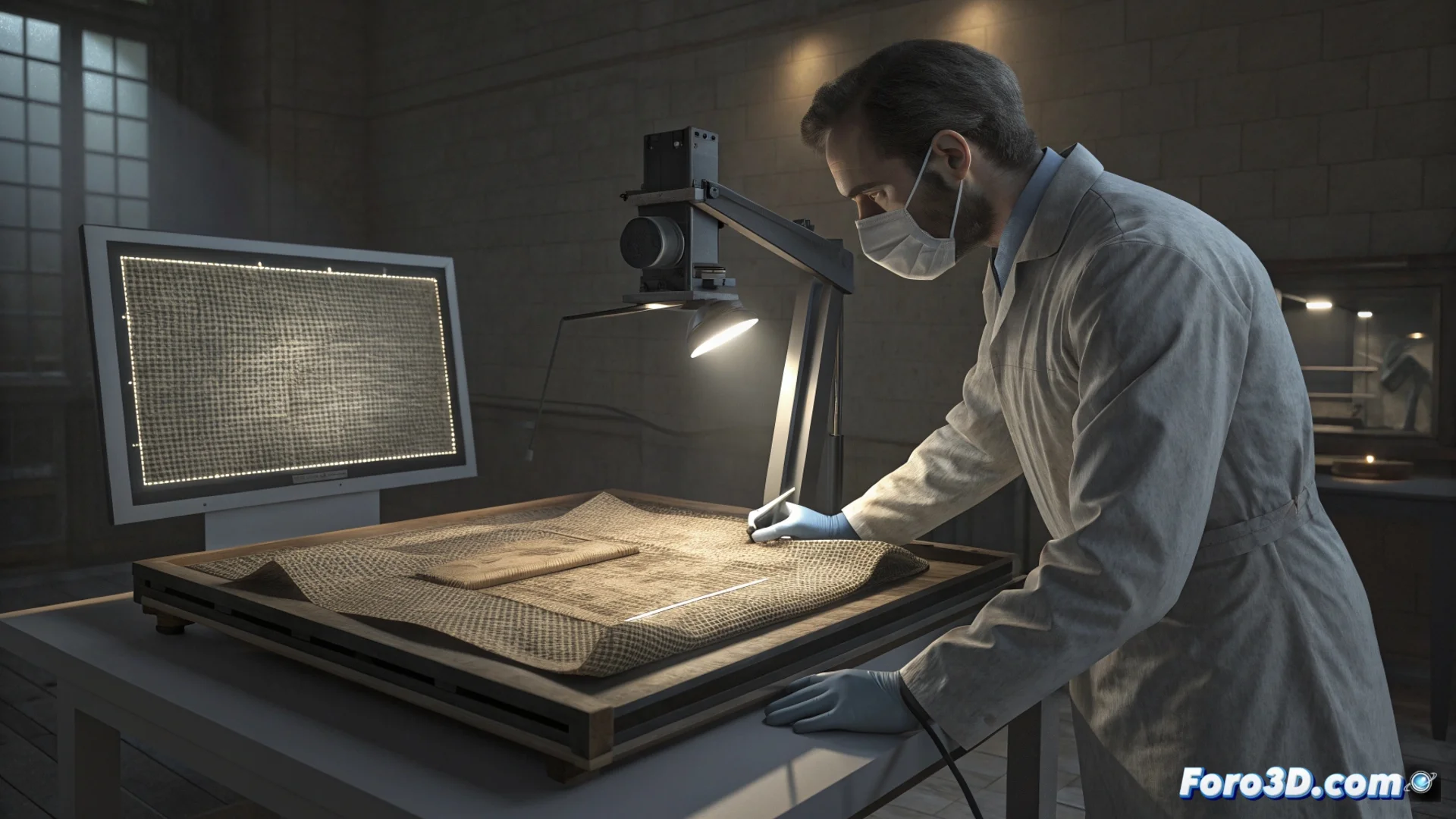
The 3D Scanner as Art Detective
When the authenticity of an ancient painting is in doubt, modern technology steps in. Experts no longer limit themselves to analyzing brushstrokes or pigments; now they scrutinize the support itself. A structured light 3D scanner, like the Lucida model, becomes the key tool for inspecting the back of the canvas with unprecedented precision. 🔍
Capturing the Canvas's Fingerprint
The process begins by scanning the back surface of the fabric. This equipment projects a light pattern onto the weave and records its deformation, generating an exact three-dimensional model with micrometric resolution. It documents every detail: the weave, the thread density, and the angle at which they cross. This digital file serves as objective and immutable proof of the physical topography of the support.
Key data recorded by the scanner:- The complete topography and relief of the weave.
- The exact density of warp and weft threads.
- The characteristic crossing angle of the weave.
The weave pattern is the unique fingerprint of a historical canvas.
Processing the Model to Reveal the Hidden Pattern
The captured 3D model is not the final result. It is imported into metrology software, such as GOM Inspect, to flatten the surface and mathematically isolate the weave relief. Then, using environments like MATLAB or Python, computer vision algorithms are executed. Filters and Fourier transforms are applied to convert the captured physical texture into a clear and analyzable digital pattern, defining the dominant frequency and orientation.
Steps in digital processing:- Flatten the 3D surface to remove canvas curvatures.
- Apply algorithms to isolate the textile pattern signal.
- Use spectral analysis (Fourier) to quantify frequency and orientation.
Comparing with History to Uncover the Truth
The extracted pattern, now a digital signature, is compared with a historical database of fabrics from the era and region to which the work is attributed. If metrics like thread density or weave type do not match documented standards, the canvas is flagged as anachronistic. This technical discrepancy is solid evidence of forgery, as reproducing or obtaining a historical fabric with the exact pattern is an almost insurmountable barrier for a forger. Thus, the next time a masterpiece seems impeccable, its back might be revealing a very different story from the one suggested by the signature on the front. 🖼️