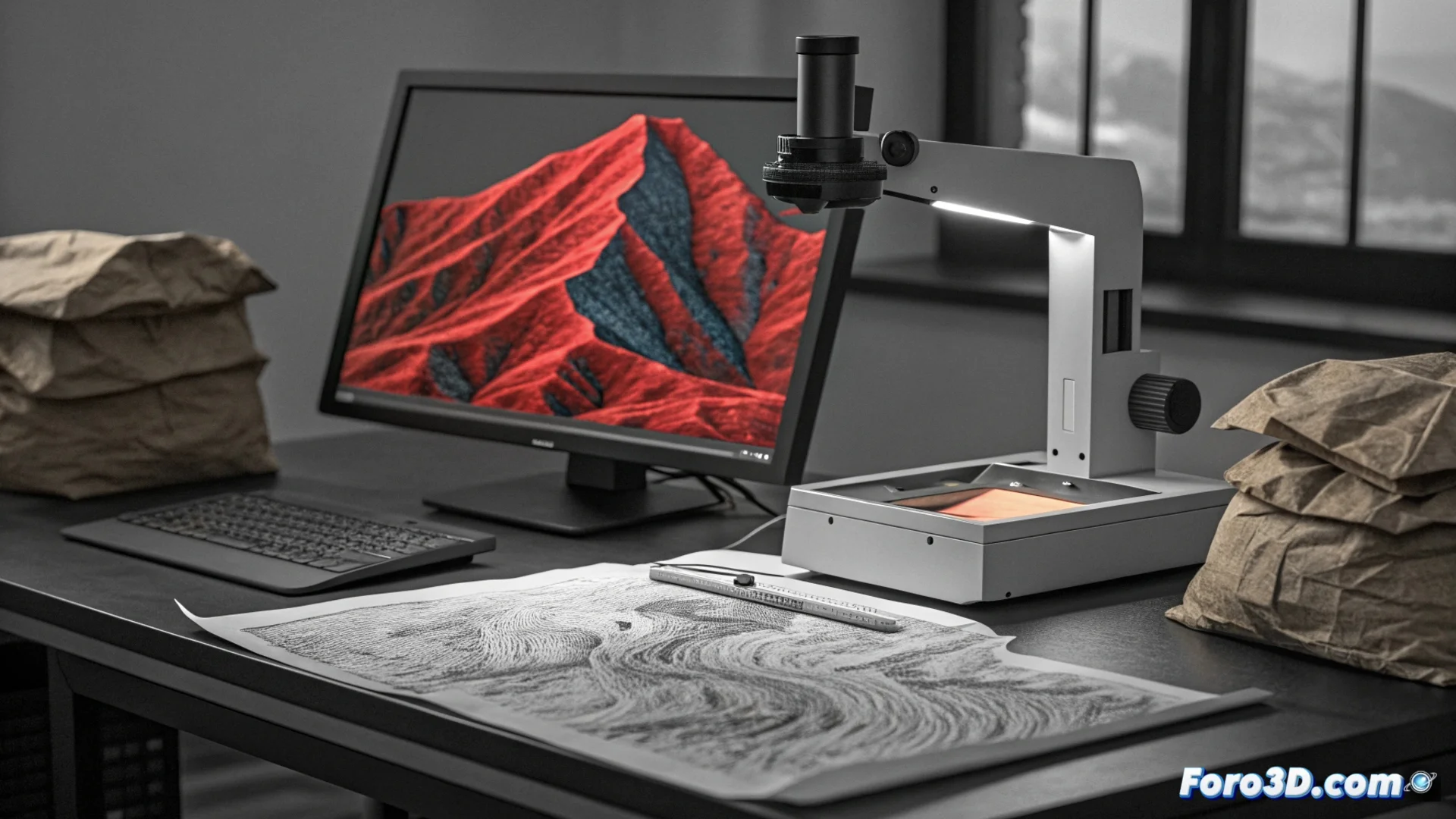
The 3D Profilometer Reveals Fake Signatures in Legal Documents
When the authenticity of a will or contract is questioned, modern forensic technology offers definitive answers. Instead of relying solely on the naked eye, experts use instruments like the Sensofar S neox 3D profilometer to scan the disputed signature. This device captures the physical footprint left by the pen, transforming a simple scribble into a three-dimensional landscape of evidence. 🔍
From Surface to Map: Capturing the Stroke's Footprint
The profilometer does not photograph the ink, but the relief imprinted by the writing instrument on the paper fibers. The scan generates an extremely precise digital topographic map that records every micro-depression and elevation. This allows measuring parameters impossible to see with the naked eye: the force applied in each millimeter and the dynamics of the hand's movement. It analyzes the how it was written, not just the what was drawn.
What the 3D scanner reveals:- The exact depth of the groove across the entire length of the signature.
- Variations in pen pressure, indicating where the author pressed harder or lighter.
- The continuity or interruption of the stroke, signaling pauses or lifts.
A genuine signature is an automated motor gesture; a fake one is often a hesitant drawing.
Specialized Software: Quantifying Suspicion
The raw scan data is processed with programs like MountainsMap or Gwyddion. These tools allow visualizing, measuring, and comparing pressure maps. The expert looks for anomalous patterns: sudden changes in force, inconsistent speeds, or reconstructed strokes. The forger usually focuses on copying the visual form, neglecting the fluency and natural pressure of the writing gesture.
Indications of forgery detected by software:- Rest points imperceptible where the forger hesitated or lifted the pen.
- Uniform depth grooves that do not match the pressure dynamics of real writing.
- Trembling stroke or filling in complex areas, instead of a confident movement.
Physical Evidence in Court
The final expert opinion contrasts the 3D map of the questioned signature with that of undisputed samples from the signer. Discrepancies in the stroke dynamics constitute objective and hard-to-refute evidence. This scientific method strengthens traditional graphoscopic analysis by providing metric and reproducible data. In a legal case, it can be the decisive element to prove document forgery, demonstrating that perfect appearance is sometimes the greatest evidence of fraud. ⚖️