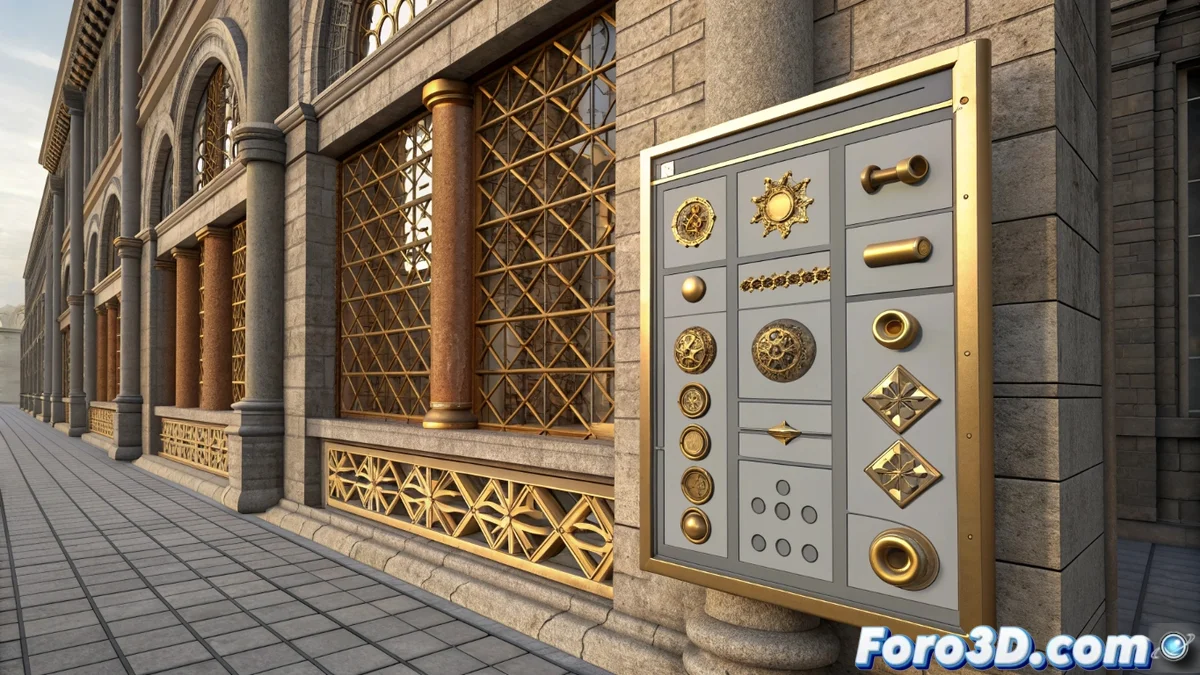
Texturing with Trim Sheets for Video Games
In the production of assets for virtual environments, where every megabyte of memory and every draw call counts, an intelligent texturing technique emerges: trim sheets. This method consists of creating a single master texture sheet that houses a complete library of small and modular details. 🧩
The Essence of Efficient Reuse
The power of this technique lies in its philosophy of massive reuse. Instead of generating unique textures for each beam, panel, or grate, the artist designs a single texture (commonly 2K or 4K) that contains all those repetitive elements. Then, the UV mapping of each 3D model is adjusted to "cut" or select only the portion of the trim sheet it needs, like a window over a visual catalog. This transforms the detailing process into a task of UV assembly rather than manual painting.
Typical elements in a trim sheet:- Architectural details: Moldings, cornices, and baseboards for structures.
- Industrial components: Rivets, screws, ventilation grates, and metal joints.
- Surface patterns: Wear, scratches, dirt, and other effects that add realism.
The real challenge is not creating the trim sheet, but remembering in which quadrant you left that perfect screw for the fiftieth beam.
Strategic Advantages in the Development Pipeline
Adopting this approach brings tangible benefits that impact from art to final performance. First, it produces a drastic performance optimization, as the number of unique textures loaded into GPU memory and draw calls is reduced, with many assets sharing the same sheet. Additionally, it greatly accelerates the artistic workflow, allowing complex geometries to be textured in minutes through UV manipulation. Finally, it ensures absolute visual coherence throughout the environment, maintaining identical resolution, lighting, and style in every repeated detail. 🚀
Key benefits of the workflow:- Memory optimization: Fewer unique textures means more efficient VRAM usage.
- Process acceleration: Texturing becomes an exercise in UV layout, not painting from scratch.
- Guaranteed consistency: All details share the same palette and quality, unifying the environment's style.
From Theory to Practice: Creation and Application
Creating an effective trim sheet requires meticulous planning. It is designed in software like Substance Painter or Photoshop, organizing elements in a logical grid to make the most of every pixel. In the 3D modeling phase, the object's UVs are cut and arranged (in a process called "baking" or "layout") over the precise areas of the sheet. A common practice is to combine this method with other techniques, using the trim sheet for structural details and adding base color textures (albedo) or unique details via masks in the game engine's shader. This hybridization offers the perfect balance between efficiency and uniqueness. 🛠️