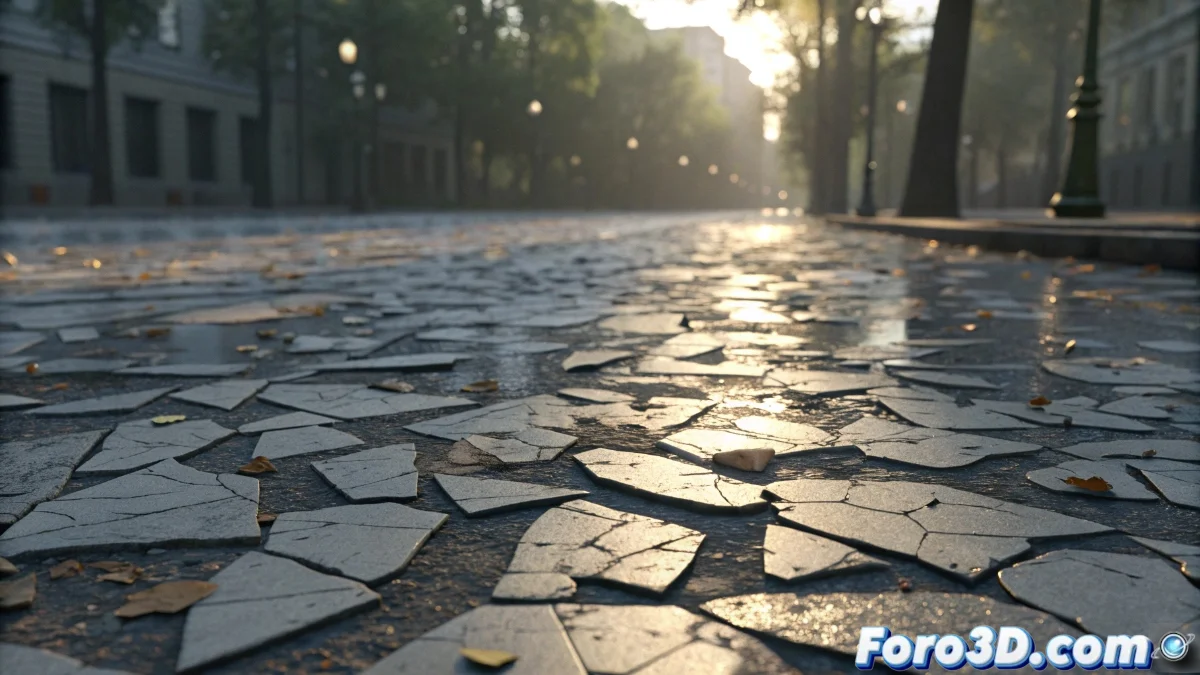
Texture Bombing: Procedural Distribution Technique for Complex Textures
Texture bombing is an advanced procedural technique that scatters texture fragments in a random and controlled manner over digital surfaces, generating intricate patterns that avoid visual monotony. This methodology employs noise algorithms to position and rotate each element, ensuring that every application produces unique and natural results 🎨.
Technical Implementation in Graphics Engines
The execution of texture bombing is primarily carried out using shaders or compute shaders, which access a texture atlas that stores multiple variations of fragments. These shaders manipulate UV coordinates using noise functions such as Perlin or Simplex, determining which segment of the atlas is projected at each location. The process incorporates masking and blending operations to integrate the fragments with the base surface, allowing precise adjustments to density, scale, and diversity 🛠️.
Key Components of the Implementation:- Use of texture atlas with multiple variations to avoid repetitions
- Modification of UV coordinates using procedural noise functions
- Mask and blend operations for perfect integration
Texture bombing transforms monotonous repetition into organized chaos, mimicking the unpredictability of nature.
Applications in Visual Projects
In production environments, texture bombing is used to simulate natural surfaces such as rock clusters, foliage layers, or grass meadows, where uniform patterns would appear artificial. Contemporary video games leverage this technique to texture vast terrains without revealing repetitive patterns, while in cinematic visual effects it is applied to build detailed backgrounds with organic variations. Additionally, it adapts to generate wear, dirt, and detailing effects that enhance realism in digital scenes 🌿.
Highlighted Use Cases:- Generation of natural terrains in video games and animations
- Creation of aging and dirt effects on 3D models
- Texturing of complex backgrounds for cinematic productions
Reflection on Procedural Realism
It is paradoxical that we use structured algorithms to generate controlled chaos that we then catalog as natural realism. Texture bombing exemplifies this irony, where mathematical precision becomes the tool to emulate the imperfection and randomness of the physical world, challenging the boundaries between the artificial and the organic 🤔.