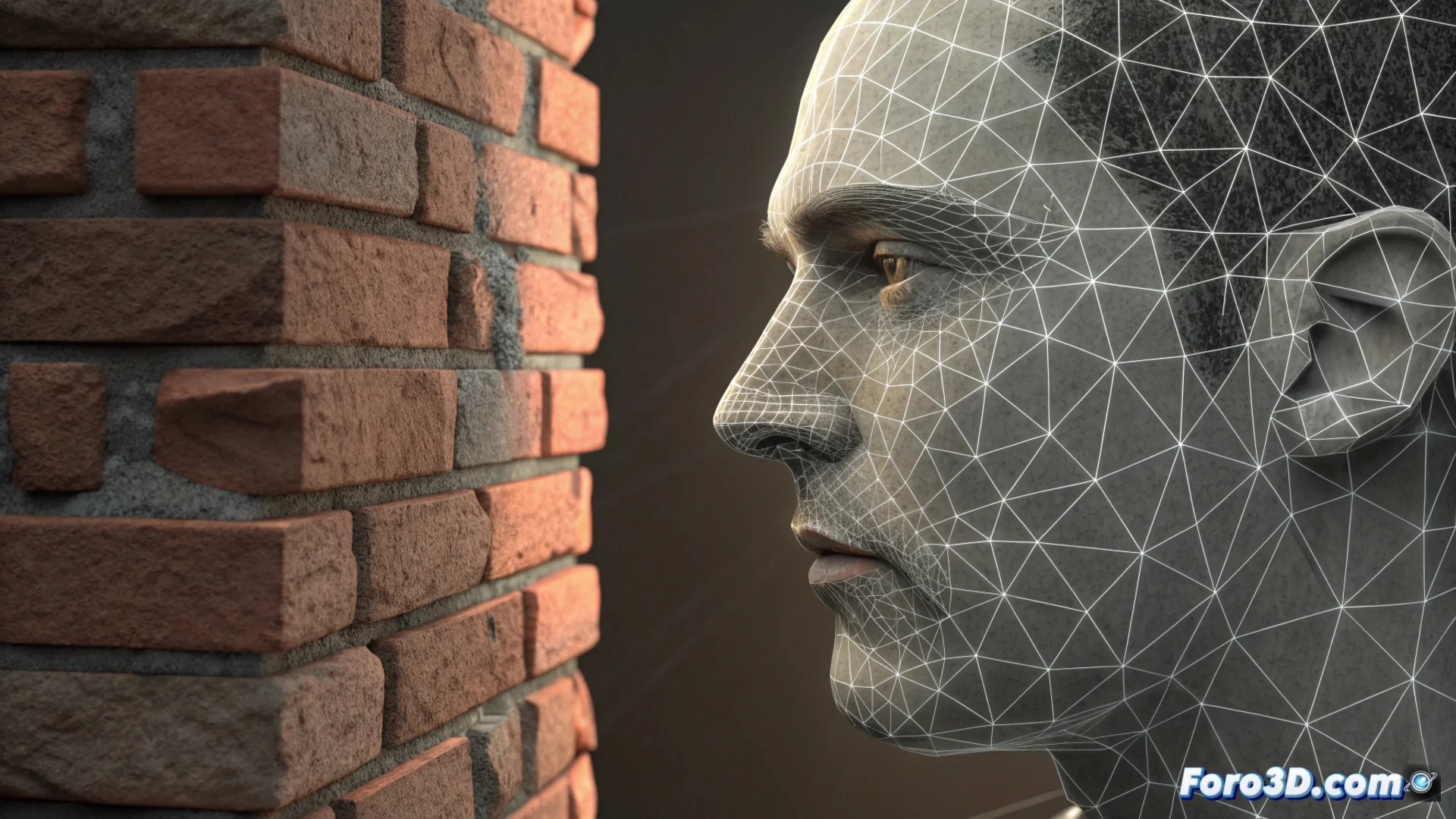
Ptex Solves Adjacency Between Faces When Texturing
The Ptex system represents a paradigm shift in texture mapping for 3D graphics. Instead of relying on a single, complex UV map for the entire mesh, it assigns a small independent texture map to each individual polygon or face. This streamlines the workflow by avoiding the need to develop, deploy, and pack UVs. However, this power introduces a key technical challenge at the junctions between faces. 🧩
The Challenge of Edges in a UV-Free Workflow
When a graphics engine renders a scene with Ptex, it must calculate the color for each pixel. The problem arises at the edges where faces converge. If the system does not manage this boundary precisely, unwanted visual artifacts are generated. These errors, such as dark lines, color jumps, or incorrect pixels, break the illusion of a continuous surface and damage the realism of the final image.
Consequences of not handling adjacency:- Visible seams: Dark or light lines that artificially delimit each polygon.
- Color discontinuity: Tones do not blend smoothly between adjacent faces.
- Loss of realism: The surface appears as a mosaic of disconnected patches.
Solving adjacency is the digital equivalent of wallpapering a room with complex corners, where each piece of paper must be cut so that the pattern matches perfectly at every corner.
How is Adjacency Between Faces Solved?
Rendering software implements a specific process to correct these edges. First, it analyzes the mesh topology to identify which faces share an edge and their relative orientation. Then, during the calculation of each pixel at those boundaries, the engine dynamically queries the texture information from both faces involved. With this data, it interpolates or calculates a coherent color value that ensures an imperceptible transition.
Key steps of the process:- Topological analysis: The engine identifies neighborhood relationships between all polygons in the mesh.
- Dynamic sampling: When rendering a pixel on an edge, samples are taken from the Ptex maps of the two adjacent faces.
- Coherent color calculation: A filter or algorithm is applied to blend the samples and produce a single, uniform color.
Fundamental Advantage of the System
This automatic mechanism for resolving seams is what makes Ptex viable in production. It allows enjoying the agility of not creating UVs, without sacrificing the final visual quality. The rendered surface shows perfect continuity, as if a single traditional texture map had been used, but avoiding all the previous manual work. The result is a more efficient workflow for texturing complex models. ✅