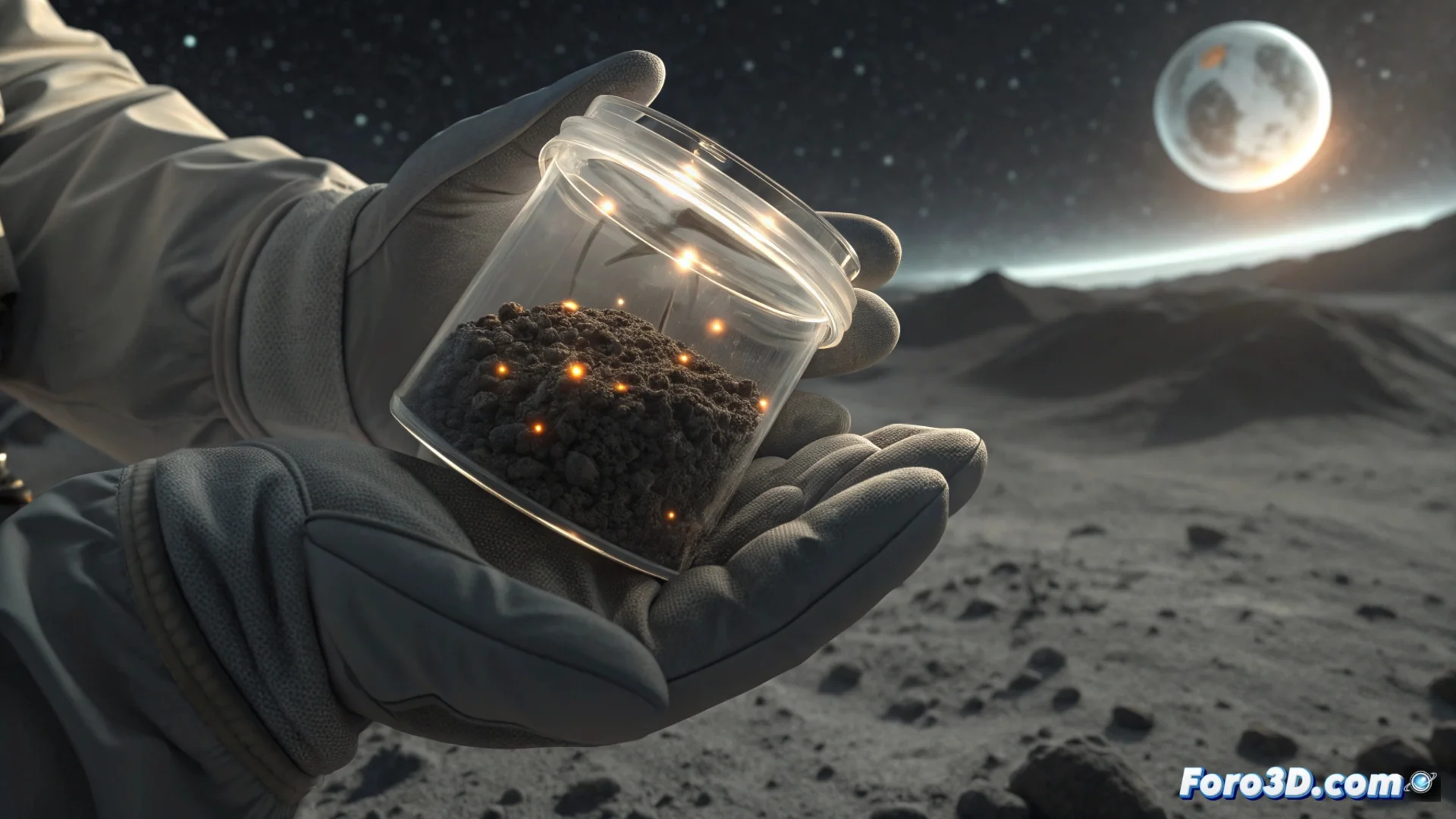
Earth Particles in Lunar Soil Pave the Way to Space Resources
A discovery published in Nature Astronomy reveals that grains of lunar regolith brought back by the Chang'e 5 mission contain particles from our own atmosphere. Oxygen, nitrogen, and hydrogen ions, stripped from Earth's upper layers by the solar wind, were implanted on the Moon's surface when both bodies aligned in a specific orbital phase. 🌌
A Finding That Transforms the View of the Moon
The confirmation of these essential volatile elements trapped in lunar dust is not just scientific curiosity. It poses an immediate practical possibility: if the materials are already there, ways can be devised to extract them. This revitalizes the debate on producing breathable air, water, or fuel for future lunar colonies autonomously.
Key Implications of the Discovery:- Demonstrates an active matter transfer cycle between Earth and the Moon.
- The resources needed for life and propulsion might not need to be sent entirely from Earth.
- Reinforces the concept of in-situ resource utilization (ISRU), fundamental for sustainable space exploration.
The Moon may be more than a sterile desert; this finding points to it as a potential repository of resources with terrestrial origin.
The Challenges of Extracting Resources from Lunar Dust
Although the principle is solid, executing the extraction presents an enormous technical complexity. The particles do not form gas pockets but are embedded at the atomic level within regolith grains. Releasing useful quantities requires processing massive volumes of soil with considerable energy expenditure.
Technological Challenges to Overcome:- Develop efficient methods to heat large quantities of regolith and release the gases.
- Create compact and powerful chemical reactors that capture and separate specific elements.
- Optimize the entire process to make it energetically viable in the Moon's hostile environment.
A Future with Air Made from Lunar Dust
This finding outlines a future where lunar bases could process local soil to obtain vital supplies. Imagine an astronaut breathing air whose oxygen was, eons ago, part of Earth's atmosphere and is now released from a lunar dust grain. A cosmic cycle that turns our ancient breath into a resource 384,000 kilometers away, redef