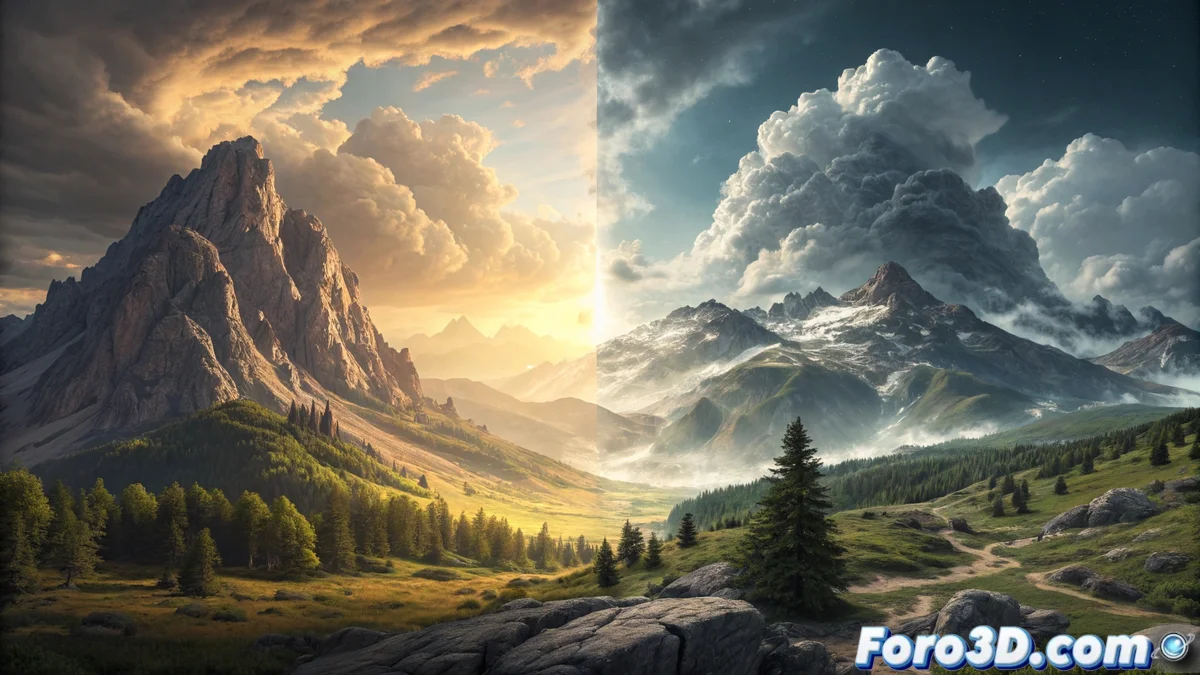
Terragen vs Houdini Solaris: Two Ways to Light Skies
Creating realistic skies is a key challenge in 3D graphics. Two powerful tools, Terragen and Houdini Solaris, address this problem with opposing philosophies: one specialized and unified, the other integrated and modular. 🌤️
Terragen's Unified Approach
Terragen focuses on simulating natural landscapes. Its core is an engine that calculates how light scatters in the atmosphere. This generates subtle color transitions, like those at dawn, with convincing physical realism. It offers intuitive controls to adjust parameters like air density or cloud height, making outdoor lighting setup quick.
Key Features of Terragen:- Specialized Atmospheric Engine: Generates the atmosphere and lighting as a cohesive unit.
- Physical Simulation: Prioritizes calculating phenomena like light scattering for realism.
- Agile Setup: Dedicated controls allow accessible adjustment of turbidity and other values.
In Terragen, light physics defines the atmosphere. It's a system where everything is interconnected from the start.
Houdini Solaris's Modular Integration
In Houdini, the Solaris module operates as a USD-based scene composition environment. Here, sky lighting is just another asset within a complex hierarchy. A Dome Light with HDRi maps or procedural systems like Karma's Physical Sky is commonly used. Its power lies in integrating that ambient light with other lights, volumetric effects, and geometry, within a non-destructive workflow.
Key Features of Houdini Solaris:- USD Workflow: Manages lighting in a broad, non-destructive context.
- Lighting as an Asset: The sky is handled as an element that can be blended and manipulated precisely.
- Technical Control: Allows deciding how the imported or built atmosphere lights the rest of the scene.
Scope and Workflow Philosophy
The main difference lies in the scope. Terragen starts from the atmosphere to define all the light, offering a specialized and closed solution for natural environments. Houdini Solaris allows building or importing the atmosphere and then precisely controlling how it interacts with each scene element, offering a fragmented but extremely flexible approach. While in Solaris you can isolate and adjust components, in Terragen the result depends on a global physics setup. 🎭