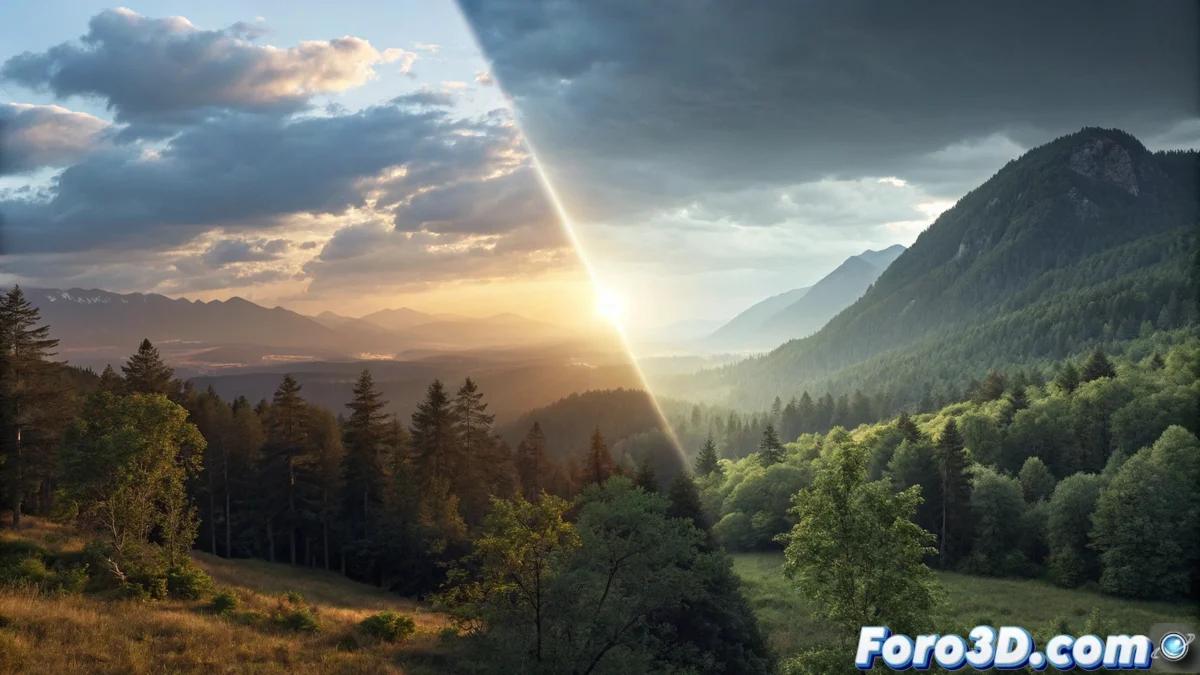
Terragen and Vue Esprit: two ways to light digital landscapes
When creating digital natural environments, lighting defines realism and mood. Terragen and Vue Esprit are specialized tools that address this challenge from opposing technical philosophies, posing a fundamental choice for the artist. Do you prefer to calculate every photon or let the software interpret the light for you? 🌄
Terragen's scientific approach
Terragen stands out for modeling light with exceptional physical rigor. Its engine treats the atmosphere as an active participating volume, where air, suspended particles, and gases modify the trajectory and color of each light ray. This allows recreating complex optical phenomena with a fidelity that other programs rarely achieve.
Key features of Terragen's system:- Simulates Rayleigh and Mie scattering to generate realistic twilight skies and bluish light at altitude.
- Offers manual control over parameters like turbidity, ozone density, and solar altitude to adjust specific effects.
- Prioritizes precision in atmospheric simulation, which requires understanding light physics concepts.
With Terragen, the user holds the reins to define how the atmosphere filters and diffuses each beam of light, from a golden dawn to the dense mist of a valley.
Vue Esprit's integrated philosophy
Vue Esprit adopts a more holistic methodology oriented toward artistic workflow. Its core is a powerful global illumination engine that automatically calculates how light bounces between objects, the ground, and the sky. This approach generates inherent visual cohesion, with soft shadows and diffuse light bounces, without needing to manually adjust each source.
Central aspects of Vue Esprit:- Integrates lighting, atmosphere, and geometry into a unified ecosystem that calculates light interactions globally.
- Includes presets and intuitive controls that abstract technical complexity, speeding up the process to achieve attractive results.
- Its atmospheric system is optimized to produce visually striking scenes efficiently, though with less physical granularity than Terragen.
Choosing between physics and workflow
The decision between both programs boils down to prioritizing scientific control or artistic automation. Terragen is the choice for those who need to simulate specific lighting conditions with a solid physical basis, ideal for scientific outreach projects or extreme architectural visualization. Vue Esprit shines in productions where time is limited and perfect integration between all scene elements is sought, such as in cinematic previsualizations or fantasy illustrations. Both tools demonstrate that there is no single "correct" way to light a digital world, but rather different technical paths to visual beauty. 🎨