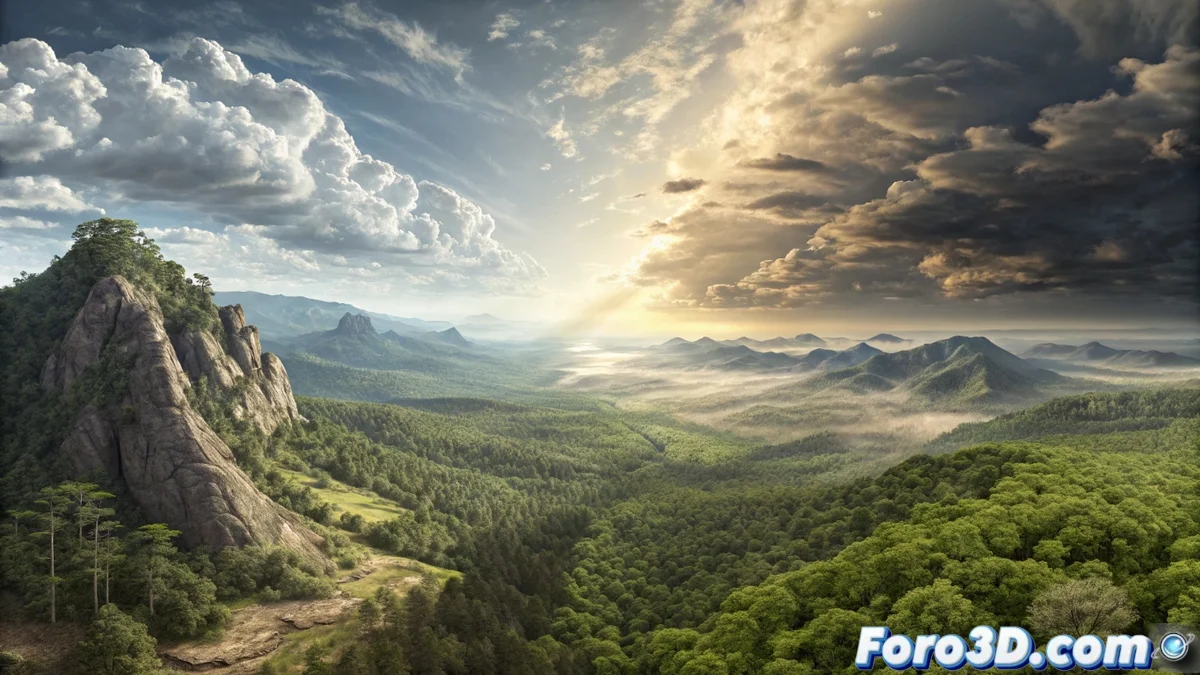
Terragen and Vue Esprit: Comparison for Rendering Landscapes
In the field of 3D graphics and visual production, creating believable natural environments is a key challenge. Two tools specialize in this task: Terragen and Vue Esprit. Although both programs generate digital landscapes and atmospheres for film, television, and artistic projects, their philosophies and workflows differ notably. Choosing one or the other depends directly on what the artist needs to prioritize in their scene 🏔️.
The Physical and Detailed Approach of Terragen
Terragen stands out for its commitment to physical precision. Its engine calculates phenomena like light scattering in the atmosphere with scientific algorithms, allowing for exceptional realism in simulating skies, sunrises, and fogs. Its power for generating terrains is another fundamental pillar.
Main Features of Terragen:- Rendering engine that simulates atmospheric light based on physical principles.
- Powerful procedural system for modeling terrains from scratch or importing real elevation data (DEM).
- Technical interface that offers granular control over climatic and geological parameters.
A Terragen user can spend hours adjusting the Earth's curvature in their atmosphere to achieve perfect lighting.
Ecosystem Management in Vue Esprit
Vue Esprit, as part of the Vue suite, adopts a more integrated approach oriented toward rapid composition. Its main strength lies in the EcoSystem system, designed to populate scenes with diverse and believable vegetation intelligently and efficiently.
Main Features of Vue Esprit:- EcoSystem technology to distribute millions of instances of plants, trees, and rocks over the terrain.
- Extensive content library and accessible atmospheric controls to build scenes agilely.
- Facilitates creating complete ecosystems and complex natural scenes with relative speed.
Deciding Between Precision and Productivity
The final choice between Terragen and Vue Esprit comes down to a balance between physical realism and production speed. Terragen is the option for those who need maximum control over every physical aspect of a landscape, ideal for hyperrealistic backgrounds. Vue Esprit shines when the goal is to quickly build a living and populated world, although its rendering may require adjustments to match Terragen's luminous realism. While a Vue artist has already populated continents with forests, the Terragen user is still fine-tuning the light in their atmosphere 🌅.