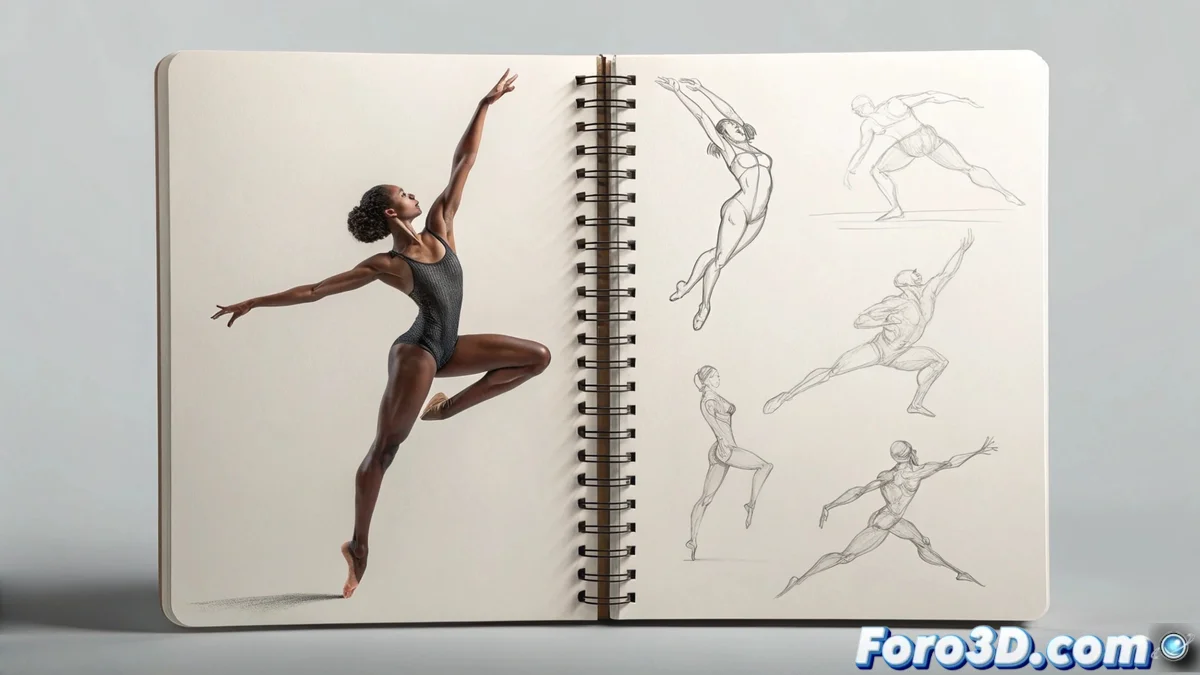
Techniques for Drawing Figures with Energy and Naturalness
Mastering the art of representing figures with vitality and spontaneity requires cultivating a keen observation of movement in reality. This methodology focuses on analyzing gestures, poses, and dynamics of living beings in action, prioritizing the capture of the essence of movement over meticulous anatomical details. 🎨
Fundamentals of Movement Observation
You start with brief observation sessions, dedicating yourself to capturing the complete pose in 30 seconds or less. You use fluid and continuous strokes to express the direction of the movement, the tilt of the torso, and the arrangement of the limbs. The focus is on conveying energy and fluidity, identifying that imaginary curve that defines the body's main action. You practice with everyday scenes like people walking, athletes in competition, or animals in motion, always seeking the distinctive gesture that communicates the activity. 🏃♂️
Key elements to consider:- Use simple lines to represent the direction and flow of movement
- Prioritize capturing the overall pose over anatomical details
- Practice with subjects in action to identify characteristic gestures
Constant practice allows you to see lines of action in your entire environment, even in simple gestures like reaching for a distant object.
Development of Visual and Muscular Memory
With repeated practice, you strengthen both your visual memory and muscular memory. Your hand acquires the ability to quickly translate what your eyes perceive, establishing a more intuitive connection between observation and execution. You create multiple interpretations of the same movement from various angles, noting changes in the silhouette and balance. You incorporate the analysis of slow-motion videos to examine specific phases of movement that the human eye cannot discern clearly. This dedication enables you to draw figures in motion without immediate references, leveraging your trained memory of poses and transitions. ✍️
Strategies to improve memory:- Create multiple versions of the same movement from different perspectives
- Study slow-motion videos to analyze detailed phases of movement
- Practice drawing without references to strengthen pose memory
Integration of the Technique into Daily Practice
Consistency in practice is crucial to internalize these skills. Over time, you will begin to perceive lines of action in everyday situations, such as when someone stretches to grab an object. This training not only improves your drawing ability but also enriches your understanding of human and animal movement, allowing you to create works full of life and dynamism with seemingly simple strokes. 🌟