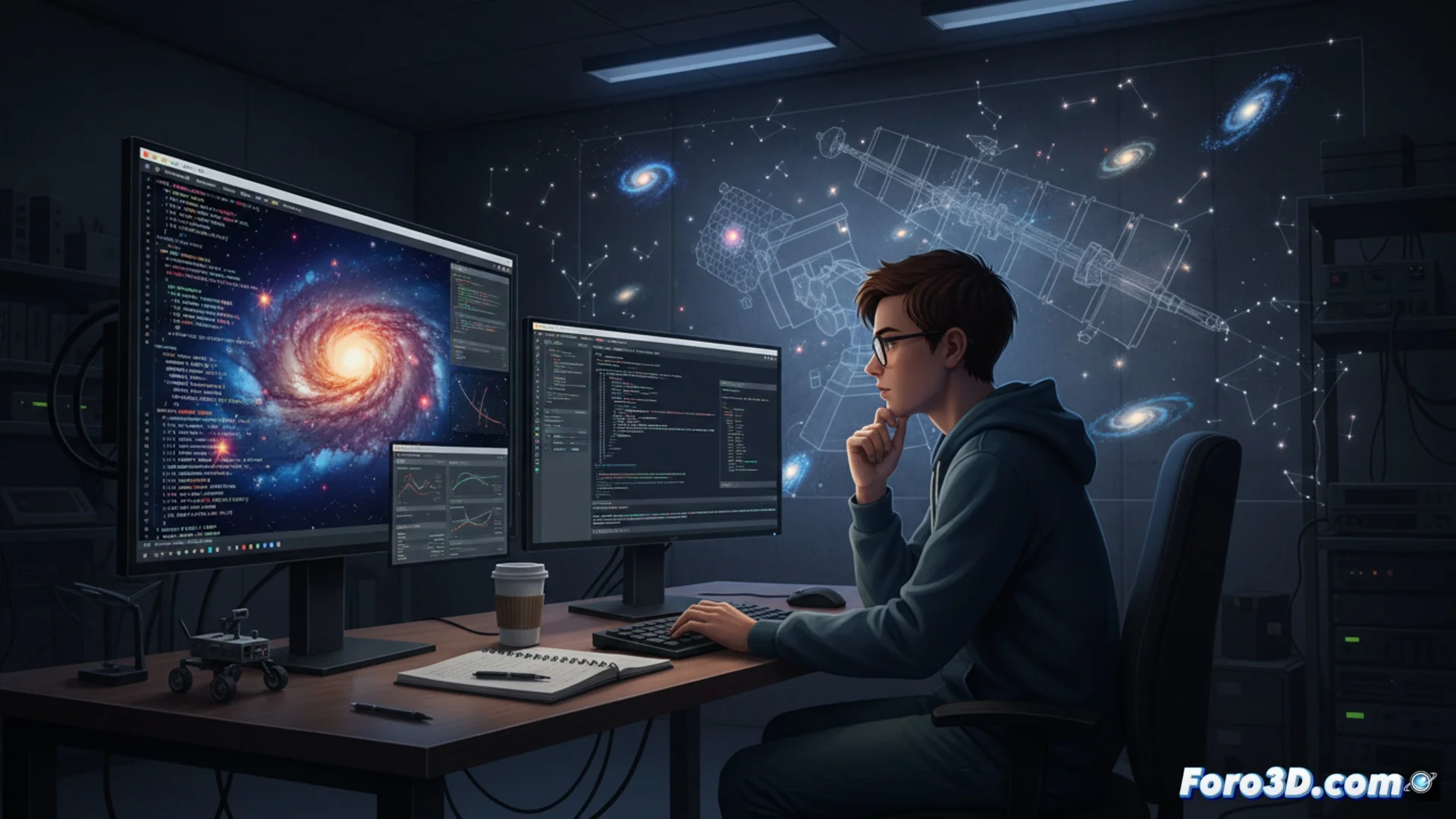
Teareduce: a Python package for learning to reduce astronomical data
In the field of observational astrophysics, processing raw images is a fundamental step. The Teareduce package emerges as a didactic tool specifically created to teach this complex process to university students. Its code is openly available and relies on interactive Jupyter notebooks to guide learning. 🔭
An educational resource to master the astronomical workflow
This software is integrated into the Experimental Techniques in Astrophysics course, part of the Master's in Astrophysics at Complutense University of Madrid. Its main purpose is for students to experience firsthand the standard task chain. Students can load unprocessed images from various telescopes, apply essential corrections for bias, dark, and flat, and finally align and combine multiple exposures. By using Python, a language ubiquitous in real research, they acquire practical and directly applicable skills. 🧑🎓
Key features of the package:- Pedagogical focus: It is designed as material for practical classes, where learning is based on action.
- Interactive documentation: It includes Jupyter notebooks that detail how to use its classes and functions.
- Public access: The code is hosted on GitHub, facilitating download, review, and possible adaptation.
Thus character is forged and coffee is appreciated: mastering the fundamentals of data processing, step by step.
Promoting open and understandable science
By publishing the project on a platform like GitHub, its developers not only foster transparency but also invite other educators or amateur astronomers to use or modify it. This philosophy of openness allows anyone to inspect the internal workings of the software or suggest improvements. The notebooks document each stage of the process, helping to understand not only the what is done, but the how it is done, a fundamental pillar for achieving reproducible research. 📖
Benefits of this approach:- Transferable skills: Students learn with a professional tool, preparing for real projects.
- Autonomous learning: Documentation with examples allows guided study at your own pace.
- Community collaboration: The open nature of the code encourages peer review and project evolution.
The value of mastering the fundamentals
Although correcting hot pixels in dark images may seem a meticulous task compared to discovering cosmic phenomena, it is the solid foundation on which any rigorous astrophysical analysis is built. Teareduce places students in this essential context, equipping them with the practical knowledge and critical mindset necessary to undertake future research with solvency. In the end, mastering these meticulous procedures is what allows, later on, to correctly interpret data and do quality science. 💻