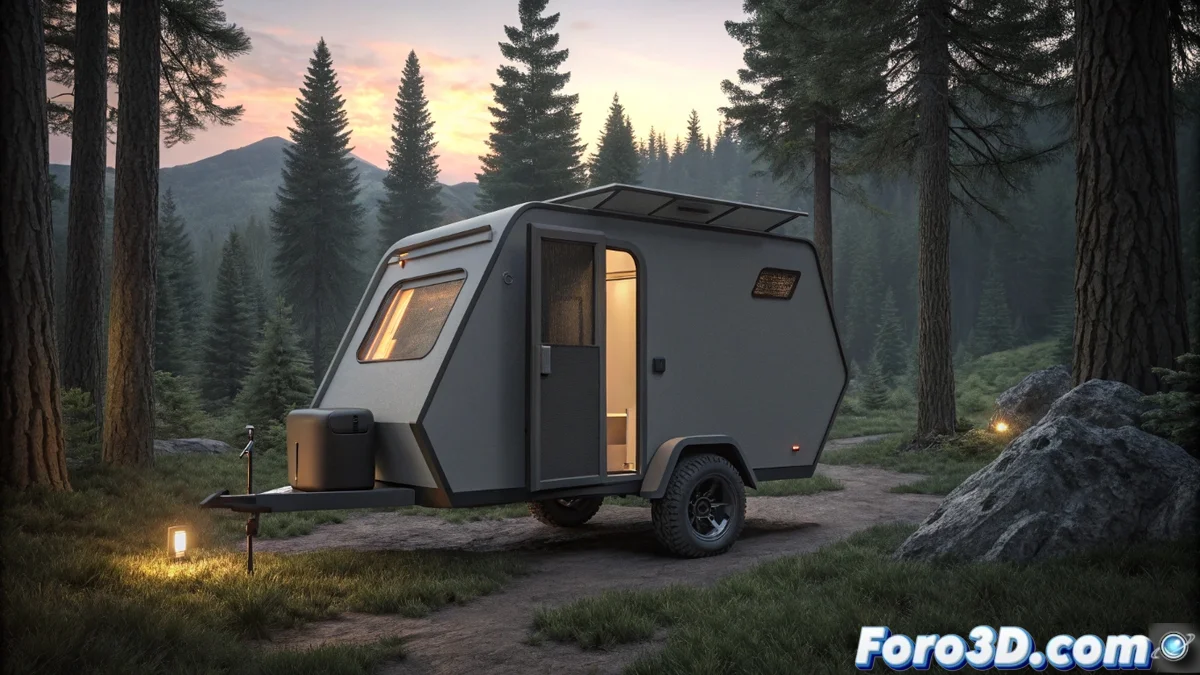
SylvanSport Revolutionizes the Market with the 3D-Printed Panel Scout Camper Trailer
The additive manufacturing industry takes a monumental leap from the workshop to the real world with an application that redefines limits. SylvanSport has unveiled its Scout model, a lightweight camper trailer whose body is not molded or assembled traditionally, but printed. Using large-format 3D printers, the company manufactures the vehicle's main structure, creating an exceptionally robust, lightweight unit with a design impossible to achieve with conventional techniques. This is not a prototype; it is the new frontier of recreational mobility 🚐.
The Engineering Behind the Monolithic Printed Panels
The heart of this innovation is a large-scale 3D printing process that employs high-performance composite materials. Instead of extruding basic plastic, the machines deposit layers of an engineering-grade thermoplastic, continuously reinforced with fiberglass. This method produces composite panels that serve as both the skin and skeleton of the trailer, offering rigidity and tensile strength far superior to common plastics. Additive manufacturing eliminates the need for expensive molds, reduces material waste almost to zero, and enables unprecedented functional integration.
Key Advantages of Additive Manufacturing in the Scout:- Integral Organic Design: The geometric freedom of 3D printing allows aerodynamic shapes and complex curves that optimize on-road efficiency and aesthetics, all in a continuous piece.
- Functional Integration: Elements such as supports, cable conduits, or anchoring systems are printed directly into the wall, eliminating numerous components and secondary assembly steps.
- Weight Reduction and Strength Increase: The monolithic composite structure is lighter than a traditional sheet metal and frame assembly, while offering exceptional durability.
Large-scale 3D printing brings the promise of customization and material efficiency from prototyping to series production of high-use objects.
A New Paradigm in Recreational Vehicle Design
This approach does not merely replace one manufacturing technique with another; it redefines the design philosophy. In the Scout, the 3D-printed body is an intelligent structural component. Its integrated design facilitates custom storage compartments and an optimized interior flow, creating a more cohesive and efficient living space. It contrasts sharply with conventional trailers, built from multiple aluminum pieces, foam, and steel frames, which are often heavier and design-limited.
Impact on User Experience:- Radical Customization: Digital manufacturing opens the door to highly personalized interior and exterior configurations without prohibitive cost increases.
- Improved Durability: The absence of joints, welds, and screws in critical points reduces weak spots and risks of leaks or corrosion.
- Distinctive Aesthetics: The trailer features a modern, fluid design language with a unique visual identity that sets it apart in the market.
Size Does Matter: From Keychains to Wheeled Shelters
SylvanSport's launch of the Scout symbolizes a crucial moment for 3D printing technology. It demonstrates that additive manufacturing has matured enough to create durable, large-scale end products ready to face real-world demanding conditions. It is no longer just a tool for prototypes or spare parts; it is a viable production method for complex systems. This advance will likely inspire debate in the community, shifting the conversation from hotend parameters to the possibilities of printing habitable structures. It is clear testimony that, in this field, the ambition to scale the technology brings transformative rewards 🏕️.