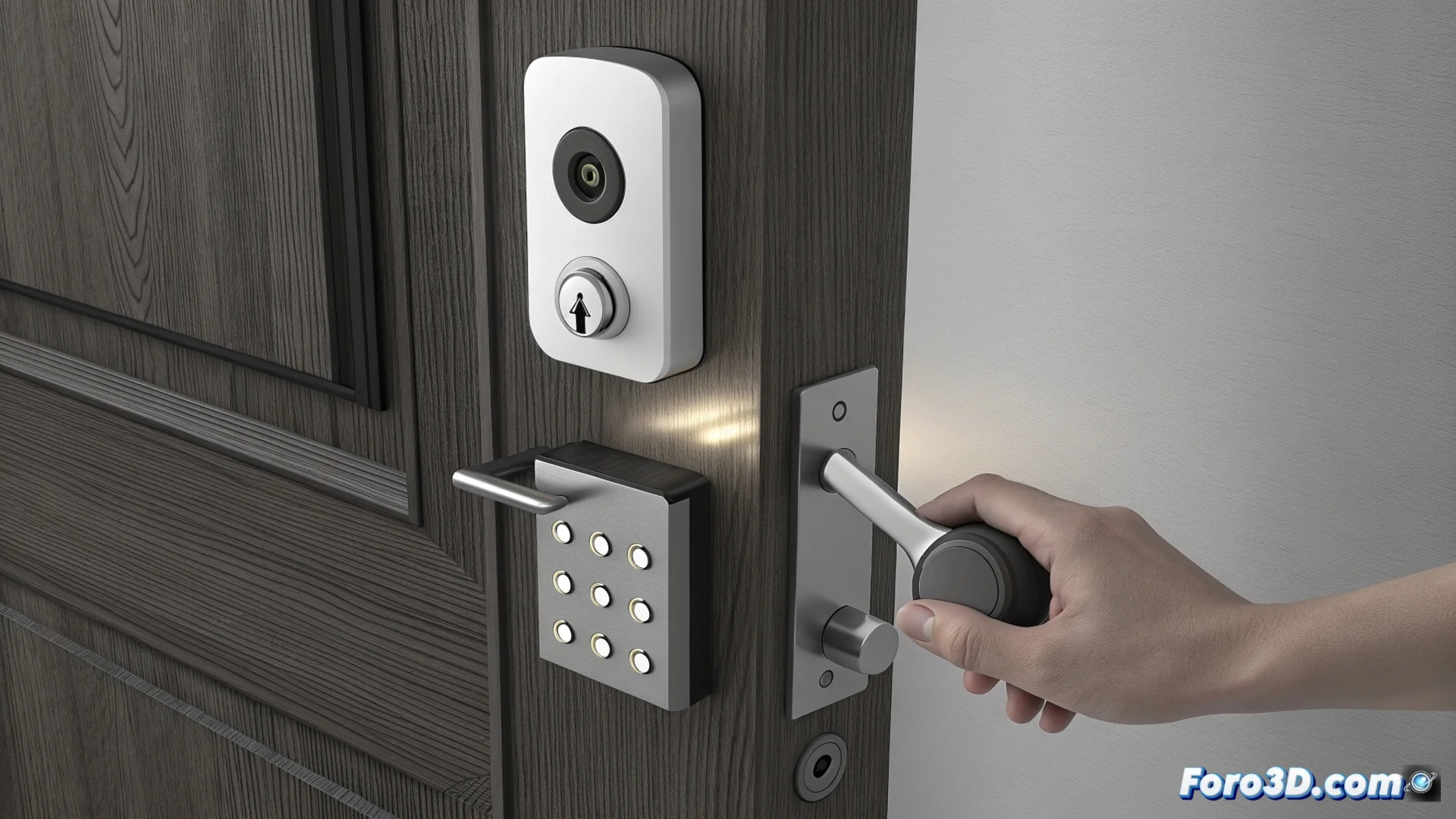
Switchbot Launches Lock Vision, a Smart Lock with Facial Recognition
The company Switchbot expands its catalog with Lock Vision, an innovative accessory that turns conventional locks into smart access systems with facial identification. This device is placed over the main lock and allows opening the door through various methods, integrating advanced biometric technology in a practical way. 🔓
A Multimodal Access System
Lock Vision does not rely on a single method to authenticate users. It combines facial recognition, fingerprint reading, validating a numeric PIN code, and the option of remote control via a mobile app. This approach seeks to offer flexibility and redundancy, ensuring there is always a way to enter, even if one method fails temporarily. The installation is non-invasive, as it adapts to different types of doors without needing to replace the original lock.
Key Components and Technical Capabilities:- Infrared Sensor Camera: Allows identifying faces accurately even in low light conditions or total darkness.
- Ample Local Storage: Manages up to 50 different facial profiles and can register 100 different fingerprints.
- Dual Connectivity: Links to the home network via Wi-Fi for remote control and uses Bluetooth for nearby interactions.
Processing biometric data occurs locally on the device's hardware, without sending sensitive information to cloud servers.
Focused on Privacy and Accuracy
A standout aspect of Lock Vision is its commitment to user privacy. The company emphasizes that the entire facial recognition algorithm runs within the device itself. This means sensitive biometric data never leaves the lock, mitigating risks associated with cloud leaks. Additionally, the system implements measures to distinguish between a real live face and a static representation, such as a photograph or screen. 🛡️
Considerations on Its Operation:- Energy Autonomy: Operates with an internal rechargeable battery that, according to the manufacturer, can last several months between charges, depending on usage.
- Performance Variables: Like all biometric technology, its accuracy can fluctuate. Factors such as drastic lighting changes, wearing glasses, hats, or alterations in appearance (like a very different hairstyle) can affect correct identification by the system.
- Modular Design: Its construction allows adjustment to fit a wide range of doors, aiming to be a universal solution.
Technology vs. Everyday Reality
Although the promise of opening a door with just a glance sounds futuristic, accuracy is not absolute. Common situations, like waking up with a tired or disheveled appearance, can test the algorithms. This serves as a reminder that, while these systems advance rapidly, they still need to be perfected to understand natural human variability in daily life. Lock Vision represents a significant step toward safer and more connected homes, but its total effectiveness will depend on how it adapts to people's real routines and environments. 🤖