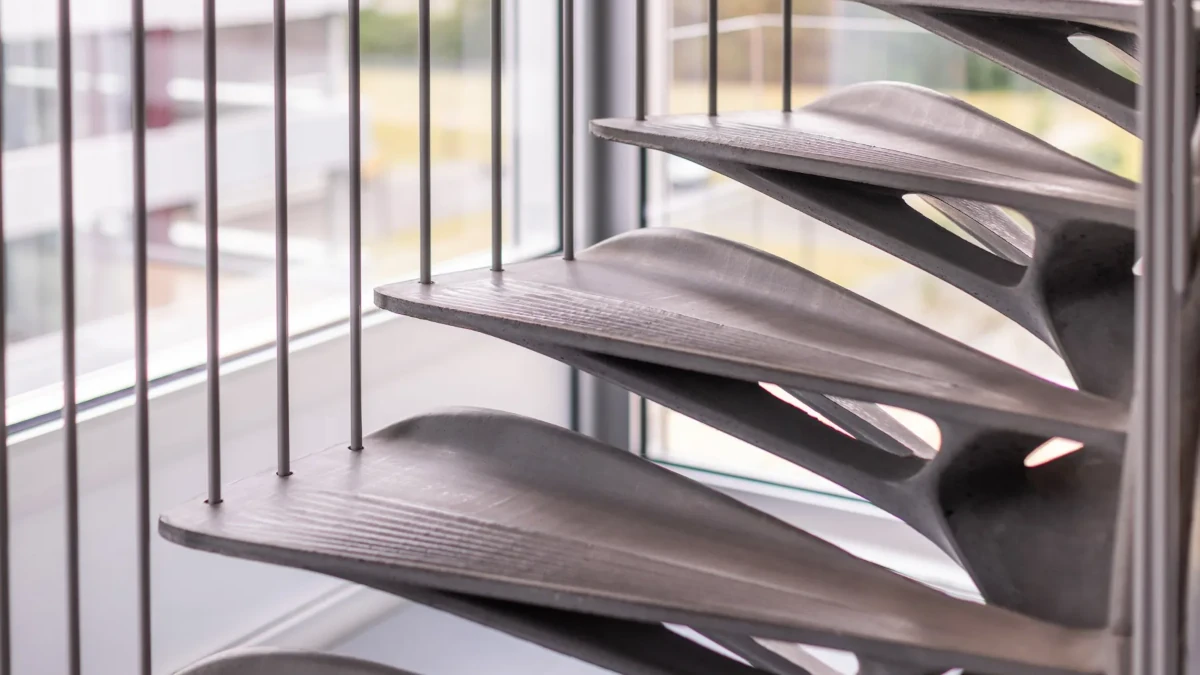
ETH Zurich, in collaboration with architects ROK, has presented an innovative staircase called Cadenza, designed to be both reusable and environmentally friendly. This staircase is installed in the NEST building in Switzerland and has been designed with the aim of reducing material waste, allowing its reuse in future construction projects.
An innovative approach to tread construction
The most surprising aspect of the Cadenza staircase is the manufacturing of its treads, which are not produced using single-use molds. Instead, a 3D-printed mold made with carbon fiber-reinforced plastic is used. This mold allows the creation of multiple treads without the need to produce new molds, significantly reducing waste and the costs associated with traditional manufacturing.
Weight reduction and increased strength
In addition to being more eco-friendly, the treads of the Cadenza staircase are 60% lighter than traditional concrete treads, as they are made with ultra-high-strength concrete that incorporates steel fiber. This not only improves the strength of the staircase but also facilitates its installation, reducing the need for heavy machinery.
Efficient and fast construction thanks to digital tools
The Cadenza staircase project is not only innovative in terms of materials but also in its manufacturing process. It uses advanced digital tools to ensure that each piece fits precisely. The staircase is assembled off-site, allowing for quick and easy installation without the need for heavy equipment, ideal for projects with limited space or renovations.
Circular design and heat-activated post-tensioning system
Another noteworthy aspect of the Cadenza staircase is its circularity-oriented design. The treads are assembled using a dry connection system, which facilitates disassembly and reuse of the pieces in future projects. Additionally, it features a heat-activated post-tensioning system that keeps the treads firmly in place without the need for fixed elements, thus favoring their reuse without generating waste.
"The Cadenza staircase demonstrates how 3D printing technology and digital tools can transform construction, making it more efficient, sustainable, and flexible."
This project highlights how 3D printing technology and digital tools are revolutionizing construction, providing more sustainable and flexible solutions. With the Cadenza staircase, a significant step is taken toward the construction of the future, where sustainability and efficiency are key.