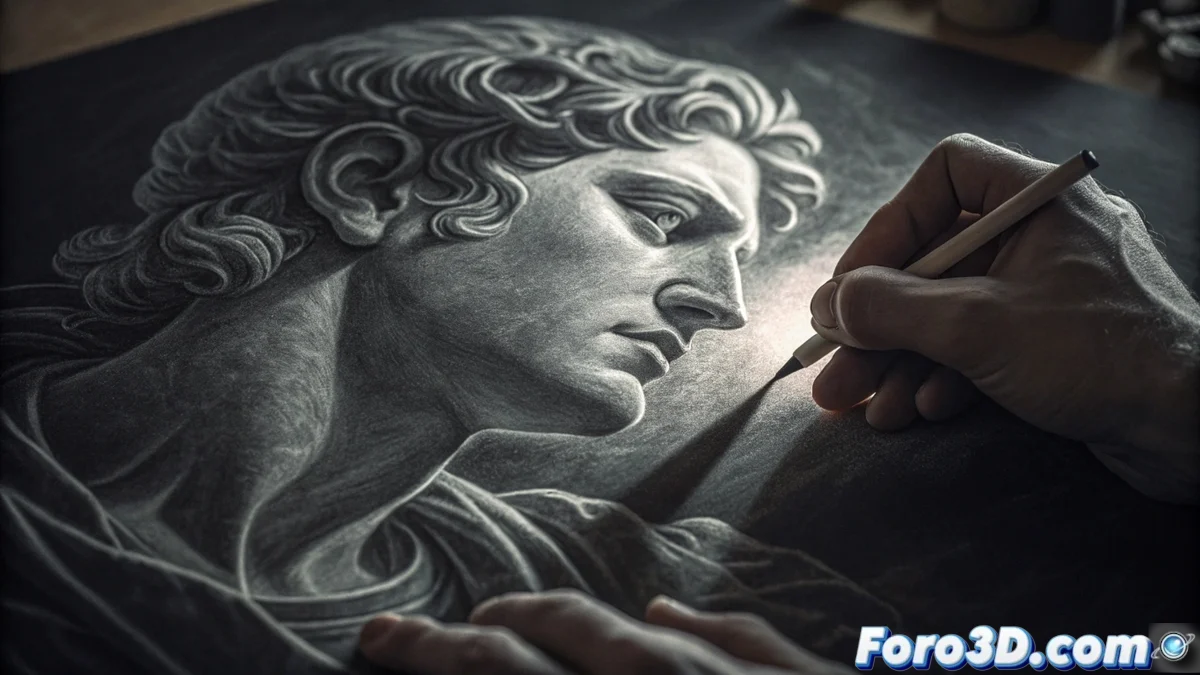
Subtractive Drawing: Sculpting Light on a Dark Background
Imagine an approach where the canvas is not an empty space, but a mass of darkness ready to be carved. The subtractive drawing technique turns the conventional method upside down. Instead of facing the dreaded white, your starting point is a surface uniformly covered with graphite, charcoal, or black chalk. This dark mantle represents the deepest shadows, and from it, the image literally emerges into the light. 🎨
Tools for Extracting and Defining
In this paradigm, the eraser leaves its secondary role to become the main instrument. The artist must handle an arsenal of erasers with different properties. The kneaded eraser or bread crumb eraser is perfect for lifting large areas of pigment and creating broad lights and atmospheric transitions. For crisp details, specular highlights, and sharp edges, plastic or pencil erasers with pointed tips are indispensable. Control over the medium extends even to the use of cloths, dry brushes, or fingers to blend and refine the extraction, sculpting the light with precision.
Essential Kit for Subtraction:- Kneaded eraser: For manipulating large masses and creating soft gradients.
- Precision plastic eraser: Ideal for fine lines, small details, and exact corrections.
- Blending tools: Dry brushes, tortillons, or fingers to control the edges of the extracted light.
Subtractive drawing is the artistic equivalent of sculpting marble: only material is removed, not added. Every movement with the eraser must be deliberate.
A Radical Shift in Perception
This methodology trains the brain to think in reverse. The focus is no longer on the outline of objects, but on how light interacts with surfaces, "stealing" space from the pre-existing shadow. You concentrate on identifying and extracting the areas of greatest clarity, reflections, and mid-tones, modeling volume through the absence of darkness. It is a formidable exercise for sharpening observation, forcing you to analyze any reference by prioritizing the organization of lights within the composition.
Key Benefits of This Approach:- Inherent Tonal Unity: Starting from a unified dark background, the drawing achieves a coherent atmosphere rich in nuances.
- Observation Training: Develops the ability to see and analyze light values above lines.
- Atmospheric Results: Encourages the creation of works with a very particular sense of depth and ambiance.
Patience as the Main Virtue
Mastering this technique requires a high degree of control and patience. Unlike additive drawing, where an error is covered with more graphite, here excessive or aggressive erasing can damage the paper's texture, leaving a shiny and irreversible mark. Recovering a lost shadow is a greater challenge. Therefore, every gesture with the eraser must be conscious and deliberate, progressing from general to specific, revealing the image step by step from the darkness. It is a path that rewards with a deep understanding of light, form, and tonal value. ✨