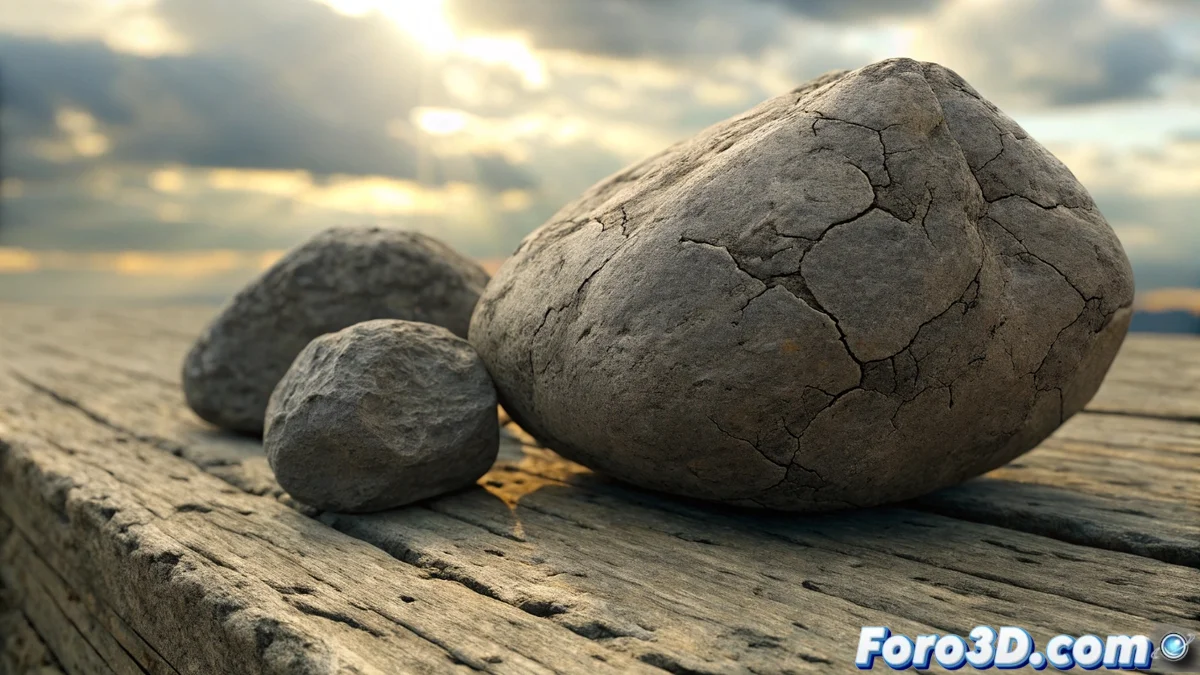
Study of Ambient Occlusion and Contact Shadows
In the world of digital lighting, there is a subtle yet profoundly transformative effect that acts as the visual glue between objects: ambient occlusion (AO). This exercise focuses on its most tangible manifestation, contact shadows, those small dark areas that appear where surfaces meet or come close. Mastering them is essential to infuse weight, cohesion, and three-dimensional realism into any creation, as they prevent the appearance of floating objects and integrate them into their environment. 🎨
The Science of Trapped Light
The foundation of this effect lies in the behavior of indirect ambient light. In a space, photons bounce off all surfaces, illuminating even shadowed areas. However, in narrow corners, deep cracks, or contact points between objects, possible light paths are severely limited. Fewer photons can access these areas, resulting in natural darkening. Ambient occlusion is not a shadow cast by a specific light source, but a probabilistic calculation of how much a surface point is "blocked" from access to the global environmental lighting. It is, essentially, shading based purely on geometry and proximity.
Key characteristics of contact shadows:- Precise location: They appear exclusively in contact zones or high proximity between surfaces.
- High definition: They are dark shadows with relatively sharp edges, unlike the soft shadows of general AO.
- Visual anchoring: Their main function is to visually connect objects to each other and to the ground, eliminating the floating sensation.
Ambient occlusion calculates the probability that a point on the surface is occluded from ambient light. It is not a shadow; it is a lack of light.
Integration into the 3D Graphics Pipeline
In 3D production, AO is typically implemented as an independent render pass. This pass generates a grayscale map where white represents full light access and black represents total occlusion. Techniques for generating it vary, from the costly but accurate ray tracing and precalculated maps, to real-time efficient methods like SSAO (Screen Space Ambient Occlusion). The art of its application lies in the meticulous control of two parameters: intensity and sampling radius. Excess produces a dirty and flat image, while a very subtle application detracts credibility and solidity from the scene. 🔧
Common calculation methods:- Ray Tracing/Path Tracing: Offers the highest physical accuracy by tracing the visibility of the hemisphere around each point.
- Oclusion Maps (Bake): Precalculated and stored in textures, ideal for static assets in video games.
- SSAO: A screen-space approximation that analyzes the depth buffer to estimate occlusion, widely used in real-time.
The Finishing Touch Between Art and Technology
Achieving convincing realism requires understanding that ambient occlusion and its contact shadows are the final step to seal the integrity of a scene. It is a low visual cost effect but with high perceptual impact. While a renderer can calculate this phenomenon globally in fractions of a second, there is undeniable formative value in attempting to paint these subtleties by hand, thus understanding the logic of trapped light. In the end, whether through algorithms or digital brush, mastering this concept is what separates a technically correct image from one that truly breathes and has presence. 💡