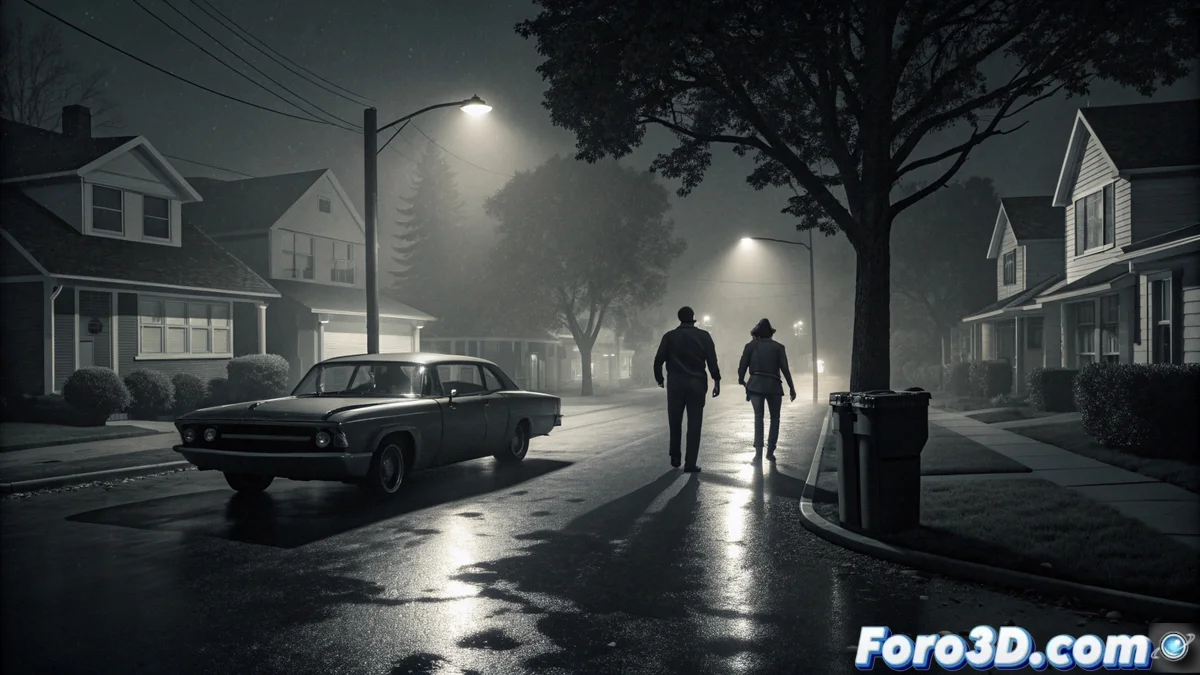
Stray Bullets: a black and white crime comic
David Lapham builds a graphic narrative that dives into the underbelly of the United States during the 1970s and 1980s. It does not glorify the criminal world, but exposes its internal mechanisms with documentary coldness. Teenagers, thugs, and losers see their paths intertwine in brutal and random ways, where every choice carries a devastating weight. 🎯
A line that reveals the rawness
The visual style that Lapham employs is another character in the story. He opts for an extreme contrast black and white, without soft shading or decorative details. This rough and direct line communicates the harshness of the environment and makes the violence, when it erupts, hit with redoubled force. The tension is maintained in every panel, conveying the feeling that calm is only a fragile prelude.
Keys to the graphic art:- Illustration in high contrast that eliminates any superfluous aesthetic element.
- A deliberately dirty line that reinforces the realism and roughness of the situations.
- The page composition generates a constant narrative tension, almost palpable.
Immersing yourself in this world is like snooping in a roadside bar at midnight: you know nothing good can happen, but you can't look away.
Weaving a web of broken destinies
The strength of Stray Bullets lies in its coral structure. Lapham does not follow a hero, but intertwines the lives of a multitude of characters. The same event is shown from different angles, revealing how a single action triggers waves of consequences in a network of people. The protagonists are complex individuals, whose motivations sometimes collide and others converge by pure chance of fate.
Elements of the coral narrative:- The plot advances by showing the hidden connections between lives that seem separate.
- It explores how an event, like a stray bullet, works as a turning point for many.
- It presents characters that avoid archetypes, showing layers of motivation and weakness.
The irreversible weight of decisions
This work functions as an unrelenting portrait of street-level criminality. Lapham does not sugarcoat reality; on the contrary, he details the tragic consequences of living outside the law. It shows how lives are altered forever and how violence, once unleashed, is rarely contained. It is a reading that does not seek to entertain lightly, but to make one perceive the human cost of a world ruled by force and chance. 💥