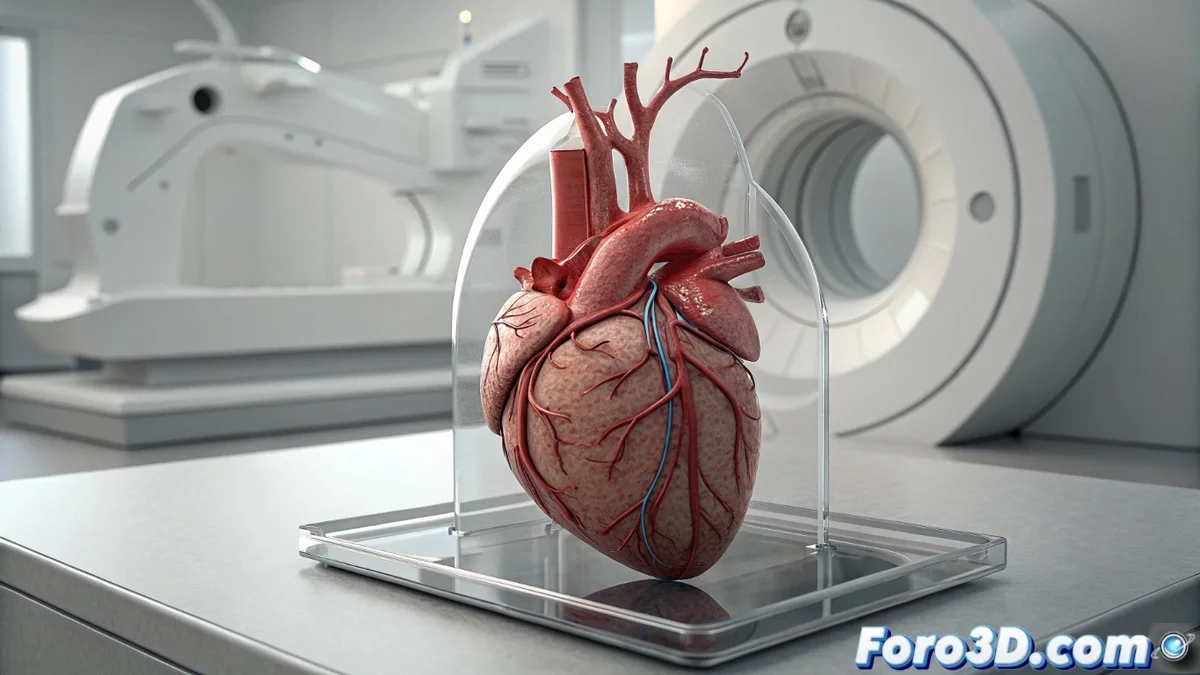
Stratasys Markets Its Radiopaque Material RadioMatrix in the United States
The manufacturer Stratasys announces the commercial availability in the United States of its RadioMatrix material. After a testing phase, hospitals, device developers, and research centers can now use this material on a general basis. Its purpose is to provide contrast in advanced medical images and to train professionals. 🏥
Clarity in Anatomical Models for Diagnosis
The key property of RadioMatrix is its radiopaque nature. This makes it block X-rays in a manner similar to human tissues or traditional contrast agents. As a result, 3D printed models are visualized with great detail in CT scanners or fluoroscopy equipment. Users can produce faithful replicas of organs or vascular systems for various medical purposes.
Main applications of the material:- Plan complex surgical interventions in advance.
- Test and validate new medical devices before clinical use.
- Simulate procedures to train surgeons and healthcare staff.
"Now surgeons can plan with a model that not only feels real to the touch, but also looks real under scanners," highlights Stratasys' strategy.
Integration into Clinical and Development Environments
Stratasys presents this launch as an advance to fully incorporate 3D printing into hospital and R&D workflows. By offering a material with predictable behavior under imaging equipment, dependence on traditional phantoms or preliminary tests with other resources is reduced.
Technical features and compatibility:- The material is compatible with Stratasys 3D printers using PolyJet technology.
- It works with specific series such as the J5 and the J700.
- Its radiopaque property is uniform and consistent in prints.
Impact on Medical Practice
This development allows medical teams to work with models that accurately replicate both the shape and the X-ray response of real anatomy. This not only helps with planning but can also shorten operating room times and improve patient outcomes. The goal is for tools like RadioMatrix to become a standard for preparing high-precision interventions. 🩺