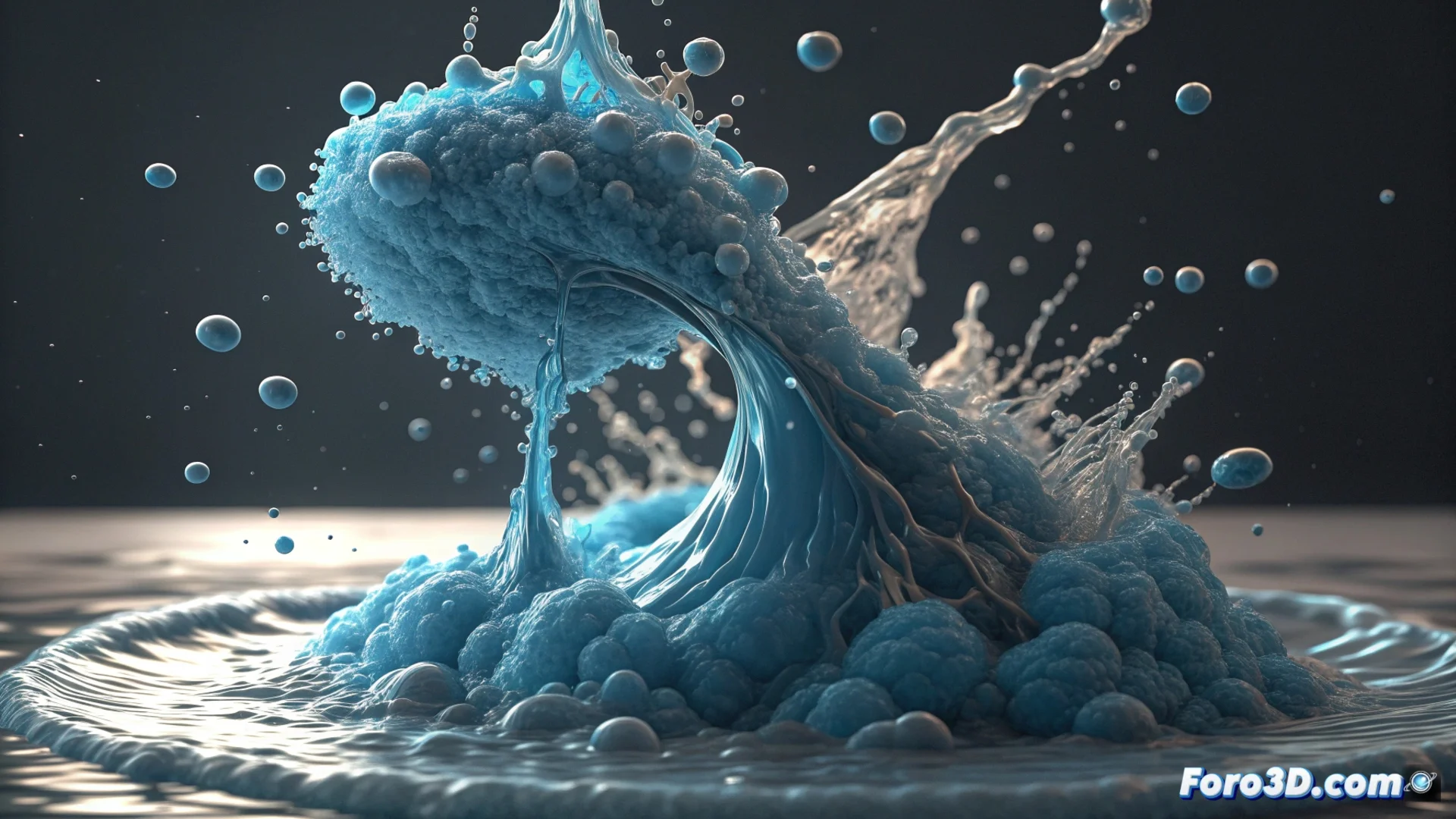
Storm HydroFX: Simulate 3D Fluids with SPH Particles for VFX
In the field of visual effects for film and television, simulating liquid behavior with realism is a key technical and artistic challenge. Storm HydroFX positions itself as a specialized solution that employs the Smoothed Particle Hydrodynamics (SPH) method to calculate and visualize complex fluid dynamics directly within popular 3D environments. 🎬
The SPH Engine: The Physics Behind the Simulation
The foundation of this system lies in modeling a fluid not as a continuous mass, but as a collection of discrete particles. Each of these particles interacts with its neighbors by applying predefined physical rules that reproduce fundamental properties such as viscosity, surface tension, and incompressibility. This approach allows processing millions of interactions to generate smooth and natural movement, where artists can adjust parameters like density or velocity to direct the final result.
Key Features of Particle Simulation:- Precise Physical Modeling: Calculates interactions between particles to recreate liquid behaviors like water realistically.
- Parameter Control: Allows adjusting density, velocity, and viscosity to guide the desired visual effect.
- Scalability: Capable of handling everything from small splashes to large bodies of water, though it requires significant computational power.
Simulating an entire ocean can demand a lot from your workstation, but the dynamic realism achieved on screen is usually worth the computational effort.
Integration and Workflow in Production
Storm HydroFX does not operate in isolation; it is implemented as a plug-in or plugin within standard industry 3D applications like Autodesk Maya or SideFX Houdini. This native integration is crucial for an efficient workflow, allowing artists to emit particles, define collidable obstacles, and guide the simulation using the tools and workspace they already know.
Main Stages in the VFX Pipeline:- Setup and Emission: Particle sources and objects that will act as barriers in the 3D scene are defined.
- Simulation Calculation: The SPH core processes interactions between particles to generate fluid movement.
- Mesh Conversion: A subsequent step transforms the particle cloud into a polygonal surface mesh ready for rendering.
- Final Rendering: Materials, lighting, and shading effects are applied to obtain the final appearance of water or other liquid with a high level of detail.
Application in Professional Visual Effects
The main objective of Storm HydroFX is to serve film and television productions where a balance between physical precision and artistic control is required. Visual effects artists use it to create sequences involving breaking waves, explosive splashes, or viscous flows, integrating these fluid elements convincingly with real or animated action. The ability to preview and adjust the simulation in context accelerates creative iteration and ensures the final result meets the production's demands for dynamic realism. 💧