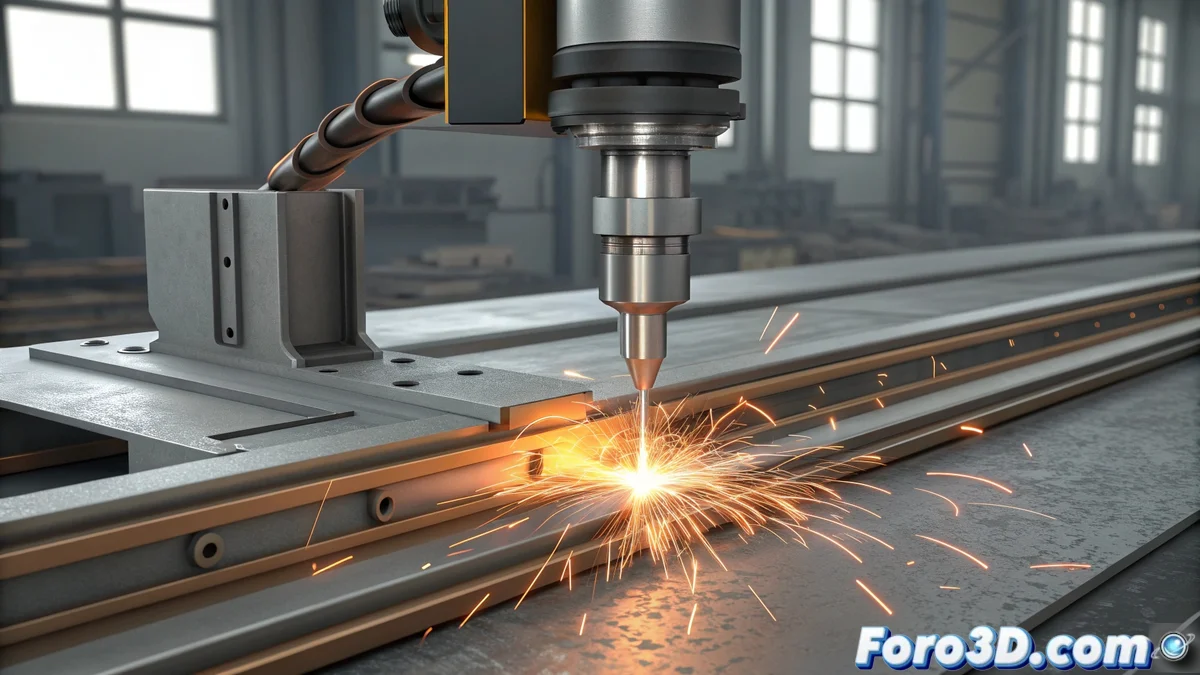
Friction Stir Welding Joins Metals Without Melting Them
This revolutionary method allows joining metals that were traditionally difficult to weld, such as aluminum with steel, without the need to melt the base materials. Instead, a specialized tool generates heat through friction to create a solid and high-quality joint. 🛠️
How Does This Process Work?
The core of the process is a rotating cylindrical tool that has a shoulder and a specifically designed pin. This tool rotates at high speed and is pressed between the two pieces to be joined. The friction and pressure generate heat, which locally plasticizes the metal. Then, the tool's pin stirs this plasticized material, intimately mixing the two components to form a monolithic joint, all while the metals remain in a solid state.
Key Characteristics of the Joint:- A welded zone is formed, known as the nugget, with a refined microstructure.
- The mechanical strength of the joint often exceeds that of the weaker base metal.
- It eliminates common defects such as porosity, solidification cracks, or excessive thermal distortions.
Friction stir welding redefines how to join materials, completely dispensing with the melting point to create stronger and more reliable bonds.
Advantages and Industrial Applications
The main advantage of this technique is that it produces high-integrity joints in heat-sensitive materials. This makes it indispensable in industries where weight and strength are critical factors.
Sectors Leveraging This Technology:- Aerospace: For manufacturing complex structures from aluminum alloys in fuselages and aircraft components.
- Automotive: Essential in the production of chassis and structures for electric vehicles, where efficiency and weight reduction are sought.
- Rail Transport: Used in the construction of wagons and lightweight structural components.
The Future of Joining Dissimilar Materials
Current research explores boundaries beyond lightweight alloys. Scientists are working to join combinations of dissimilar materials, such as copper with aluminum. This advancement could transform component design in sectors like power electronics and renewable energy systems, enabling new solutions where joining was previously a challenge. Essentially, this technology demonstrates that it is possible to create solid bonds without the inherent problems of melting the materials, a principle that many would wish to apply beyond the workshop. 🔗