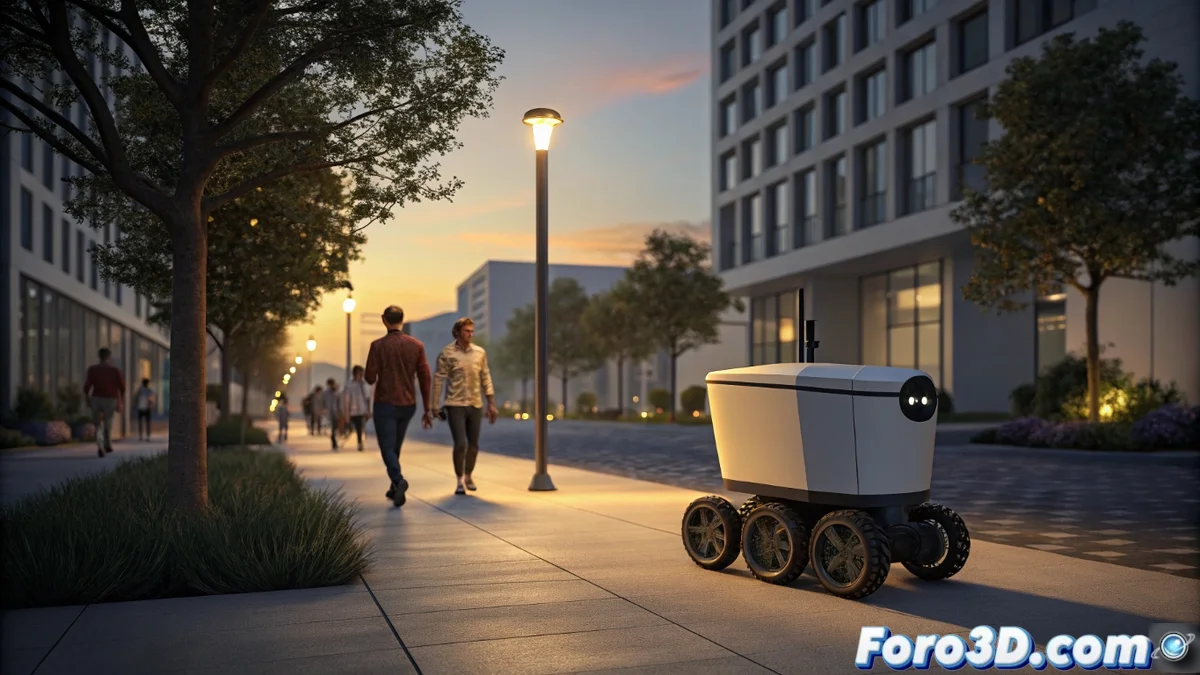
Starship and its Autonomous Robots for Last-Mile Delivery
In the landscape of urban logistics, Starship's autonomous delivery robots have gone from being a concept to an operational reality in multiple cities and university campuses. These devices, with their characteristic six-wheeled chassis, are specifically designed to solve the challenge of last-mile delivery, transporting food, packages, or grocery shopping directly to the final recipient. 🛵
The Step-by-Step Operation of an Autonomous Delivery
Everything begins when a user places an order through a mobile app. The robot, completely independently, heads to the store to pick up the order. From there, it calculates the most efficient route to the destination address, always traveling on sidewalks and pedestrian spaces. Its system relies on machine learning and constant mapping of the environment, allowing it to adapt its path in real time.
Key Capabilities During the Journey:- Obstacle Avoidance: If it encounters an unforeseen impediment, such as urban furniture or construction, the robot safely goes around it or patiently waits for the path to clear.
- Real-Time Tracking: The user can monitor the exact location of the delivery robot via GPS integrated into the app.
- Secure Delivery: Upon arrival at the destination, the user unlocks the robot's thermal compartment using their smartphone to retrieve the order, ensuring its security and integrity.
Its compact design and reduced speed aim to integrate them safely into public pedestrian spaces, prioritizing coexistence.
The Technological Architecture Guiding Every Decision
Autonomous navigation is possible thanks to data fusion from a suite of sensors. This information is continuously processed by an artificial intelligence system that makes all movement decisions without human intervention.
Sensors and Their Main Function:- 360° Cameras: Provide a complete peripheral view to identify traffic lights, signs, pedestrians, and the sidewalk layout.
- Ultrasonic Sensors: Measure very short distances to detect and avoid collisions with curbs, steps, or low objects.
- Inertial Measurement Units (IMU): Composed of gyroscopes and accelerometers, they are crucial for maintaining the robot's stability and orientation at all times.
- GPS Receivers: Help globally position the robot and plan the macro route to its destination.
Perception, Decision-Making, and Social Integration
The AI synthesizes all sensor data to create a dynamic 3D model of the immediate environment. Based on this model, the system decides the next action: advance, turn, slow down, or stop. This perceive, plan, and act operation is repeated hundreds of times per second throughout the journey. Their silent presence and appearance often lead people to treat them with curiosity, like urban pets, although their "brain" only processes data and algorithms, not emotions. Their true goal is to optimize logistics by being a more efficient and discreet link in the delivery chain. 🤖