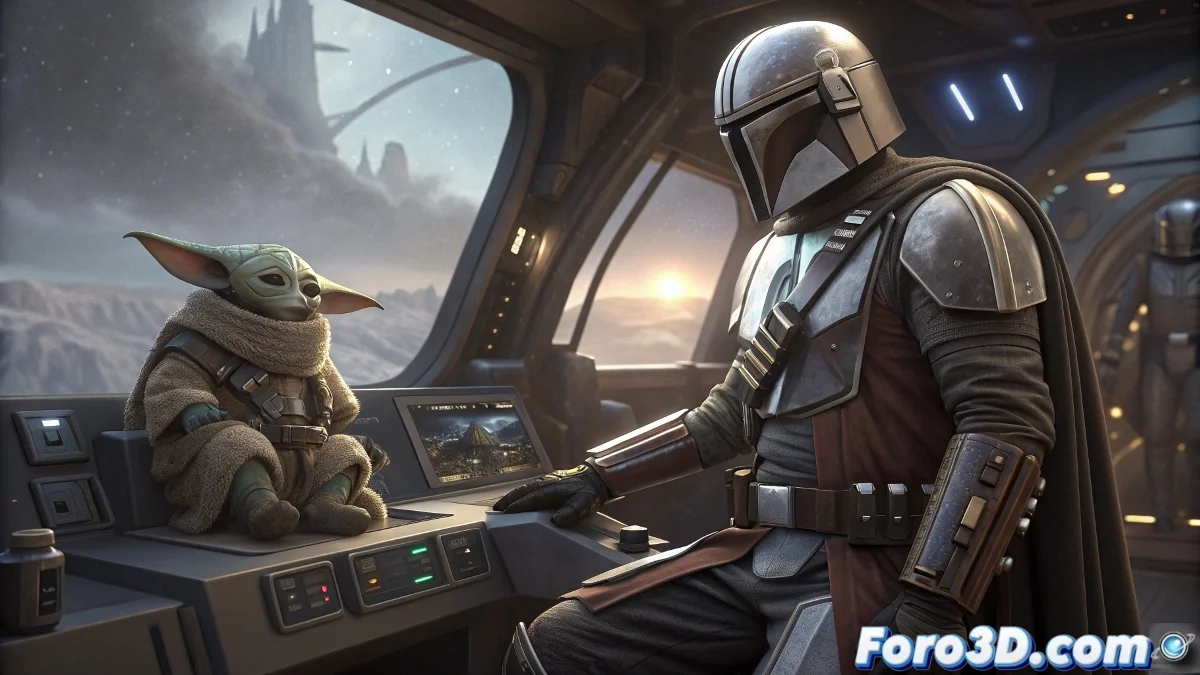
Star Wars: The 3D and VFX Technology Behind the Return to the Big Screen with The Mandalorian and Grogu
The return of Star Wars to the big screen with The Mandalorian and Grogu represents much more than a new adventure in a galaxy far, far away. It is a technological demonstration of how advances in visual effects and 3D modeling have revolutionized the creation of imaginary worlds, allowing digital characters and impossible environments to reach a level of realism never seen before. 🚀
The Digital Arsenal Behind the Magic
Behind every epic scene exists a specialized software army that makes the impossible possible. Programs like Maya, Blender, ZBrush, Houdini, and Substance Painter have become invisible protagonists of the production, allowing artists to build from scratch every creature, ship, and planet in virtual spaces where everything is editable and testable. 💻
Key Software in Production:- Maya and Blender for character animation and rigging
- ZBrush for high-resolution organic modeling
- Houdini for complex visual effects simulations
Every creature, ship, and planet is first built in a virtual space where everything is editable and testable
The VFX Artists' Workflow
The creative process follows a meticulous workflow that combines multiple digital disciplines. Artists begin by modeling characters in ZBrush, then texturize them in Substance Painter and Mari, to finally animate them in Maya or Blender. The attention to detail is such that every movement must appear natural and consistent with the physical laws established in the saga. 🎨
Production Pipeline Stages:- Digital modeling and sculpting of characters and props
- Texturing and creation of realistic materials
- Animation, rigging, and physics simulation
Advanced Visual Integration Techniques
To achieve the perfect integration between the real and the digital, modern productions use innovative techniques such as virtual cameras and motion capture. Complex special effects like explosions, laser flashes, or moving ships are created in Houdini and After Effects, integrating particle and fluid simulations that are then composited in Nuke or Fusion for the final result. ✨
Visual Integration Technologies:- StageCraft and LED screens for immersive backgrounds
- Motion capture for facial and body animations
- Dynamic simulations for destructive and natural effects
The Human Side Behind Digital Perfection
Although on screen everything may seem perfect and calculated to the millimeter, the reality of the creative process includes constant errors and adjustments. Artists frequently deal with particles that refuse to behave, textures that don't render correctly, and animations that require dozens of iterations. This daily creative struggle reminds us that even in a galaxy far, far away, the software has its own sense of humor. 😄