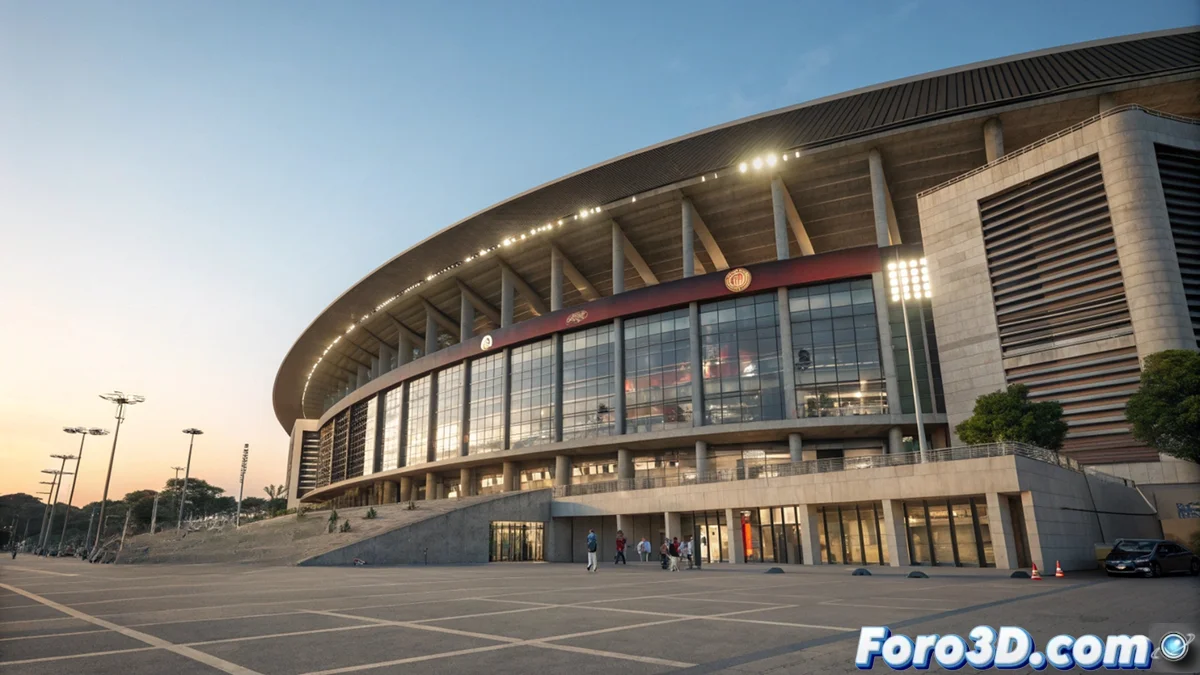
Official Renders as a Window to the Future
The architectural transformation of Spotify Camp Nou represents much more than a simple structural renovation. 🏟️ It is an extraordinary challenge in the field of three-dimensional modeling and architectural visualization where each official render serves as a window to the future stadium. These hyperrealistic images, developed by specialized studios, condense months of meticulous work in precise structural modeling, advanced texturing, and simulation of architectural materials. Far from being mere promotional illustrations, they constitute crucial technical tools that allow visualizing the complete fan experience in what will be Europe's largest stadium after its complete remodeling.
Modeling and Texturing Challenges
The digital recreation of a mega-structure like Camp Nou requires addressing technical challenges of exceptional complexity. The monumental scale of the project demands a workflow that combines millimeter architectural precision with convincing visual realism. Every element, from the nearly one hundred thousand individual seats to the complex roof structure, must be modeled with sufficient polygonal density to support close-ups while maintaining computational efficiency. Advanced texturing with PBR techniques allows simulating the physical behavior of materials like translucent glass, stainless steel, and architectural concrete, capturing how they interact with light under different atmospheric conditions and times of day.
These images represent months of work in structural modeling, hyperrealistic texturing, and material simulation
Visual and Emotional Impact
Beyond their technical value, the renders fulfill a fundamental communicative and emotional function in the project. They allow fans, club partners, and sponsors to virtually experience the atmosphere of the new stadium before its physical completion. The extreme realism in the finishes generates not only expectation but also confidence in the project's viability and quality. The ability to visualize specific scenarios—from a classic match under nighttime rain to a concert with special lighting—provides an intuitive understanding of the remodeled space's potential that traditional technical plans cannot effectively communicate.
The Paradox of Detail versus Practical Utility
There is a fascinating irony in the contrast between the technical effort dedicated to the renders and the immediate priorities of the stadium's future users. While 3D artists invest months perfecting PBR material simulations, specular reflections, and ambient shadows, most fans upon entering the stadium will instinctively seek basic services like restrooms and food stalls. This disconnect between the technical virtuosity of visualization and the pragmatic needs of the end user illustrates how the perceived value of specialized work can vary dramatically depending on the observer's perspective.
Project Setup and Structural Modeling
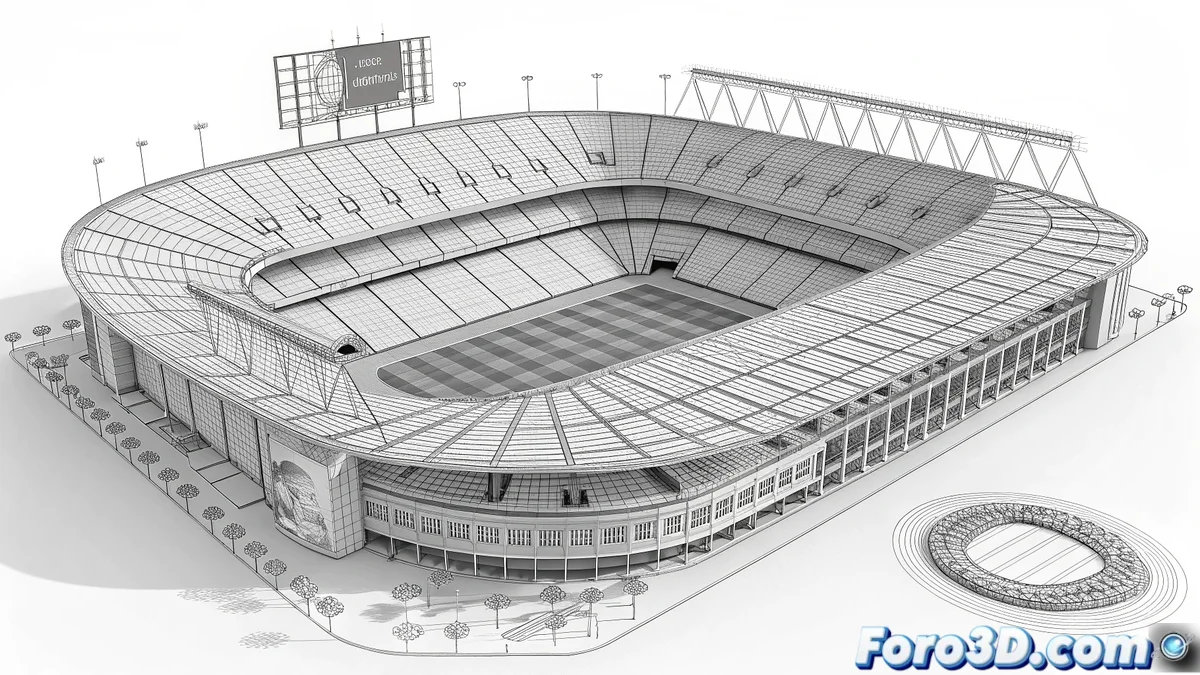
The faithful recreation of Camp Nou requires meticulous planning from the initial phase. Project organization determines workflow efficiency and final result quality.
- Architectural Scale: Establish real units and coordinate system that preserves the stadium's monumental proportions
- Modular Modeling: Develop reusable structural components like stand sections and facade elements
- Mesh Optimization: Balance polygonal density for visual details with manageable computational performance
- Layer System: Organize different stadium elements into logical collections for selective manipulation
Texturing Techniques and PBR Materials
Convincing visual appearance depends on advanced material treatment that communicates both realism and architectural intent.
- PBR Workflow: Implementation of physically based shaders for common architectural materials
- Tileable Textures: Development of high-resolution repetitive patterns for extensive surfaces like stands and floors
- Custom Maps: Creation of normal, roughness, and displacement maps specific to Camp Nou materials
- Shader Mixing: Strategic combination of different shaders for complex materials like structural glass
Lighting and Atmosphere
Lighting setup is the element that unifies all visual components and establishes the emotional tone of each render.
- HDRI Global Illumination: Use of high-resolution environment maps for credible natural lighting
- Artificial Light Systems: Simulation of stadium LED spotlights with realistic color temperature and intensity
- Specialized Render Engines: Leveraging Cycles capabilities for realism and Eevee for rapid iteration
- Atmospheric Effects: Implementation of volumetrics to simulate weather conditions and light pollution
Environment and Context Elements
Integrating the stadium within its urban environment is crucial for the overall visualization credibility.
- Terrain Geometry: Modeling of specific topographic features of the Les Corts neighborhood
- Urban Environment: Creation of contextual buildings that establish scale and city relationship
- Procedural Vegetation: Implementation of particle systems for trees and natural environmental elements
- Animated Elements: Incorporation of vehicles, pedestrians, and flags to add life and movement
While architects debate angles and materials, 3D artists demonstrate that sometimes the best way to build a stadium is through perfectly rendered pixels. ⚽ Because, let's be honest, what would be more ironic than a digital model that looks more real than the physical construction?