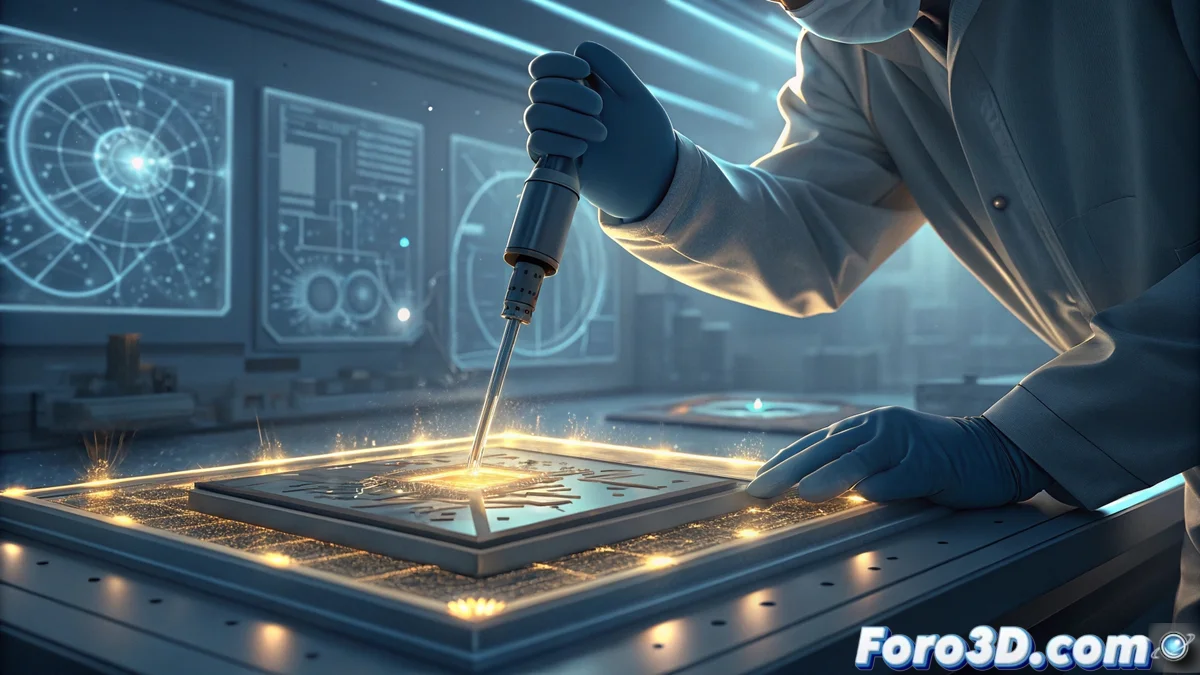
Spintronics Explores a New Logic for Processing Data
Spintronics, also known as spin electronics, represents a paradigm shift. It does not limit itself to using the electron's electric charge, but also harnesses its spin, an intrinsic quantum property that behaves like a tiny magnet. This dual approach allows for the design of components radically different from conventional transistors, aiming to merge processing and storage functions into a single fundamental unit. This could completely redefine how computers are built. 🔬
Key Advantages of Spintronic Devices
By using spin orientation to encode and manipulate information, these systems theoretically achieve superior performance. They consume much less energy and dissipate less heat compared to traditional charge electronics. Additionally, they can switch states at extraordinary speeds and be fabricated at atomic scales. This enables more compact and powerful circuits, where memory resides alongside the processing core, eliminating a critical bottleneck in current architectures.
Main Benefits:- Low Energy Consumption: Manipulating spins requires less power than moving electric charges.
- Ultrafast Operation: Spin states can switch at very high frequencies.
- Dense Integration: Allows fabrication of structures at nanometric and atomic scales.
The future of computing doesn't just want to think faster, but also with better magnetic orientation.
The Fundamental Role of Materials
Research focuses on exploring and designing materials with specific magnetic properties. Ferromagnetic alloys and topological insulators are in the spotlight. Scientists work with thin-layer structures where spin orientation can be precisely controlled and detected. A central device in this field is the spin valve, whose electrical resistance varies depending on how spins align in its magnetic layers, thus allowing the stored information to be read. 🧲
Essential Concepts and Materials:- Spin Valve: Basic device that acts as a sensor or switch based on spin alignment.
- Ferromagnetic Alloys: Materials where spins align spontaneously, crucial for data storage.
- Topological Insulators: Materials that conduct electrons on their surface, protecting their spin state, ideal for transmitting information without losses.
Towards a New Era of Computing
Spintronics is not just an evolution, but a potential revolution in hardware. By integrating logic and memory, it paves the way for more efficient and compact computing architectures. The challenge lies in mastering the fabrication and control of these quantum phenomena at an industrial scale. If overcome, we could witness a profound transformation in how we process information, from data centers to personal devices, marking the beginning of a post-silicon era. ⚡