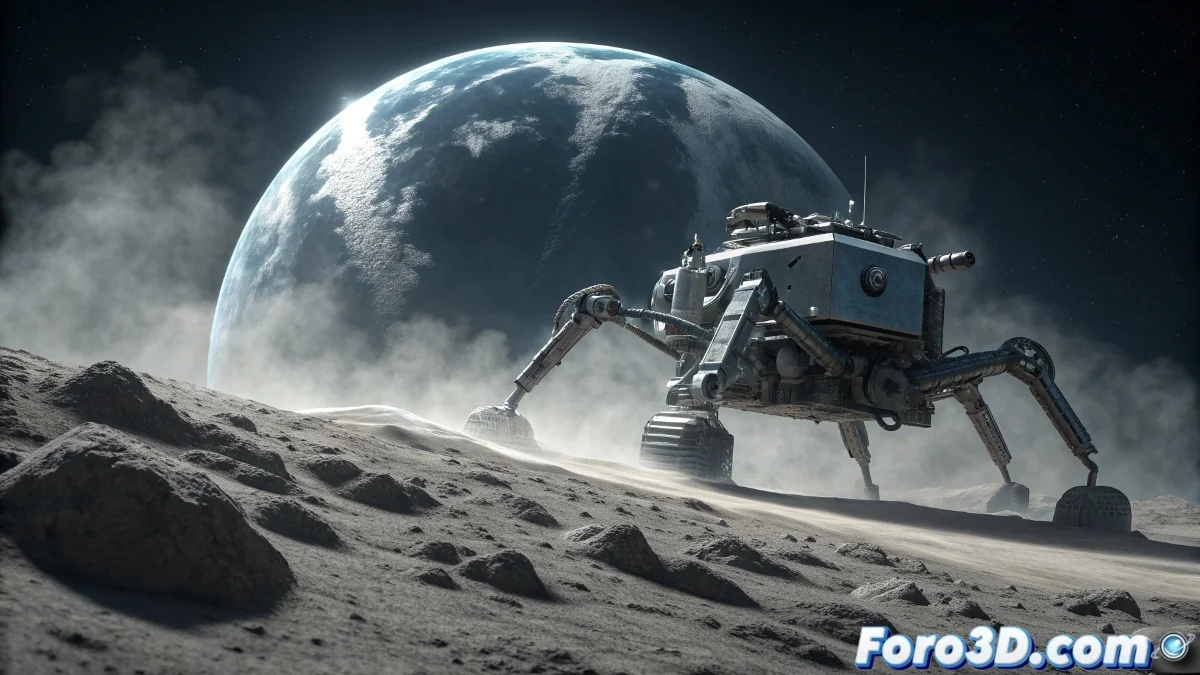
When Nature Inspires Space Construction
The fusion of biomimicry and additive manufacturing has given rise to a robotic development that promises to revolutionize construction in extreme environments. Inspired by the anatomy and mobility of spiders, this construction robot uses 3D printing to build structures both on Earth and in the future lunar colonization. What began as an engineering exercise inspired by nature could become the key to autonomously building extraterrestrial habitats.
The robot, which moves with characteristic arachnid elegance, is equipped with a three-dimensional printing system that allows it to deposit construction materials while traversing uneven terrain. This mobility represents a significant advantage over conventional 3D printers, which are limited to fixed work areas. The system can adapt its construction strategy according to terrain conditions, printing support structures where the ground is unstable.
Innovative Technical Features
- Multidirectional mobility inspired by arachnid locomotion
- Printing system adaptable to different materials and gravities
- Energy autonomy through deployable solar panels
- Autonomous navigation to select optimal construction sites
Dual Application: Terrestrial and Extraterrestrial
The robot's design has contemplated from the outset a dual functionality that few automated construction projects have addressed. On Earth, it can work in disaster zones or places difficult for humans to access, building emergency shelters or basic infrastructure. On the Moon, its ability to operate in reduced gravity and with local materials makes it the ideal candidate for preparing habitats prior to astronauts' arrival.
Nature solved millions of years ago problems that engineering is only now beginning to understand
The printing system has been specially designed to work with lunar regolith, that dust covering the surface of our satellite. Through a laser sintering process, the robot can transform local material into solid structures without the need to transport large quantities of cement or other earthly materials. This ability to use in-situ resources is crucial for the economic viability of prolonged space missions.
Advantages Over Traditional Construction Systems
- Topographic adaptability that overcomes terrain limitations
- Modular scalability through cooperative robot swarms
- Environmental resistance to extreme temperature and radiation conditions
- Structural versatility for creating complex and organic geometries
Current prototypes demonstrate a surprising ability to work collaboratively when deployed in groups. Like insect colonies, these spider robots can coordinate to build structures that would be impossible individually. Communication between units allows dividing complex tasks and collectively verifying the structural integrity of what is built.
Those who thought spiders only weave webs probably never imagined they would inspire the construction of the first lunar habitats 🕷️