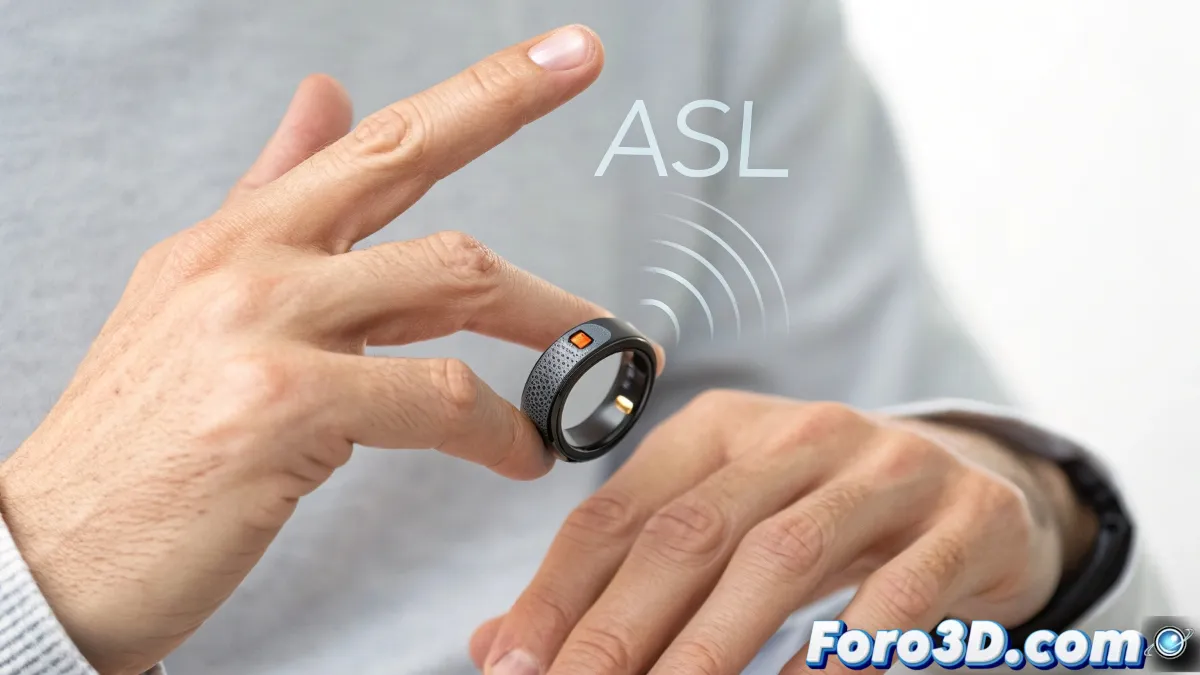
Researchers from Cornell University have created a smart ring called SpellRing, which uses artificial intelligence to instantly interpret spelling in American Sign Language (ASL). This innovative device employs microsonar inside a 3D-printed ring, about the size of a coin. Its compact design and advanced features position it as a valuable tool for improving communication.
A compact and effective technology
The SpellRing features a microphone, a speaker, and a miniature gyroscope that work together to record hand and finger movements. This data is processed through a deep learning algorithm, enabling the translation of spelling into text. In tests conducted, the device achieved an accuracy rate of between 82% and 92% when interpreting over 20,000 words of varying lengths.
A device designed for the deaf community
Hyunchul Lim, lead author of the study and PhD student in information science, highlighted that many previous technologies have not been adopted by the deaf community due to their size and lack of functionality. The SpellRing is discreet and easy to use, making it a promising tool for facilitating communication. This advancement will be presented at an international conference on human-computer interaction in Japan.
Challenges and technological improvements
One of the main challenges of the project was training the artificial intelligence system to recognize the 26 hand shapes corresponding to the letters of the alphabet. Since ASL users modify the shapes for greater fluency, this added complexity to the process. Currently, the device allows entering text into electronic devices through spelling, ideal for proper names and technical terms in ASL.
A comprehensive approach for the future
Although spelling is an important part of ASL, it does not represent the full language. Jane Lu, co-author of the study, noted that spelling only covers a fraction of ASL and does not encompass its entirety. To improve language interpretation, the team plans to integrate the microsonar system into glasses to capture body movements and facial expressions, which will significantly expand the device's capabilities.
Collaboration and institutional support
This project was developed in Cornell University's Intelligent Computing Interfaces Lab for Future Interactions, with financial support from the National Science Foundation. The researchers worked hand-in-hand with ASL users, both experts and beginners, to ensure the device was functional and practical for the deaf community. This collaborative approach ensures that the technology meets the real needs of users.