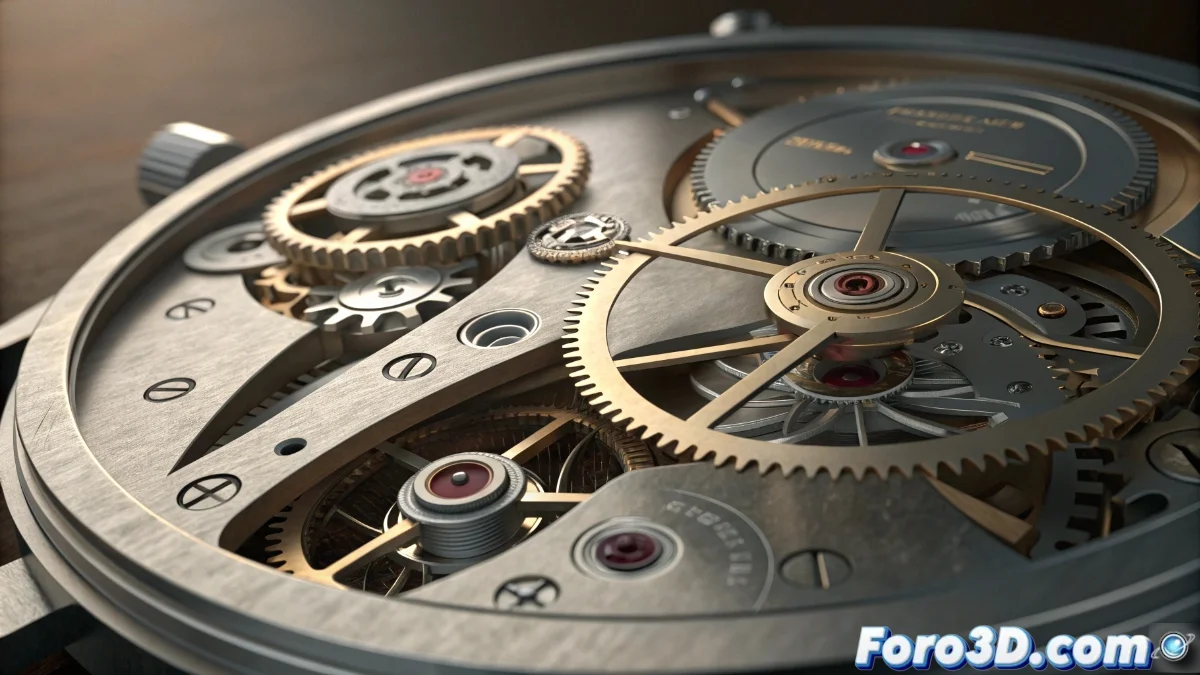
Solvespace as an Animation Tool for Complex Mechanisms
SolveSpace radically transcends conventional static CAD modeling capabilities to emerge as a comprehensive mechanical animation platform through its sophisticated parametric constraints system. Designers can establish exact geometric relationships between multiple components, enabling the recreation of realistic kinematic behaviors in systems ranging from precision watch mechanisms to complex power transmission systems. 🎯
Constraints Engine for Dynamic Simulation
The fundamental essence of this capability lies in SolveSpace's constraints system, where each defined geometric link—such as point coincidences, strict parallelisms, or invariant distances—transforms into an active element within the global kinematic behavior. By configuring these relationships between moving elements, the software automatically calculates the degrees of freedom of the entire assembly, allowing manipulation of individual parameters to generate synchronized movements throughout the mechanism without requiring advanced programming.
Main features of the system:- Definition of advanced geometric constraints between multiple components
- Automatic calculation of degrees of freedom and dependent movements
- Real-time simulation of complex kinematic behaviors
The true elegance emerges when a simple adjustment to a basic constraint perfectly coordinates dozens of interconnected components
Practical Implementations and Export Capabilities
This advanced functionality provides incalculable value for engineers and designers who need to visualize and communicate the internal workings of mechanisms such as planetary gears, vehicle suspension systems, or industrial lifting mechanisms. SolveSpace facilitates the export of animations in standard industry formats, enabling the creation of explanatory material for technical presentations, specialized project documentation, or educational resources that clearly illustrate the dynamic interactions between moving components.
Specific applications in engineering:- Visualization of transmission mechanisms and their movement patterns
- Analysis of complex articulated systems with multiple pivot points
- Creation of didactic material for specialized technical training
The Paradox of Controlled Complexity
The fundamental irony lies in the fact that while the mechanisms you animate can reach extraordinary levels of complexity, the ultimate satisfaction emerges when you finally resolve that seemingly trivial constraint you had overlooked, preventing the entire assembly from catastrophically collapsing on screen. This experience perfectly reflects the dual nature of mechanical design: intricate systems that depend on correctly applied fundamental principles. ⚙️