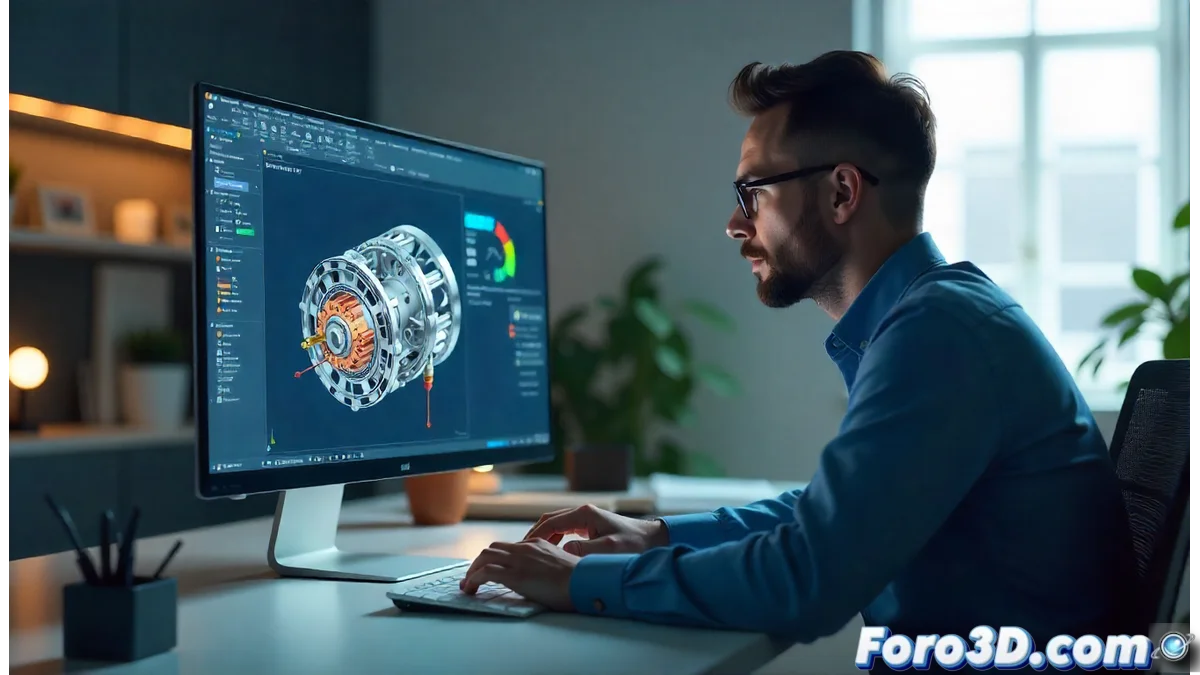
Solid Edge Today: The Power of Mature Synchronous Technology
While the CAD world debates between traditional solutions and cloud-first platforms, Solid Edge has followed its own path under the Siemens umbrella. What began as an alternative to the dominant trio has become a sophisticated and distinctive platform that offers unique approaches to old design problems. With its synchronous technology now fully mature and an ecosystem spanning from design to manufacturing, Solid Edge in 2025 demonstrates that quiet and steady innovation can be as powerful as the noisiest revolutions. 🔄
Synchronous Technology: The Mature Crown Jewel
Synchronous modeling is no longer that novel feature promising to revolutionize everything; it is a proven and refined technology that delivers tangible results. The ability to edit geometry imported from any CAD system without historical parameters, while maintaining design intent, has become extraordinarily robust. Where there were once limitations, there is now fluency and reliability in complex operations. For companies working with multi-CAD data or needing to modify legacy designs, this capability remains a powerful differentiator that no other software fully matches. 🎯
Advantages of synchronous modeling today:- direct editing of geometry without historical dependencies
- manipulation of imports from other CAD systems
- flexible combination with traditional parametric modeling
- rapid optimization of existing designs
Siemens Ecosystem: The Integration That Makes the Difference
As part of the Siemens portfolio, Solid Edge enjoys deep integrations with world-class tools. The connection with NX for advanced projects, Teamcenter for data management, and Simcenter for analysis creates a workflow that few competitors can match. This integration is not superficial; it enables working at different levels of complexity within the same ecosystem, scaling from simple projects to complex product developments without changing platforms. For growing companies, this scalability is invaluable. 🏢
Solid Edge does not compete feature by feature, but offers a different work philosophy
Integrated Manufacturing: From Design to the Plant
Where Solid Edge truly shines is in its comprehensive approach to manufacturing. Sheet metal, welded structures, and mold design tools are not separate modules, but organic parts of the system. The automatic generation of manufacturing documentation, including sheet developments and cut lists, significantly accelerates the transition from design to production. Integration with CAM creates a continuous workflow where design changes are automatically reflected in toolpaths, eliminating costly rework. 🏭 Highlighted manufacturing capabilities:
- sheet metal design with automatic unfolding
- advanced welded structures tools
- integrated mold and casting design
- direct connection with CAM systems
Cloud and Collaboration: Evolution Without Disruption
Solid Edge has adopted a pragmatic approach to the cloud through Solid Edge SaaS Edition. Instead of replacing the desktop version, it offers a complementary alternative for specific scenarios: collaboration with suppliers, mobile design review, and flexible access for distributed teams. Synchronization between local and cloud versions is seamless, allowing users to choose the best environment for each task without sacrificing capabilities. This intelligent hybridization avoids the "all or nothing" dilemma faced by other systems. ☁️
Artificial Intelligence and Automation
AI capabilities in Solid Edge have evolved from novel features to productive tools. The design assistant suggests operations based on usage patterns, the feature recognition system accelerates reverse engineering, and generative optimization tools produce practical and manufacturable results. Most importantly, these AI functions integrate discreetly into the existing workflow, enhancing productivity without requiring users to learn entirely new methodologies. 🤖
Highlighted recent innovations:- design assistant with contextual suggestions
- enhanced organic modeling tools
- integrated sustainability analysis
- generative optimization for real manufacturing constraints
Solid Edge in 2025 represents the maturity of an alternative vision in the CAD world. It does not seek to be the most popular or revolutionary software, but to offer a unique combination of power, flexibility, and pragmatism that resonates deeply with specific users. For those who value the ability to work unrestricted with diverse data, seamless integration with manufacturing processes, and a solid enterprise ecosystem, Solid Edge remains an extraordinarily compelling choice. Sometimes, constant and well-directed evolution proves more valuable than constant disruption. 🚀