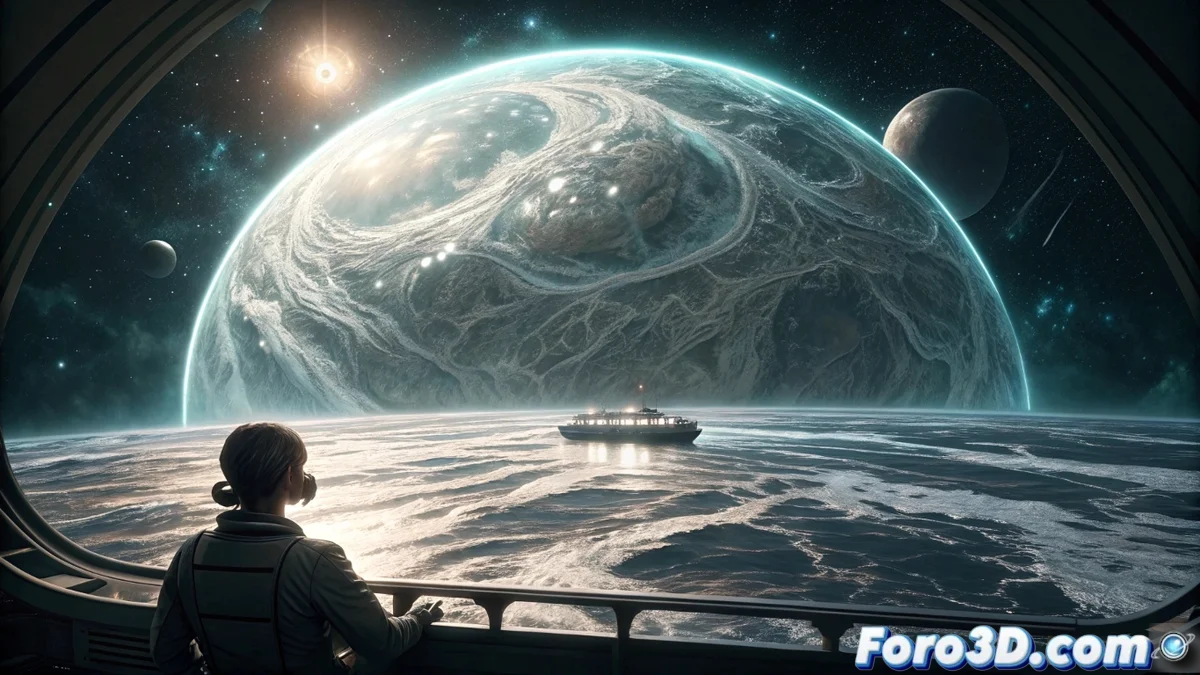
Stanislaw Lem's Solaris: the ocean that reflects the mind
In Stanislaw Lem's work Solaris, a space station orbits a singular planet whose mantle is not rock, but a living ocean. This planetary entity, a radically alien intelligence, reverses the roles of scientific study: instead of being analyzed, it begins to examine the humans trying to decipher it. Its method is disturbing, as it generates physical projections from the most intimate and painful memories of the crew. The narrative centers on psychologist Kris Kelvin and his encounter with a chaotic environment and an impossible visitor. 🪐
The planet as a mirror of the psyche
The ocean of Solaris operates as a device that forces the characters into a self-examination. It does not communicate through language, but reacts to human presence in ways that science cannot interpret. By materializing the visitors, solid entities created from traumatic memories, the alien intelligence reflects the human psyche back onto itself. This transforms the research mission into an introspective and claustrophobic journey, where the protagonists must deal with their own ghosts. The novel proposes that trying to understand the completely other can become an exercise in self-knowledge, often harrowing.
Key narrative mechanisms:- The visitors: Physically and emotionally charged projections, drawn from the scientists' subconscious memories.
- The station as a psychological laboratory: An isolated environment that amplifies internal conflict and confrontation with the past.
- The reversal of study: The subject of study (the ocean) becomes the agent that investigates and provokes the human observers.
Trying to understand the completely other can be an exercise in self-knowledge that reveals more about the observer's limitations than about the object of study.
Questioning the capacity of science
Through its structure, Solaris interrogates science's capacity to process and categorize all of reality. The fictional discipline of Solaristics, dedicated for centuries to studying the planet, has only accumulated mountains of contradictory theories without progress. Lem criticizes anthropocentric arrogance, showing how humans project their expectations even when seeking non-human intelligences. The planetary entity persists as a fundamental mystery, a reminder that there may exist a consciousness so complex that it is inaccessible to human research methods.
Aspects of scientific criticism in the work:- Failure of Solaristics: Symbolizes the limits of knowledge when faced with the radically unknown.
- Anthropocentric projection: Scientists seek familiar patterns and answers where they may not exist.
- The ineffable: The ocean's consciousness is presented as something that cannot be translated or reduced to human parameters.
A reflection that transcends the genre
Lem's work transcends the framework of science fiction to pose enduring philosophical questions. Themes such as memory, guilt, grief, and the limits of understanding are interwoven in a plot that avoids conventional interstellar conflict. Instead of presenting space battles, it places us before a cosmic mirror. The next time you think about the limitations of communicating with an artificial intelligence, remember the scientists of Solaris, trying to decipher an ocean that argues back by returning the forms of their ex-partners. The true frontier, Lem suggests, is not in the stars, but in the abysses of our own mind. 🧠