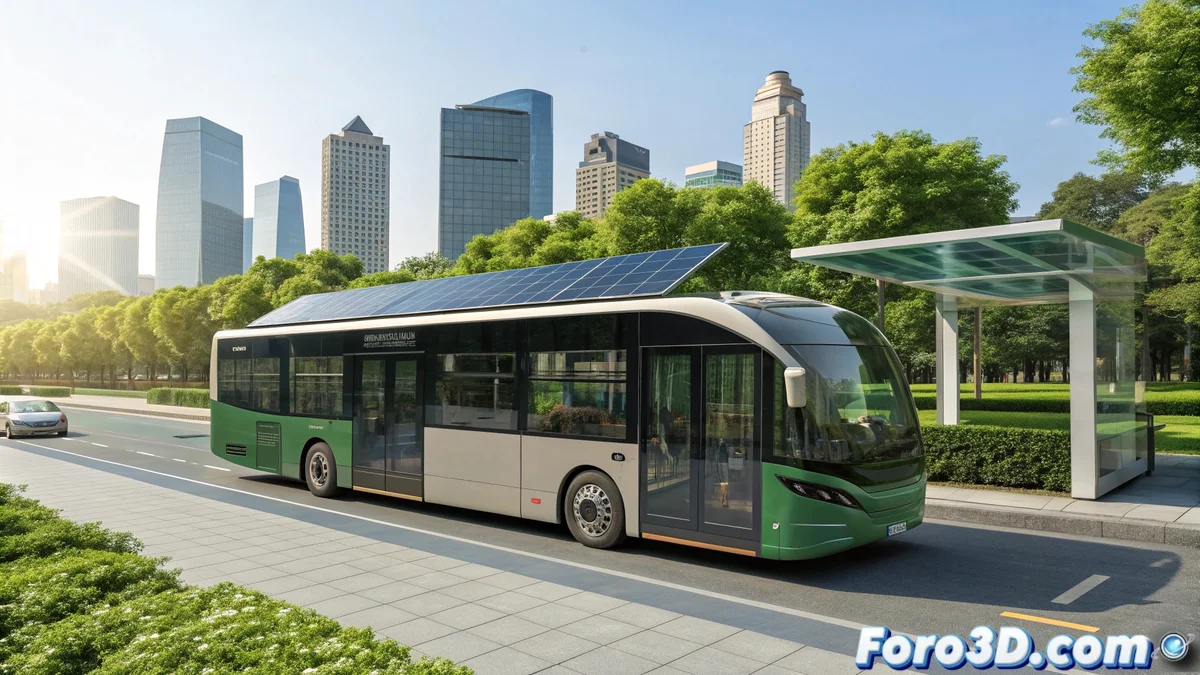
When the Sun Powers Public Transport
A significant advance in urban mobility has emerged with the presentation of a bus prototype that runs exclusively on solar energy, designed to transport up to 50 passengers. This project, driven by the urgent need to find cleaner alternatives to conventional transport, represents an important step toward the consolidation of truly sustainable public mobility systems. The innovation combines cutting-edge solar technology with efficient urban design. 🌞
Urban Transport that Respects the Environment
The bus is equipped with high-efficiency solar panels that power an electrical system capable of covering high-demand urban routes without generating polluting emissions. The dual objective is not only to reduce the carbon footprint of public transport but also to significantly decrease operating costs compared to vehicles that rely on fossil fuels, creating an economically sustainable model.
Design Optimized for Efficiency and Comfort
With capacity for 50 passengers, the interior design has been meticulously planned to maximize both user comfort and energy efficiency. The engineers have incorporated state-of-the-art lightweight materials that reduce the vehicle's total weight, improving autonomy and allowing better utilization of the solar energy captured by the panels installed on the roof.
- Extended Autonomy: Batteries that store excess solar energy for nighttime use.
- Improved Comfort: Ergonomic design and optimized spaces.
- Reduced Maintenance: Fewer moving parts than conventional vehicles.
- Silent Operation: Contributes to reducing urban noise pollution.
Solar energy applied to public transport represents the ideal convergence between technological innovation and urban sustainability.
Transformative Environmental Impact
The large-scale implementation of this type of transport has a significant potential to reduce the carbon footprint of cities, especially in countries with high solar radiation where the system's performance can be maximized. This approach aligns with global decarbonization goals for transport, one of the sectors that contributes most to polluting emissions in urban environments.
Cutting-Edge Solar Technology
The incorporated solar panels use high-efficiency cells that can capture energy even in diffuse light conditions, ensuring operation on partially cloudy days. The system includes high-capacity batteries that store surpluses to allow operation at night or during periods of low insolation, addressing one of the main criticisms of solar mobility. 🔋
Integration into Urban Infrastructure
The design considers compatibility with fast-charging systems at terminal stops, complementing autonomous solar generation. This feature enables continuous operations on high-frequency routes, making the model viable for implementation in existing public transport networks without requiring massive infrastructural modifications.
Global Implementation Perspectives
The developers project that, once the testing phase is overcome, this prototype could mark a milestone in the electrification of worldwide public transport. Cities in sunny regions represent ideal markets for the technology, where the return on investment would be faster thanks to greater utilization of the available solar resource.
With this bus, the only smoke we'll see will be clouds in the sky, and the only traffic jams will be caused by pedestrians wanting to take selfies with the vehicle of the future. Sustainable mobility has its own challenges, but at least they are cleaner. 😅