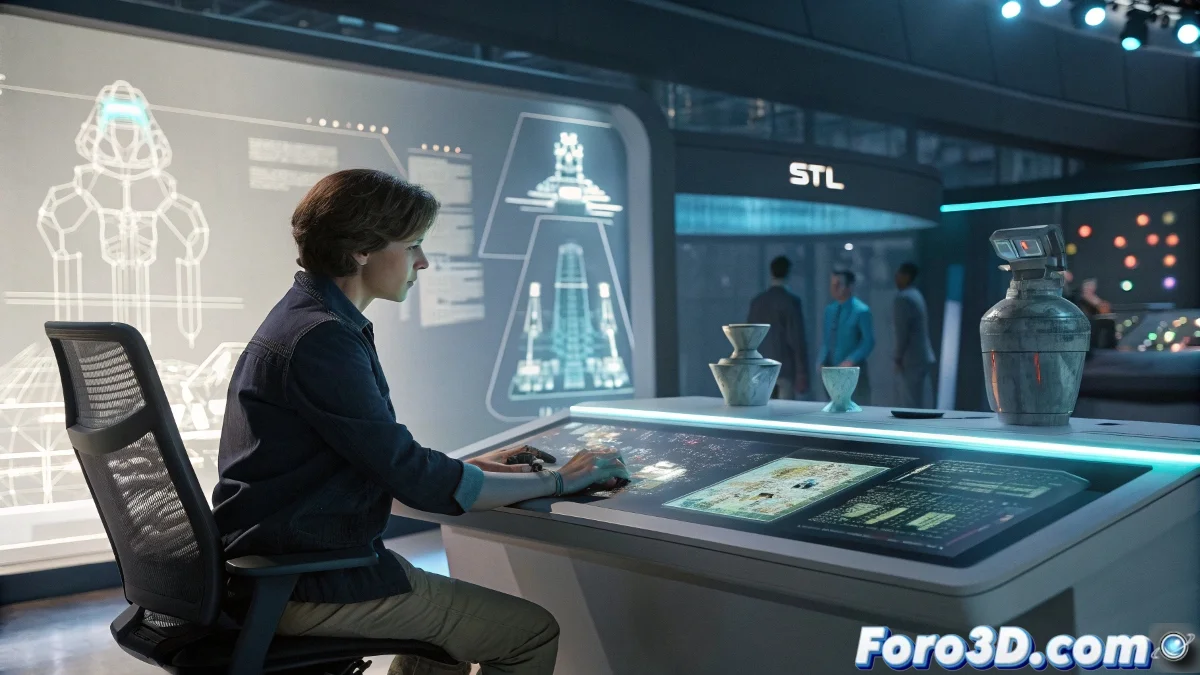
When writing becomes sculpting
Sloyd has just made real what many considered science fiction: transforming textual descriptions into 3D models ready for printing ✍️. Now you can get an STL file just by typing "art deco jar with geometric handle"... and waiting for the AI to do the dirty work (or the creative one, depending on how you look at it).
How does this Norwegian magic work?
The process is as simple as it is baffling:
- You write a detailed description in English (the more specific, the better)
- The AI analyzes the text and generates model variations
- You select the version you like best
- You download the STL optimized for 3D printing
- Optional: import it into Blender/Maya to refine it
"We don't replace 3D artists, we give them superpowers" - claims the Sloyd team, while traditional modelers look at their numpads with nostalgia.
Advantages that will make more than one think
- Supersonic speed: From idea to printable model in less than a minute
- Bridge for non-modelers: Designers, engineers, or makers without 3D skills can materialize concepts
- Instant inspiration: Generates multiple variants of the same concept
- Integration with existing workflows: STLs can be refined in traditional software
Current limitations (which they will surely overcome)
| Challenge | Current status | Possible future solution |
|---|---|---|
| Dimensional precision | Requires manual adjustments | Integration with technical parameters |
| Complex topology | Meshes sometimes too dense | Automatic retopology options |
| Artistic style | Limited to generic shapes | Training with specific datasets |
How to make the most of it in your workflow?
Ideas for integrating Sloyd into real projects:
- Rapid prototyping: Generate bases to iterate in Blender/ZBrush
- 3D concept art: Visualize ideas before detailed modeling
- Education: Teach design principles without software learning curve
- Mass customization: Automatically create product variations
The irony of technological progress
While some continue to master manual retopology, a tool is capable of generating clean meshes with a couple of well-constructed phrases. The good news: artists will always be needed to give that special touch that AI still doesn't understand... or maybe it's just a matter of time. 🤖
One thing is certain: the future of 3D modeling will be hybrid. And those who know how to combine artistic intuition with these new tools will have a competitive advantage. Are you ready to write your next model?
Try Sloyd here: [link] (and prepare to question everything you knew about 3D modeling)