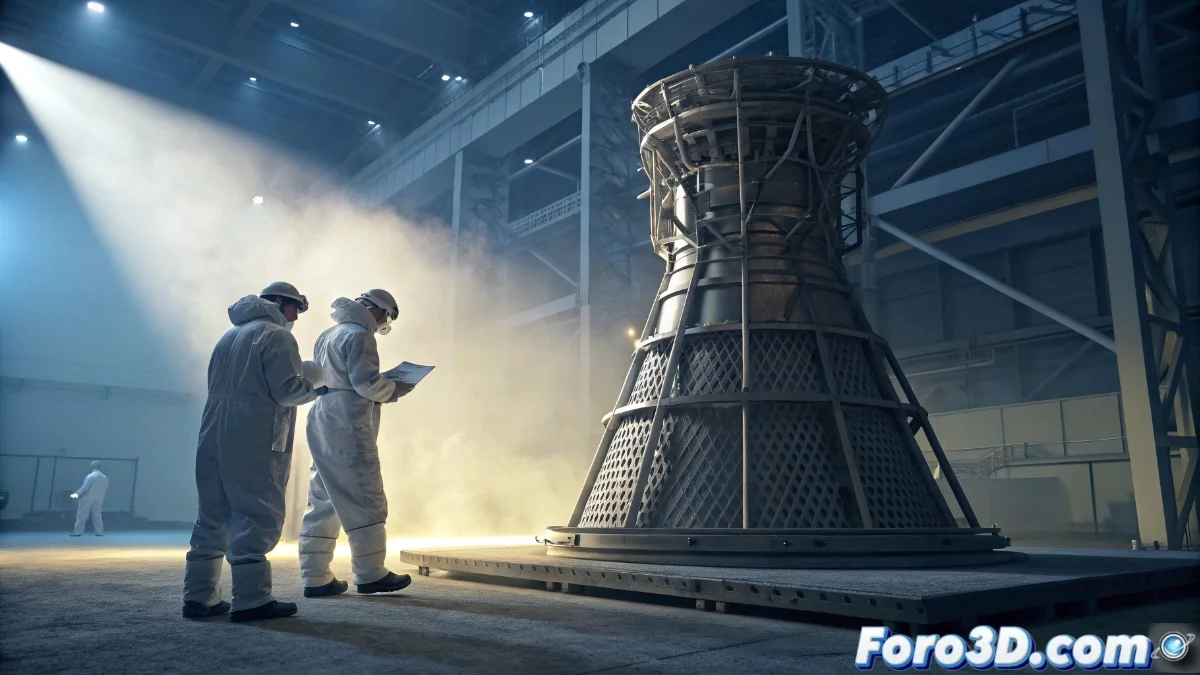
Skyrora and the European Space Agency Boost Rocket Manufacturing with 3D Printing
The space company Skyrora has established a strategic alliance with the European Space Agency (ESA) to revolutionize rocket component production through additive manufacturing technologies. This collaboration represents a crucial step toward European industrial autonomy in the aerospace sector, significantly reducing external technological dependencies 🚀.
Innovation in Materials for Extreme Conditions
The core of this cooperation focuses on the research and development of specialized metal alloys and composite materials optimized for industrial 3D printing processes. These advanced materials must pass rigorous thermal and mechanical resistance tests to ensure their functionality in the most adverse space conditions.
Key contributions of the partnership:- Skyrora brings its practical expertise in the design and manufacturing of space launch systems
- The ESA provides access to state-of-the-art testing facilities and certified validation protocols
- Joint development of 3D printing parameters for critical structural components
This collaboration accelerates Europe's transition to more efficient and globally competitive space manufacturing
Transformation of the European Space Ecosystem
The benefits of this initiative extend beyond Skyrora's specific projects, significantly strengthening the European space value chain. Additive manufacturing enables substantial reductions in production costs and development times, while enabling geometrically complex designs impossible to achieve with traditional methods.
Competitive advantages of space 3D printing:- Reduction of up to 40% in component weight while maintaining structural integrity
- Optimization of manufacturing timelines from months to weeks
- Possibility of on-demand manufacturing and component customization
Strategic Positioning for Europe
The expected outcomes of this pioneering collaboration aim to position Europe as a global benchmark in the application of additive manufacturing technologies for aerospace applications. This technological advancement represents a paradigm shift in space production, comparable to the transition from artisanal methods to industrialized processes, with the added advantage of millimetric precision that ensures zero spare parts in the final assembly 🌌.