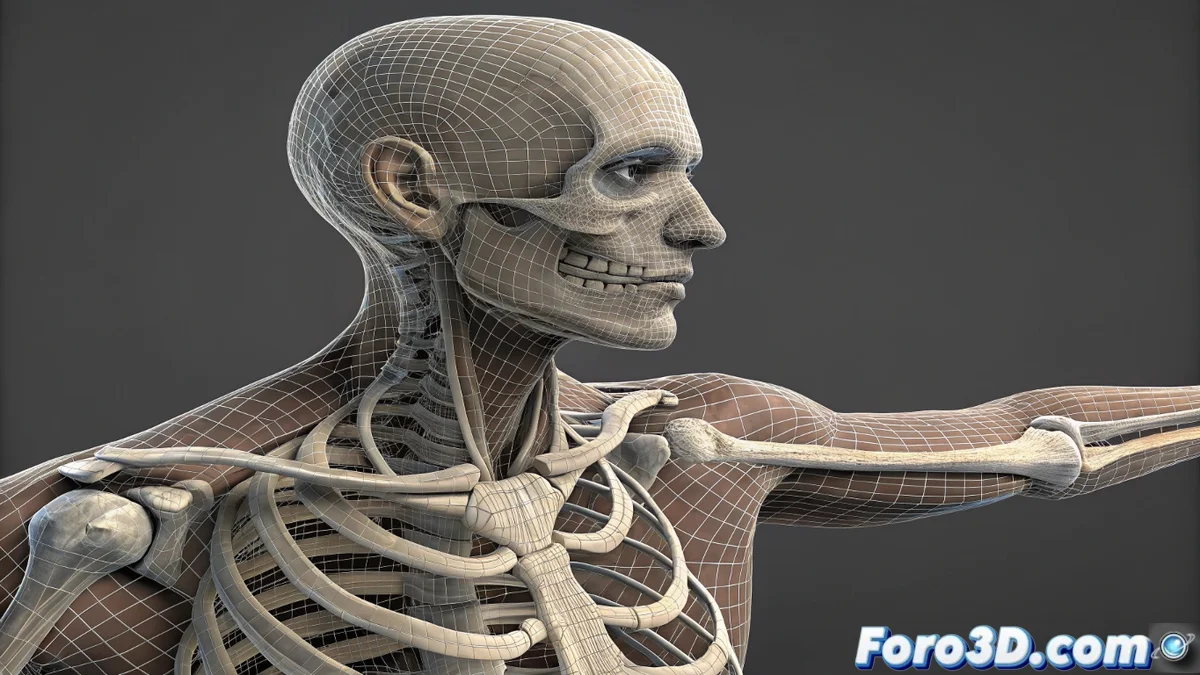
Dual Quaternion Skinning to Preserve Volume
In 3D character animation, a key challenge is deforming the mesh realistically when the skeleton moves. The classic method, known as linear skinning, often fails in extreme rotations, causing the geometry to collapse and lose volume. Dual quaternion skinning emerges as a mathematically more robust solution to this problem. 🦾
The Problem with Traditional Linear Skinning
When binding a mesh to a skeleton using only 4x4 transformation matrices and blending their results, a simple linear interpolation occurs. This causes an undesired visual effect in areas like elbows or shoulders, where the mesh appears to flatten, like a twisted candy or a bowtie. This collapse gives the impression that the limbs are made of a gummy material, not muscle and bone.
Key limitations of linear skinning:- Volume loss: The geometry sinks in the folds of the joints.
- Lack of local rigidity: The mesh does not maintain its shape properties under wide rotations.
- Visual artifacts: Unnatural effects appear that break the illusion of anatomy.
Sometimes the simplest mathematics is not the kindest to virtual anatomy. Linear skinning can make an arm look like chewing gum.
How Dual Quaternions Work
This technique employs dual quaternions, a mathematical tool that efficiently encapsulates a rotation and a translation into a single unit. When applied to the mesh vertices during the skinning process, the resulting deformation preserves local rigidity. This means the mesh bends in a more natural and believable way, maintaining its apparent volume even in very wide movements. 🧮
Main advantages of using dual quaternions:- Preserve volume: Geometry at the joints does not collapse, preserving visual mass.
- Natural deformation: The bowtie effect is eliminated, achieving more realistic folds.
- Unified mathematical representation: Managing rotation and translation together avoids inconsistencies.
Implementing This Technique in a Project
To implement dual quaternion skinning, the skeleton information must be processed using these structures instead of traditional matrices. This calculation, although more costly, is usually executed in a vertex shader on the GPU for efficiency. It is an advanced option available in most game engines and professional 3D animation software. To make the most of its benefits, it is crucial to carefully adjust the vertex weights in the mesh. ✅