The Continuous Evolution of Fluid Simulation
Sitni Sati has just released FumeFX 7.1 for 3ds Max, a significant update that further refines the already impressive fluid simulation toolkit. This version not only improves overall performance but also introduces community-requested specific features that optimize workflows for visual effects artists and animators. Users of previous versions will find immediate tangible improvements in speed and creative control.
What makes this update particularly notable is its focus on workflow efficiency. While previous versions focused on adding new simulation capabilities, FumeFX 7.1 is dedicated to optimizing and refining existing tools, resulting in faster, more stable, and predictable software. Artists report simulation time reductions of up to 40% in complex scenes thanks to improvements in the core algorithm.
In fluid simulation, every second saved is an additional frame of creativity
New Caching System and Memory Management
The FumeFX 7.1 caching system has been completely redesigned to offer greater speed and flexibility. Users can now resume interrupted simulations without losing previous progress, an invaluable feature when working with simulations that require days of computation. The new incremental caching system allows saving different versions of the same simulation, facilitating comparison and selection of the best results.
Memory management shows particularly dramatic improvements in high-resolution and large-scale scenes. The engine now allocates memory more intelligently, significantly reducing RAM requirements for equivalent simulations. Users can work with higher resolution grids on the same hardware, or complete existing simulations faster thanks to memory access optimization.
- Incremental caching for multiple versions
- Resuming interrupted simulations
- Optimized memory management for large scenes
- Faster access to simulation data
Enhanced Simulation Tools
FumeFX 7.1 introduces a new set of vorticity controls that allow artists to precisely direct vortex behavior in smoke and fire simulations. The system can now preserve complex vortical structures for longer, resulting in more dynamic and visually interesting simulations. Turbulence and dissipation settings have been refined to offer more intuitive control over the longevity and behavior of simulated phenomena.
The collision system has received major improvements in accuracy, particularly when working with complex and moving geometry. Collisions are now calculated with improved sub-step accuracy, reducing common artifacts from previous versions when objects moved quickly through fluid simulations. Users report more believable interactions between fluids and animated geometry.
Controlling chaos is the true art of fluid simulation
- Advanced vorticity controls
- Improved preservation of vortical structures
- More precise sub-step collisions
- Optimized fluid-geometry interactions
Integration with 3ds Max 2024/2025
FumeFX 7.1 is specifically optimized for the latest versions of 3ds Max, leveraging viewport performance improvements and new extension APIs. Integration with 3ds Max's Coordinate Reference System has been enhanced, allowing more complex simulation setups in nested coordinate spaces. 3ds Max 2025 users will especially appreciate the viewport acceleration when working with large simulation volumes.
Arnold Renderer support has been updated for the latest versions, with better volumetric handling and render-time memory optimization. Export to other render engines like V-Ray and Redshift also shows significant improvements in speed and compatibility.
Workflows for Atmospheric Effects
One of the most celebrated additions is the new large-scale atmospheric effects toolkit. Artists can now create clouds, fog, and mist with greater artistic control and less computational overhead. The new density modulator allows locally adjusting fluid opacity based on different criteria such as height, velocity, or custom fields.
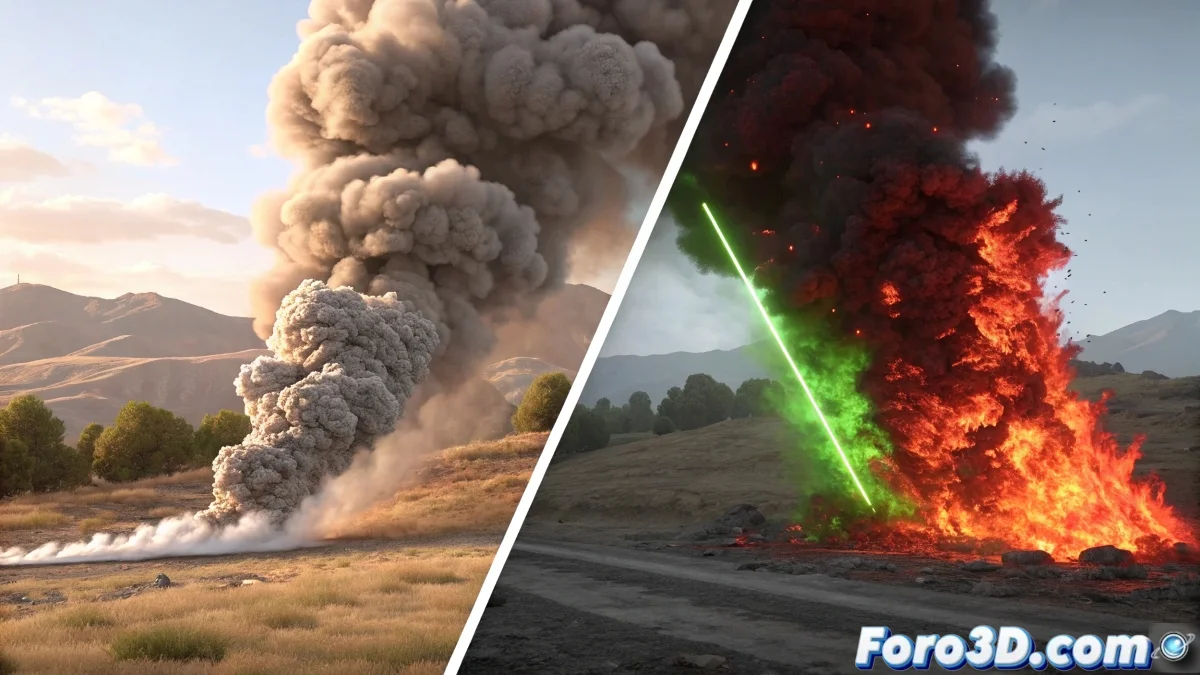
For explosion and fire effects, FumeFX 7.1 introduces combustion modeling improvements that result in more realistic flames with fewer manual adjustments. The system now automatically calculates temperature variations and their effect on smoke behavior, reducing the need for complex setups for believable results.
- Tools for clouds and atmosphere on a large scale
- Density modulator for localized control
- Improved combustion modeling
- Automatic calculation of temperature variations
Usability and Learning Improvements
Sitni Sati has paid special attention to the learning curve in FumeFX 7.1. The interface now includes improved presets organized by categories—fire, smoke, explosions, atmospheric effects—that provide optimized starting points for different types of simulations. Each preset includes integrated comments explaining key parameters and how to adjust them for different results.
The contextual help system has been significantly expanded, offering detailed explanations for each parameter directly in the interface. New users can learn while working without constantly switching between the software and external documentation.
The best software isn't the most powerful, but the one that makes its user feel powerful
Performance on Modern Hardware
FumeFX 7.1 is optimized for modern CPU architectures, showing better scaling on multi-core systems and leveraging AVX2 and AVX-512 instructions where available. Users with latest-generation CPUs report particularly notable performance improvements, with simulations completing up to 60% faster compared to FumeFX 6.
Support for modern graphics cards has also been improved, with GPU acceleration for certain preview and post-processing operations. While the main simulation remains CPU-bound, auxiliary tasks like vector field visualization and cache manipulation benefit from graphics hardware acceleration.
- Optimization for modern multi-core CPUs
- Support for AVX2/AVX-512 where available
- GPU acceleration for auxiliary tasks
- Better scaling on systems with many cores
Compatibility and Upgrade
FumeFX 7.1 maintains full compatibility with scenes from previous versions, allowing users to upgrade without interrupting ongoing projects. Users with active maintenance licenses can download the new version immediately from the Sitni Sati website. For new users, the full trial version is available for 30 days, including all new features.
The complete documentation has been updated with tutorials specific to the new features and scene examples demonstrating performance improvements and expanded capabilities. The user community continues to be an invaluable resource, with active forums where artists share techniques and optimized settings for FumeFX 7.1.
The Future of Simulation in 3ds Max
With FumeFX 7.1, Sitni Sati solidifies its position as the leader in fluid simulation for 3ds Max, demonstrating a continuous commitment to innovation and refinement. This update not only improves the existing software but also lays the foundation for future innovations in fluid simulation and integration with the broader 3ds Max ecosystem.
For visual effects artists, FumeFX 7.1 represents another powerful tool in their arsenal—faster, more stable, and more intuitive than ever, enabling the creation of stunning simulations with greater efficiency and creative control.
It seems that in the world of fluid simulation, the only thing that doesn't evaporate is Sitni Sati's commitment to continuous improvement 💨