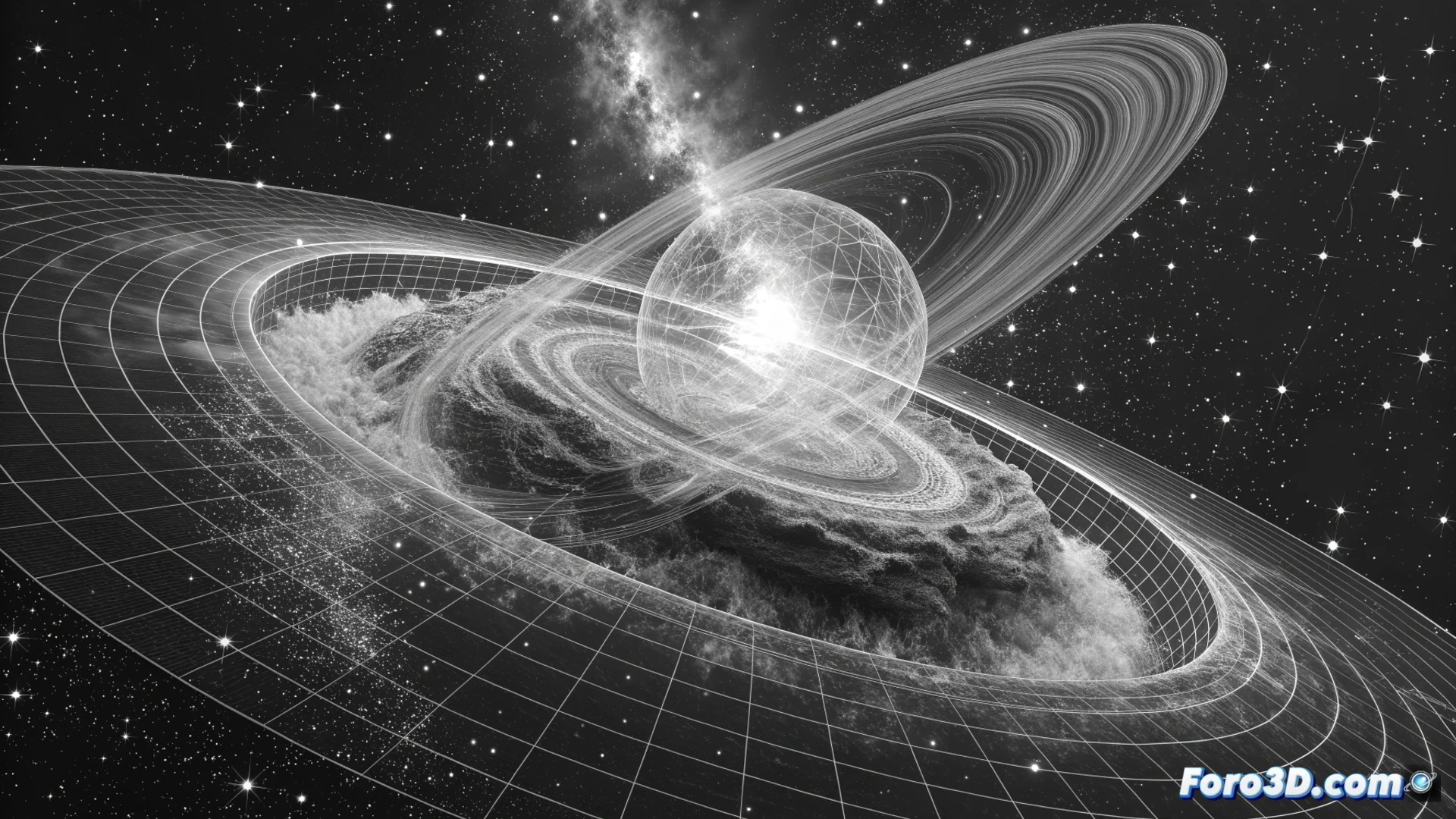
Simulations Reveal How Eccentric Protoplanetary Disks Form
The initial phases of a protoplanetary disk, known as Class 0, are a dynamic and chaotic environment where the structure grows rapidly. Recent research employs advanced three-dimensional simulations that integrate magnetohydrodynamics, ambipolar diffusion, and radiation to model gravitational collapse in a self-consistent manner. These models reveal a much more complex and anisotropic formation process than previously thought. 🌀
The Initial Chaos: Accretion Through Filaments
Contrary to the idea of uniform collapse, simulations demonstrate that magnetic fields and turbulence in the original molecular cloud do not halt rotation. Instead, they channel the infall of material. Gas and dust do not accumulate homogeneously, but flow toward the incipient disk through dense accretion filaments or streamers. These elongated structures impact the disk from multiple directions, defining its early growth.
Key Consequences of Filamentary Flow:- Generate Internal Turbulence: The impact of the filaments drives vigorous turbulent activity within the disk. This turbulence transports angular momentum efficiently, allowing the disk to expand radially rapidly.
- Produce an Angular Momentum Deficit: This highly directional material flow delivers mass with a significant angular momentum deficit. This factor is the central piece that explains the eccentric morphology.
- Create and Maintain Eccentricity: The angular momentum deficit is not a one-time event; it continuously generates and sustains a substantial orbital eccentricity in the global disk. This makes its shape clearly elliptical, not circular.
The results suggest that eccentric kinematics are ubiquitous in Class 0 disks, an aspect widely overlooked.
Implications for Planet Formation
The presence of a substantial eccentricity in such young disks has profound repercussions for their subsequent evolution and the processes they host. The non-uniform distribution of material and the gravitational forces that vary along