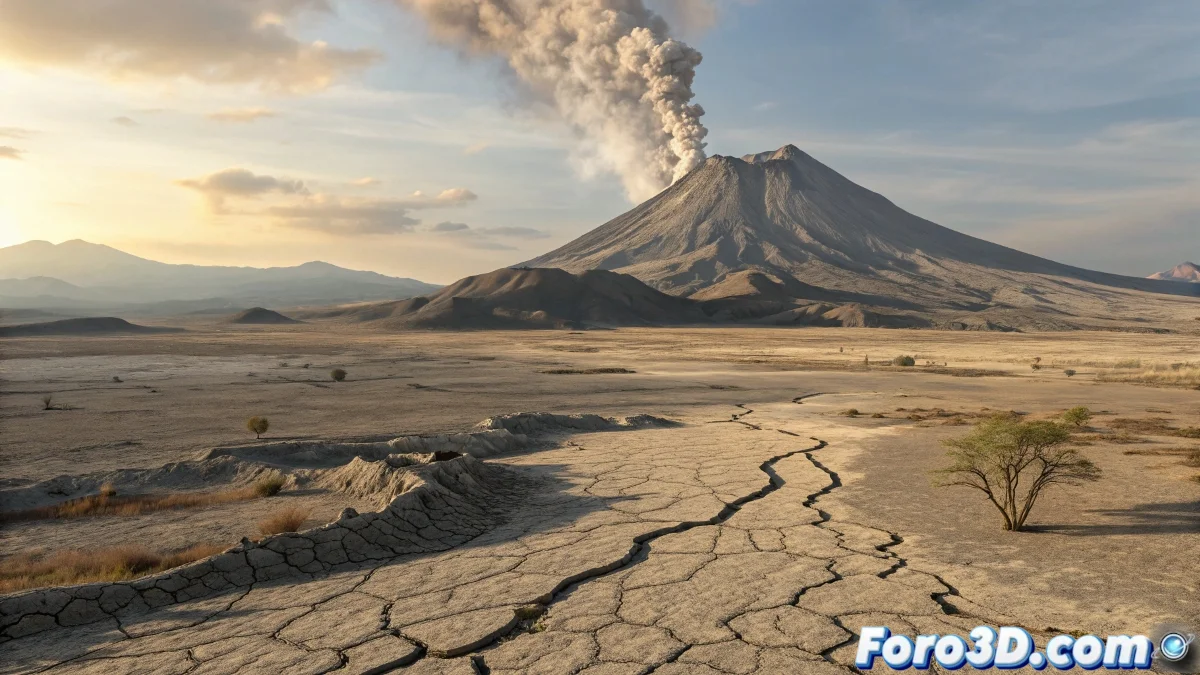
When the Earth Trembles and the Mud Erupts
The powerful earthquakes that shook Turkey in 2023 demonstrated that the force of nature knows no limits, activating unexpected mud volcanoes nearly a thousand kilometers away. 🌋 These geological phenomena do not expel incandescent lava, but a bubbling mixture of hot mud, gases, and sediments that emerge under pressure when seismic waves destabilize underground pockets. For visual effects artists, recreating this natural spectacle in Houdini is a challenge as fascinating as it is complex, combining fluid simulations and digital pyrotechnics.
Preparing the Geological Scene
Everything begins with the creation of the terrain. In Houdini, a HeightField node of 200x200 units and a resolution of 1024 allows generating a realistic base. Adding HeightField Noise incorporates irregularities and natural geographical features. 🏔️ The crucial step is to use HeightField Mask by Object to carve a central crater approximately 20 meters in diameter, which will serve as the emission point for the mud and gases. This procedural approach ensures total control over the morphology of the environment.
- Terrain generation: Use of HeightField with noise for realism.
- Crater creation: Masking techniques to define the volcano's mouth.
- Realistic scaling: Adjustment of dimensions to make the simulation believable.
The Mud Simulation: Thicker Than Mashed Potatoes
The heart of the simulation lies in the FLIP Fluids system. A sphere placed in the center of the crater acts as a FLIP Source in volume mode. The key to achieving the characteristic viscosity of mud is adjusting the viscosity parameter in the FLIP Solver to a high value (around 200). 💧 An initial Y velocity between 4 and 6 units simulates the gas pressure pushing the mud to the surface, while a particle separation of 0.05 ensures an adequate level of detail for the fluid to behave in a heavy and coherent manner.
Simulating viscous fluids is like trying to make honey behave epically; it requires patience and many adjustments to resistance and gravity.
Adding Gases and Atmospheric Details
To complete the effect, it is essential to simulate gas emission. Using the same crater as a source, a Volume Source is configured connected to a Pyro Solver. A low density (0.2) and a medium temperature (1.0) create the appearance of vapor and hot gas. Adding turbulence (around 0.8) provides that organic and chaotic movement observed in real references, integrating perfectly with the main mud simulation.
Lighting, Materials, and Final Render
The visual aspect is defined in the materials. For the mud, a dark brown shader (hex #3a2c1a) with low glossy reflections and an irregular normal map captures the wet and muddy texture. For the gases, a semi-transparent volumetric shader in gray and white tones simulates light dispersion. ☀️ A sunlight with a low angle, like at dawn or dusk, enhances the shapes and volumes of the eruption. Render engines Karma XPU or Redshift are ideal for handling the complexity of particles and volumes with cinematic quality.
The Most Important Tip: Always Cache
Before launching a 500-frame simulation at high resolution, it's always prudent to do low-resolution tests (particle separation of 0.1) and save lightweight versions. 🫠 Otherwise, your workstation could turn into a parody of the very phenomenon you're trying to simulate: a volcano of heat and fans spinning at full speed. Because, just like in geology, in Houdini it's always better to be prepared for the unexpected eruption. 😅