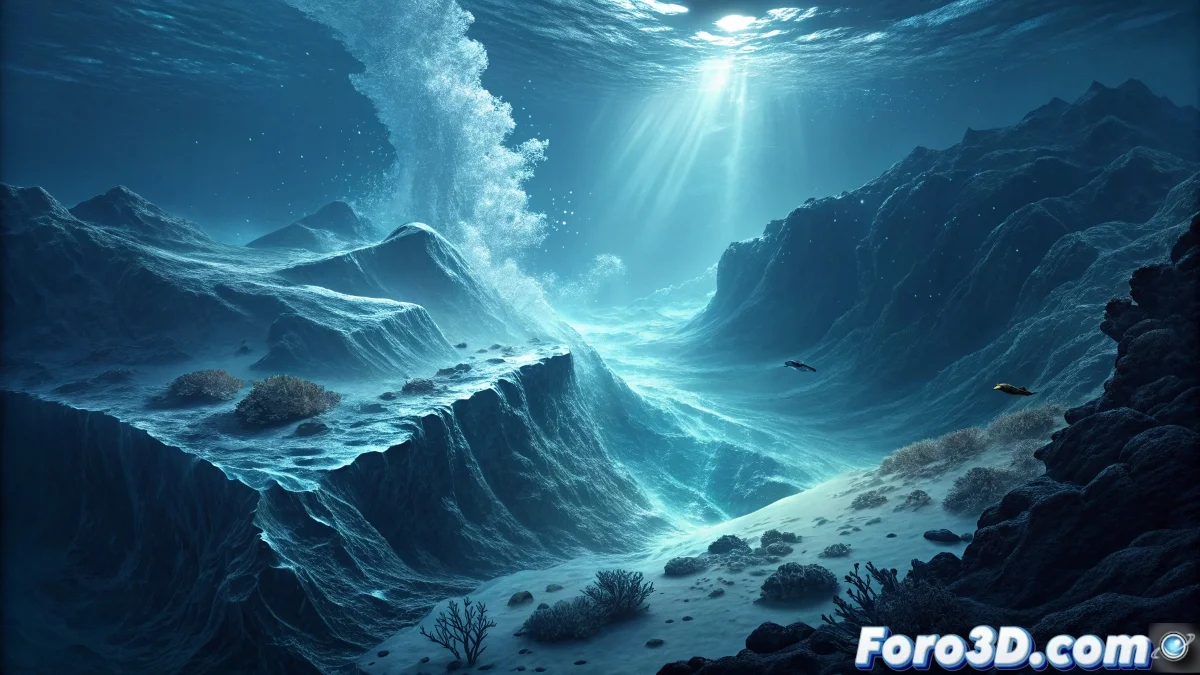
Simulating the Mariana Trench with RealFlow: Guide to Deep Ocean Effects
The Mariana Trench represents the deepest point in the planet's oceans, an abyssal trench that descends to nearly 11 kilometers in the Challenger Deep, and whose environment of perpetual darkness and extreme pressure constitutes one of the most fascinating geological and biological mysteries on Earth. With less than 5% explored, we will recreate this hidden world using RealFlow's advanced fluid simulation capabilities. 🌊
Initial Simulation Environment Setup
Begin by establishing the base parameters that will replicate the unique conditions of the trench: extreme pressure, water density, and absence of sunlight. In RealFlow, configure the main domain with dimensions that reflect the monumental scale of this underwater canyon.
Simulation Domain Preparation:- Create main domain of 1000x1000x11000 units to represent real depth
- Set gravity to 9.8 m/s² with progressively increased water density
- Establish boundary conditions to simulate trench walls
"Simulating the Marianas in RealFlow requires understanding how water behaves under pressures that would crush a submarine like a can" - Oceanic Visual Effects Supervisor
High-Pressure and Density Fluid Simulation
The extreme hydrostatic pressure is the most challenging factor. Use RealFlow's advanced density and viscosity parameters to create a fluid that behaves credibly under these abyssal conditions.
Fluid Configuration in RealFlow:- Progressive Density Map increasing from 1000 kg/m³ at surface to 1090 kg/m³ at bottom
- Variable Viscosity simulating water compression at depth
- Reduced Particle size for greater detail in high-resolution simulations
Sediment and Suspended Particle Effects
The abyssal water column is filled with particulate matter and marine snow. Employ RealFlow's secondary particle system to simulate these elements that float slowly toward the ocean floor.
Particle System for Abyssal Environment:- Volume-type Emitter for uniform distribution of sediment particles
- Reduced gravity forces to simulate slow fall of organic debris
- Terrain collision detection for bottom accumulation
Lighting and Bioluminescence Effects
In the total darkness of the depths, the only light comes from bioluminescence of abyssal creatures. Set up emissive particle systems that simulate these organisms and their light patterns.
Lighting Techniques in RealFlow:- Point lights linked to particles for bioluminescence effects
- Dim volumetric lighting to simulate light scattering in dense water
- Custom shaders for particles emitting light in blue-green spectra
Final Integration and Rendering of the Abyss
When exporting the simulation, focus on capturing the monumental scale and mystery of this extreme environment. Use separate render passes to control the water opacity, particles, and light effects, allowing fine adjustments in post-production that accentuate the alien atmosphere of the most unexplored place on our planet. 🔦