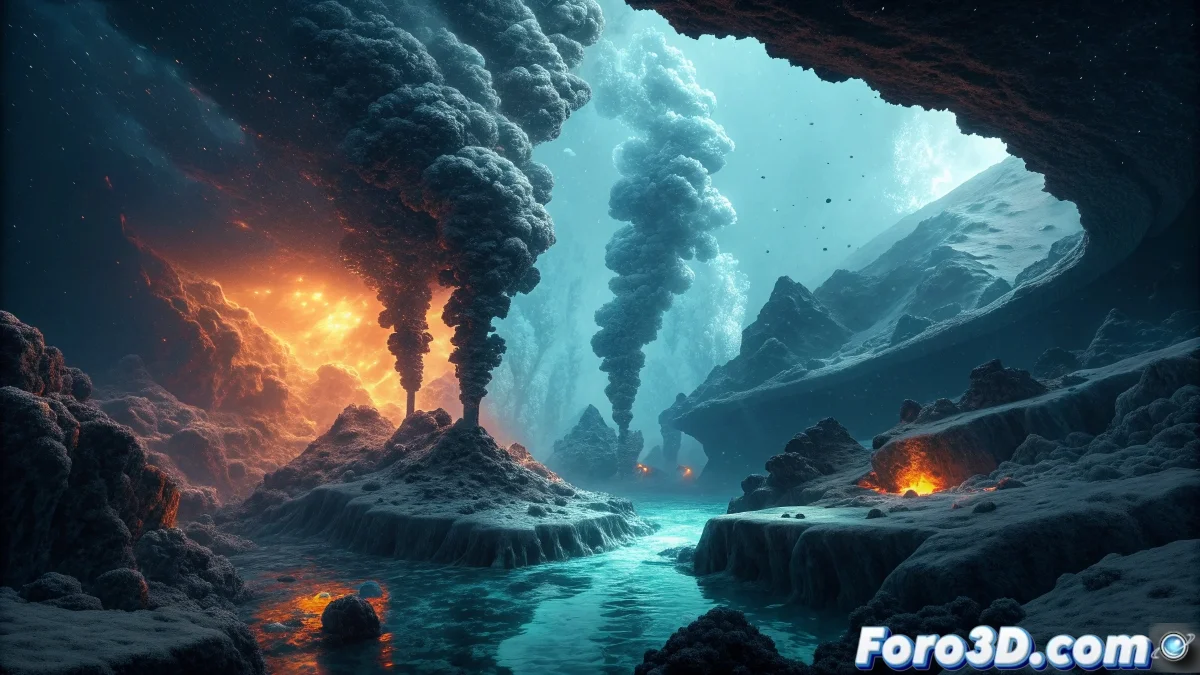
Simulating the Gakkel Ridge with Ziva VFX: Life in the Arctic Abyss
The Gakkel Ridge in the Arctic Ocean represents one of the most extreme and unexplored environments on our planet, being the slowest-spreading and deepest oceanic ridge in the world, located beneath the thick permanent ice cover of the Arctic. Its remote location and inhospitable conditions have made exploration extremely difficult, turning it into one of the greatest contemporary geological and biological mysteries. The main mystery lies in its unique hydrothermal vents and the specialized life forms that have evolved to survive in this environment of extreme cold, high pressure, and complete darkness. We will recreate this unique ecosystem using the power of Ziva VFX's biological simulation. ❄️
Setting up the Arctic Environment and Extreme Conditions
Start by establishing the unique conditions of the Gakkel Ridge, which stretches for 1,800 kilometers under the Arctic ice with depths exceeding 5,000 meters. The environment is characterized by temperatures near the freezing point, extreme pressure, and the complete absence of sunlight, creating an ecosystem that relies entirely on the chemical energy from hydrothermal vents.
Environment Preparation in Ziva VFX:- Set up real-world scale units to maintain the correct proportions of abyssal creatures
- Establish environmental parameters that simulate the density and viscosity of Arctic water
- Prepare reference geometry for the seafloor and ridge formations
"The Gakkel Ridge is like a natural laboratory of evolution in slow motion, where life has found extraordinary ways to thrive in perpetual darkness" - Deep-sea Biologist
Creating Anatomy for Arctic Abyssal Creatures
Design specialized creatures adapted to extreme cold, such as Arctic variants of goblin sharks, giant sea cucumbers, and tubeworms. These species feature unique adaptations like tissues more flexible at low temperatures and extremely slow metabolisms.
Anatomical Setup in Ziva VFX:- Model muscles, fat, and connective tissues with Ziva Material Maker
- Adjust material parameters to simulate tissues rich in TMAO (natural antifreeze compound)
- Create thicker subcutaneous fat layers for thermal insulation
Tissue Simulation and Movement Dynamics
Arctic deep-sea creatures exhibit slower and more fluid movements due to low temperatures and high water density. Set up simulations that capture this efficient, energy-conserving swimming characteristic of the ecosystem.
Simulation Parameters in Ziva:- Adjust lower stiffness values to reflect flexibility in extreme cold
- Set up damping parameters for more viscous and cushioned movements
- Simulate neutral buoyancy with fine-tuned tissue density adjustments
Interaction with Hydrothermal Vents and Environment
The Gakkel Ridge hydrothermal vents are unique for operating in extreme cold conditions. Simulate how creatures interact with these columns of mineral-rich hot water, creating vital microclimatic zones in the perpetual darkness.
Environmental Interaction Systems:- Create thermal influence volumes around the hydrothermal vents
- Simulate convection currents with custom wind forces
- Set up thermal responses in Ziva materials for temperature changes
Final Effects and Ecosystem Integration
Combine all the biological simulations into a coherent ecosystem, where creatures interact with each other and their environment. Use Ziva's collision and contact system to create credible interactions between species and geological formations, capturing the essence of this mysterious world where life has found extraordinary ways to flourish in one of Earth's most hostile environments. 🐙