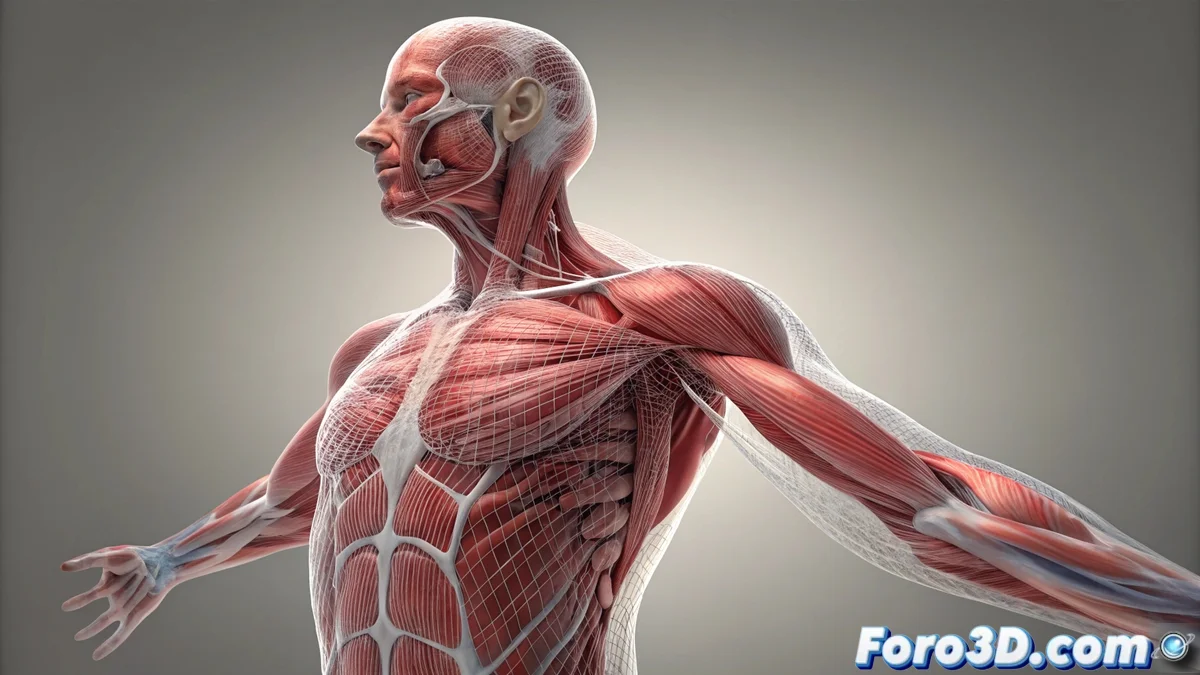
Simulating Soft Bodies with the Finite Element Method
The finite element method (FEM) is a numerical procedure that allows analyzing how objects deform when forces act upon them. This method divides a complex 3D model into an mesh of small elements, such as tetrahedrons, which can stretch and compress independently. It is fundamental for accurately predicting the behavior of materials that are not completely solid or rigid. 🧠
Modeling Organic Tissues Accurately
This approach is ideal for recreating biological tissues like skin, fat, or muscles because it faithfully models how these materials preserve their internal volume. By processing the forces acting on each individual element, the system calculates realistic deformations. These deformations transmit movement from one area to another, generating a believable physical interaction that is vital for both animations and advanced engineering studies.
Key Features of FEM Simulation:- Divides complex objects into a mesh of interconnected elements, typically tetrahedrons or hexahedrons.
- Calculates realistic deformations by processing forces at each node of the mesh, allowing natural movement transmission.
- Is especially effective for simulating materials that preserve their volume, a key property of organic soft tissues.
FEM transforms a continuous and complex physical problem into a discrete system of equations that can be solved numerically, bridging the real and digital worlds.
The Computational Requirements of the Process
Simulating with finite elements requires significant hardware resources, as it must solve an extensive system of equations at each time step or frame. Specialized programs optimize these calculations to make them viable, often employing the GPU (graphics card) to accelerate parallel data processing. The final result allows observing how a soft object responds to collisions, falls, or interactions with its environment in a physically coherent manner.
Technical Considerations for Implementing FEM:- Requires high computational power to solve millions of simultaneous equations in each iteration.
- GPU acceleration is common to handle the large number of mathematical operations involved.
- The ultimate goal is to visualize physically consistent interactions, such as the impact or compression of soft materials.
Balance Between Accuracy and Resources
The finite element technique offers an unmatched level of physical realism for simulating deformable bodies, but it comes with a considerable computational cost. While software is optimized to handle these loads, the user's hardware must be powerful enough to calculate the interaction of millions of elements without the operator's patience deforming in an equally realistic manner. ⚙️