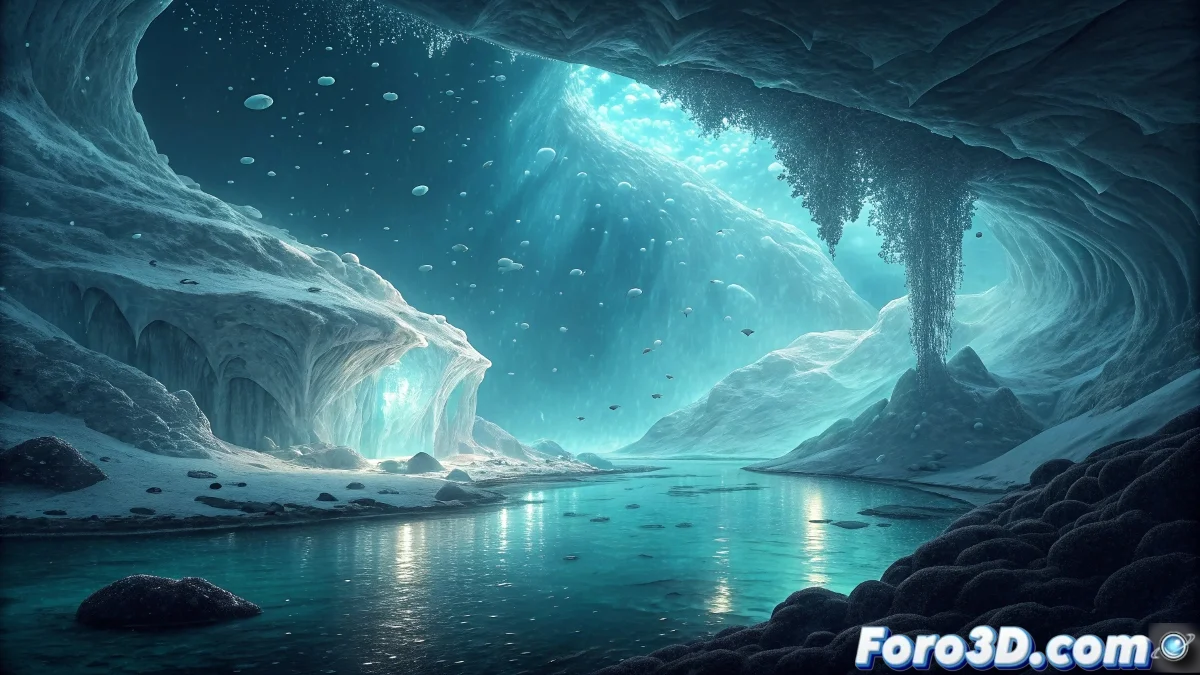
Simulating Lake Vostok under Antarctic Ice with RealFlow: Guide to Extreme Environments
The Lake Vostok in Antarctica represents one of the most extreme and mysterious environments on our planet, a massive freshwater lake buried under approximately 4 kilometers of Antarctic ice that has remained completely sealed and isolated from the outside world for millions of years. This unique ecosystem, with possible presence of unknown microbial life forms, constitutes a biological time capsule that we will recreate using the advanced capabilities of RealFlow for fluid simulation and environments. ❄️
Subglacial Simulation Domain Setup
Begin by establishing the monumental scale of this unique environment. In RealFlow, set up a domain that captures the real dimensions of the lake (250km long x 50km wide) and the 4000-meter ice column covering it.
Environment Preparation in RealFlow:- Create main domain with dimensions 250000x50000x4000 units
- Set up Antarctic gravity and density parameters for ice and water
- Establish constant sub-zero temperature conditions (-3°C in the lake)
"Lake Vostok is like exploring another planet on Earth, an ecosystem that evolved in complete isolation over geological eras" - Glaciologist from the Antarctic program
Simulation of the Millennial Ice Layer
The 4km ice column requires a hybrid simulation approach. Use RealFlow's particle system combined with static meshes to create crystalline formations and the unique features of deep Antarctic ice.
Techniques for Ice in RealFlow:- Hybrido 3 with high viscosity to simulate extremely slow glacial flow
- Particle meshing with variable resolution for foreground detail
- Material points for air inclusions and sediments trapped in the ice
Liquid Water under Extreme Pressure Conditions
The subglacial lake water exists in unique pressure conditions (over 350 atmospheres) and at -3°C, remaining liquid due to the pressure exerted by the overlying ice mass. Set up specific parameters for this anomalous behavior.
Subglacial Water Parameters in RealFlow:- Density of 1000 kg/m³ with increased compressibility due to pressure
- Viscosity adjusted for supercooled water under extreme pressure
- Surface tension modified for low thermal energy conditions
Sediment Effects and Possible Microbial Ecosystems
Simulate the lake bottom sediments and possible microbial life forms that could inhabit this unique environment. Use secondary particle systems to create suspended sediment columns and possible biofilms.
Elements of the Simulated Ecosystem:- Volume-type Emitters for organic sediment distribution
- Particle systems for possible microbial colonies at interfaces
- Custom Forces for minimal thermal convective currents
Lighting and Rendering of Total Darkness
The complete darkness of the lake presents a unique visualization challenge. Set up lighting systems that simulate only artificial sources (like research probes) or possible microbial bioluminescence phenomena, creating an atmosphere that conveys the mystery and isolation of this lost world under the ice. 🔬