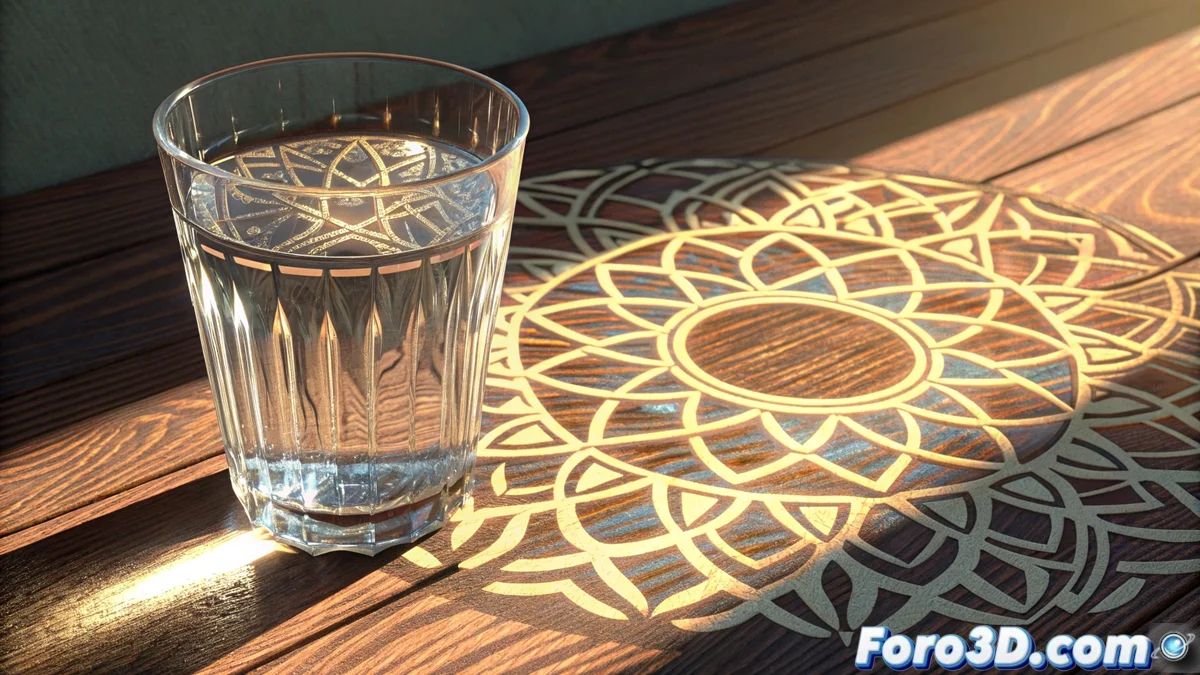
Simulating Caustics in 3D Graphics: Methods and Challenges
In the world of computer graphics, caustics represent one of the most complex lighting effects to recreate. These bright light patterns appear when light rays are refracted through a transparent medium or reflected off a curved surface, as happens with the light dancing in a pool. Achieving this visual realism demands great computational power, as it requires precisely processing how light behaves in complex media. 🎨
Main Techniques for Generating Caustics
Modern rendering engines employ various methods to calculate these effects efficiently. The goal is to balance physical fidelity with rendering time.
Most Common Approaches:- Backward Ray Tracing (Path Tracing): Captures caustics with high physical accuracy, but requires a very high number of samples to eliminate noise, which greatly slows down the process.
- Photon Maps: This older technique first stores luminous energy in the scene in a map for later reuse. It speeds up rendering but can produce results with less detail or visible artifacts.
- Hybrid Engines: Combine ideas from ray tracing and photon maps to seek a balance between speed and final visual quality.
Including realistic caustics multiplies the rendering time of a frame, a critical factor in production.
How It Affects the Artist's Workflow
Integrating these simulations into a project has a direct impact on deadlines and planning. An artist must evaluate when the effect is narratively essential and when it can be suggested with tricks or in post-production.
Strategies to Optimize the Process:- Render in Separate Passes: Isolating caustics in a specific render pass allows greater control in compositing and speeds up iterations.
- Use Powerful Denoiser Systems: They allow working with fewer light samples, reducing render time while maintaining acceptable quality.
- Make Technical Decisions Early: Define from the start which scene elements require physical caustics and which can have an approximate solution.
The Balance Between Realism and Efficiency
Caustics add a deep layer of realism to a scene, but their computational cost is high. Sometimes, the time invested in rendering the light passing through a glass exceeds that used to model the rest of the environment. It is a constant trade-off between seeking physical beauty and meeting delivery deadlines. Mastering when and how to simulate these effects is a key skill in modern visual production. ⚖️