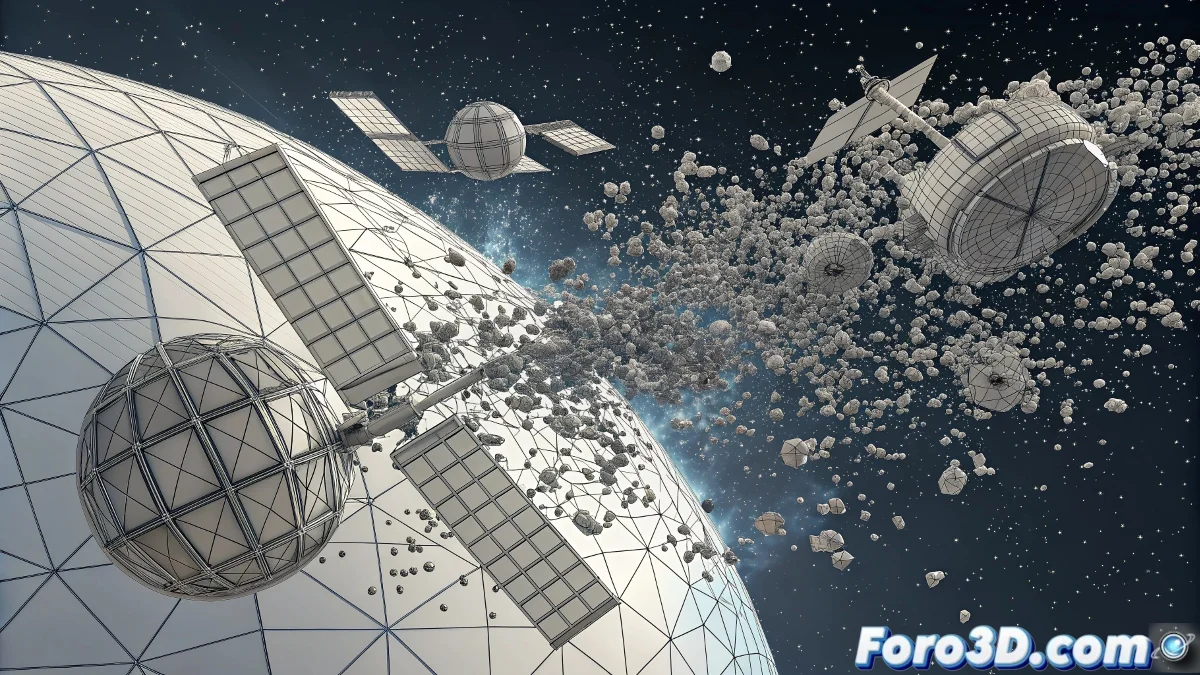
The Orbital Pyrotechnic Spectacle That Worries Scientists
Recent viral posts have revealed an increasingly common phenomenon: SpaceX Starlink satellites disintegrating during their atmospheric reentry. According to astrophysicist Jonathan McDowell, there are currently between one and two reentries daily of these satellites, a figure that will increase progressively as the constellation reaches its planned thousands of units. These events, although part of the planned lifecycle of the satellites, raise legitimate concerns about space sustainability and orbital debris management.
The growing frequency of these phenomena represents a visual and scientific challenge for digital artists and visual effects specialists. Recreating them in Houdini requires understanding both the physics of atmospheric reentry and the material disintegration processes that occur at hypersonic speeds and extreme temperatures.
Each satellite that burns up in the sky writes an equation between technological progress and environmental responsibility
Initial Setup and Satellite Modeling
The process begins with the simplified modeling of Starlink satellites, capturing their essential features: main rectangular body, foldable solar panels, and characteristic flat antennas. Using procedural geometry, we create variations that reflect the different models deployed by SpaceX over the years. Massive instancing allows us to distribute dozens of satellites along realistic orbital trajectories.
It is crucial to establish precise scales and transformation hierarchies that enable coherent animation of both the entire constellation and individual disintegration processes. Each satellite must have defined geometry groups that correspond to different materials and behaviors during reentry.
- Base geometry with controlled subdivisions
- Instance system for model variations
- Material groups for different components
- Transformation hierarchies for coherent animation
Reentry Dynamics and Atmospheric Forces
The central simulation uses Houdini's Pyro solver combined with custom force fields that replicate upper atmosphere conditions. We set up a atmospheric density gradient that increases progressively, generating the characteristic friction that heats and eventually disintegrates the satellites. The velocity curve follows real parameters: from the initial 27,000 km/h to critical deceleration.
Atmospheric wind fields add realistic turbulence, while differential drag forces explain why some components separate before others. This physical approach ensures that the disintegration occurs credibly, following patterns observed in documented reentries.
The atmosphere forgives no imperfections at hypersonic speeds
- Realistic atmospheric density gradient
- Friction fields variable with altitude
- Differential drag forces per component
- High-altitude atmospheric turbulence
Fragmentation and Particle System
The fragmentation process is controlled by temperature and pressure thresholds applied to different geometric groups. Solar panels, more fragile, detach first, followed by antennas and finally the main body. Each fragment becomes a secondary emitter of incandescent particles and smoke, creating that characteristic trail that makes reentries visible from the ground.
The particle system uses custom attributes to control temperature, mass, and lifetime of each fragment. Lighter elements burn up quickly, while denser ones may survive to lower atmospheric layers, replicating real reentry observations.
Pyrotechnic Effects and Plasma Simulation
The ionized plasma effect around the satellites is simulated using thermal emission volumes controlled by the speed and temperature of each fragment. We use blackbody radiation shaders to generate the characteristic color that varies from orange-red to bluish-white depending on heat intensity. Procedural noise fields add the turbulent texture observed in real videos.
For the incandescent particle trails, we combine POP systems with volumetric drag forces that create those chaotic yet directional patterns typical of objects traveling at hypersonic speeds. Light intensity control follows physically precise curves based on dissipated kinetic energy.
- Plasma volumes with thermal emission
- Blackbody shaders for realistic color
- POP systems for incandescent particles
- Intensity curves based on dissipated energy
Atmospheric Integration and Background Elements
The Earth's atmosphere is represented by scattering volumes that affect both visibility and trail color. We set up multiple atmospheric layers with different density and light scattering properties, from the mesosphere to the lower stratosphere. Background stars provide spatial context, while a subtle Earth terminator helps establish scale and orientation.
Scale handling is particularly challenging: we must represent 3-meter satellites traveling through hundreds of kilometers of atmosphere, maintaining visual impact without losing scientific precision. Multiple cameras allow showing both wide views of the phenomenon and individual disintegration details.
In space, scale is always the first special effect to fail
Render and Post-Production for Dramatic Impact
The final render uses separate passes for satellites, pyrotechnic effects, atmosphere, and starry background, allowing independent adjustments in compositing. We apply color corrections that enhance the contrast between the cold of space and the extreme heat of reentry. Controlled lens flare effects add that touch of verisimilitude that connects with ground observers' experience.
In post-production, we adjust timings to compensate for the difference between the real event duration (minutes) and its visual representation (seconds). Designed sound—although silent in the vacuum of space—can be added for versions intended for public outreach, always indicating its artistic nature.
- Separate render passes for maximum control
- Color correction for thermal contrast
- Lens effects for observational verisimilitude
- Temporal compression for narrative impact
Applications Beyond the Visual
This simulation has not only artistic value but also educational and scientific potential. It can help communicate to the public the challenges of space sustainability, illustrate complex physical processes, and serve as a tool for visualizing risk scenarios associated with growing orbital congestion.
The techniques developed find application in cinematographic productions, scientific visualization, and space safety analysis, demonstrating how visual effects can bridge the gap between technical data and public understanding.
As Starlink satellites continue turning into scheduled shooting stars, at least we can console ourselves knowing that the internet connection survives their disintegration... until the interplanetary roaming bill arrives 🛰️